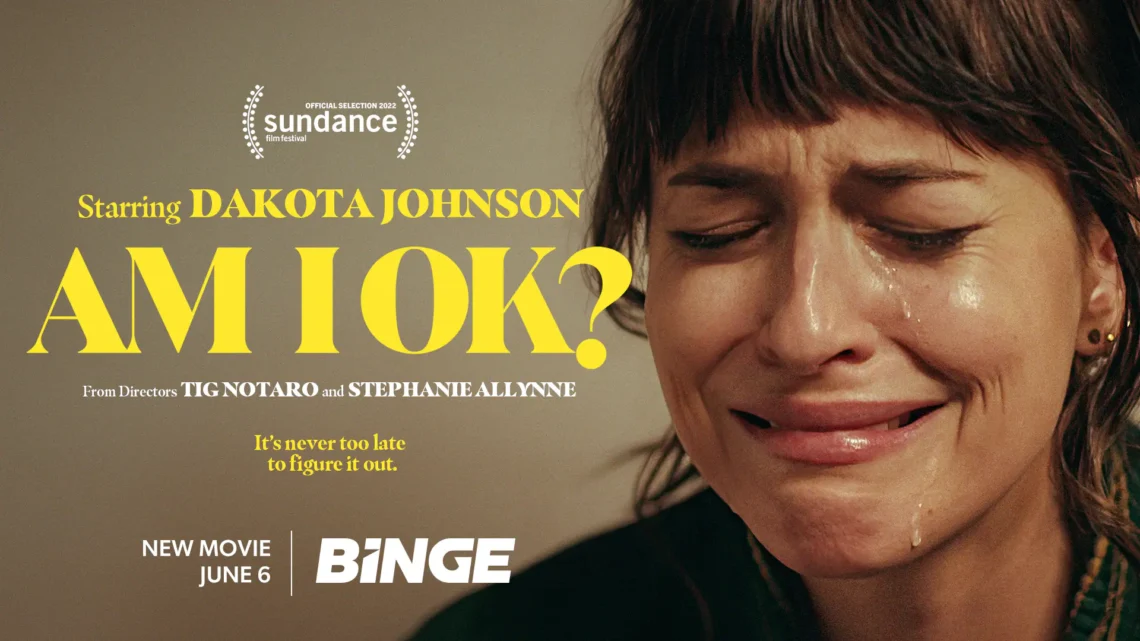
Am I OK? Interpretation and Ending Review: The Tender Consolation of Late Self-Discovery
There are times when, having crossed into our thirties, the place we stand on the tracks laid down by the world suddenly feels foreign. The film Am I OK? captures, with an exceedingly tender yet sharp gaze, the journey of a woman wandering between life’s stability and inertia as she awakens to her true sexual orientation and strips away the outer layers of a relationship that has sustained her for so long.
To those who have failed to look into their own interiority because they were walking at the pace of others, this work opens a pathway of growth that moves past isolation and deficiency toward solidarity.
🌿 Moments When This Film Deeply Permeates
- Nights spent suppressing one’s own secret within the comfortable prison of familiarity
- When the gaze of another, who claims to know you better than you know yourself, suddenly suffocates you
- Dawns when a vague anxiety—asking if it is truly okay to start now—engulfs the entire body
- When you wish to learn how to love someone fully without losing yourself
- Therefore, at the end of this text, we witness the true locus of relationship that finally begins the moment we accept our imperfect selves.
🎞 Note Before Viewing the Film
While this work deals with an adult woman’s realization of her sexual identity and her dating process, it focuses on the intimate psychological shifts and relational dynamics of the characters rather than provocative or sensational depictions. It is a work centered on emotional communion and a narrative of growth.
🎬 Film Information
- Title: Am I OK? (2022)
- Director: Tig Notaro, Stephanie Allynne
- Screenplay: Lauren Pomerantz
- Country: United States
- Genre: Comedy, Drama
- Running Time: 86 minutes
- Platform: Wavve, Netflix (Subject to regional availability)
- Cast: Dakota Johnson, Sonoya Mizuno, Kiersey Clemons
📖 Am I OK? Plot, The Fracture of Identity and Standing Alone at Thirty-Two [No Spoilers]
Living in Los Angeles and working as a spa receptionist, thirty-two-year-old Lucy lives a monochromatic daily life, having shelved her dreams of becoming a painter. By her side is her best friend Jane, her sole anchor who directs every aspect of her daily existence.
When Jane announces she is relocating to London for work, Lucy, amid a profound sense of loss, confesses to Jane that her true sexual orientation, which she has suppressed for a long time, is lesbian. Jane enthusiastically arranges dates and takes Lucy to bars to assist in her late self-discovery, but Jane’s excessive management conversely manifests as pressure for Lucy.
Amidst their mutual codependency and a subtle power imbalance, their emotions gradually hurtle toward catastrophe, eventually leading them to sever contact after a massive argument that feels impossible to bridge.
🎬 Psychological Interpretation of Late Self-Discovery and the “Late Bloomer” in Am I OK?
Through Lucy, who awakens to her sexual orientation only upon reaching the age of thirty-two, the film relentlessly interrogates the internal anxiety experienced by a “late bloomer.” Lucy’s question, “Am I OK?”, transcends a simple query about sexual identity; it reflects a fear of social metrics that dictate she has fallen behind others.
The work portrays this late realization not as a deficiency to be ashamed of, but as an intact process of growth blossoming at its own pace, offering profound consolation to the audience.
👥 Lucy and Jane’s Codependent Friendship: The Fracture and Dissolution of Its Power Structure
The relationship between Lucy and Jane exemplifies a classic case of codependency masked under the guise of friendship. The proactive Jane satisfies her desire for control by choosing menus on Lucy’s behalf, while the passive Lucy has fled from the responsibility of making her own decisions by hiding behind Jane’s shadow.
Jane’s relocation to London serves as the catalyst that destabilizes this asymmetrical power structure, and the film sharply notes that the fracture of this long-standing symbiosis was an inevitable rite of passage for their respective growth.
🎨 Interpretation of the Correlation Between Artistic Subjectivity and Sexual Identity
The narrative arc wherein Lucy begins to paint again, after having set it aside, runs completely parallel to the awakening of her sexual orientation. The act of picking up the brush for Lucy, who had lost her own colors on the canvas, visually demonstrates the process of breaking free from a life pattern reliant on the gaze of others to establish an autonomous self.
To accept one’s identity does not merely signify a change in the object of romantic affection; it amounts to the reclamation of artistic subjectivity through which one independently authors an authentic life.
🔎 Reinterpretation of the Ending — The Beginning of True Solidarity Met by Two Independent Subjects
The conclusion of this film moves beyond the narrative of the protagonist establishing her sexual identity, achieving an aesthetic fulfillment that completely subverts the paradigm of the relationship these two women have maintained. The scene at the restaurant they revisit, where Lucy selects her menu independently without Jane’s intervention, is a symbolic declaration that brings closure to their past subordinate relationship. The final ending, in which Lucy voluntarily chooses to accompany Jane on her move to London, demonstrates the establishment of a mature companionship chosen of her own volition, rather than a regressive, evasive dependence.
The blind friendship that once filled each other’s deficiencies has vanished, and a healthy solidarity between two distinct subjects possessing independent selves has commenced. Through this ending, the film demonstrates that Lucy has acquired the dignity of fully embracing her sexual orientation, while simultaneously leaving a poignant resonance by implying that Jane has also confronted her controlling tendencies and grown.
❓ Am I OK? : Deep FAQ — Interpretation of Late Narratives and Modes of Female Representation
Q. How do you view the criticism that the film is somewhat placid and the resolution of conflict is conventional?
Because Am I OK? unfolds without dramatic twists or transgressive narrative devices, it may come across as somewhat muted to audiences expecting the fierce struggles or passionate melodrama characteristic of certain queer cinema. However, this point of divergence in audience preference is precisely an intentional aesthetic choice.
Rather than framing a queer narrative as a grand tragedy or an exceptional incident, the film seamlessly integrates it into the context of mundane fractures in friendship and personal growth, thereby reproducing the realistic anxieties of ordinary women with greater depth.
Q. Does the structure, which focuses more on their friendship than Lucy’s realization of her sexual orientation, present a limitation as a queer narrative?
Some viewers express disappointment that Lucy’s romance is not explored more deeply. However, this work demonstrates that the realization of sexual identity extends beyond the question of ‘whom one dates’ to encompass the formulation of ‘who I am’ and the question of ‘how to reconfigure relationships with those around me.’
Consequently, the process of dismantling the dynamic of her friendship with Jane is an indispensable narrative structure for the consolidation of Lucy’s identity, and through this, the film constructs a more multi-dimensional female narrative. Where do you, the readers, believe Lucy’s true growth originated—in romance or in friendship?
✨ Am I OK? A Final Sentence Offered Before the Mirror of Identity
The ending of Am I OK? sends a clear message to the numerous ‘late bloomers’ navigating contemporary society: there is no necessity to calibrate oneself to the speedometer of others. The essence of love, identity, and relationship ultimately initiates from the conviction one extends to oneself. This film reminds us, in a tone both gentle and resolute, that a relationship maintained at the cost of losing oneself can never function as a safety net.
The moment you affirm your own pace, every late beginning in the world becomes a most brilliant efflorescence.
💬 What Color is Being Painted on Your Canvas?
A true relationship is completed not when you paint another person’s world for them, but when you each hold your own brush and silently gaze at each other’s canvas.
Are you excessively controlling someone else’s life, or perhaps comfortably depending on it, under the label of an old friend or lover? For the sake of genuine solidarity, what you require right now—is it the effort to be together, or the courage to stand alone?
🍿 Violet Screen Recommendation: Other Female-Centric Relational Works
- The Series Dickinson (2019–2021)
- Reason for Recommendation: A modern reinterpretation of the historical figure Emily Dickinson’s life. It utilizes a sensuous mise-en-scène to depict the intense, secretive female-centric narrative of Emily and Sue, who understood and loved each other’s literary artistry and souls at the deepest level despite the limitations of their era.
- The Film First Girl I Loved (2016)
- Reason for Recommendation: It sharply captures the subtle emotional shifts and relational power structures between two high school girls, Anne and Sasha, hidden beneath the vitality of the high school genre. It is an excellent piece that captures the growing pains experienced between identity confusion and social gazes through static camera work and deep psychological portraiture.
TODAY'S QUESTION
What's the most memorable new release you watched this year?
Your answer isn't saved. Feel free to share it in the comments below.


You May Also Like

Benedetta Interpretation: A Sacred and Provocative Holy War of Two Women Who Substituted Desire for Faith
The Vagina Monologues: A Record of Language Breaking Taboos and Liberation, a Sovereign Interpretation Reclaimed by the Female Body