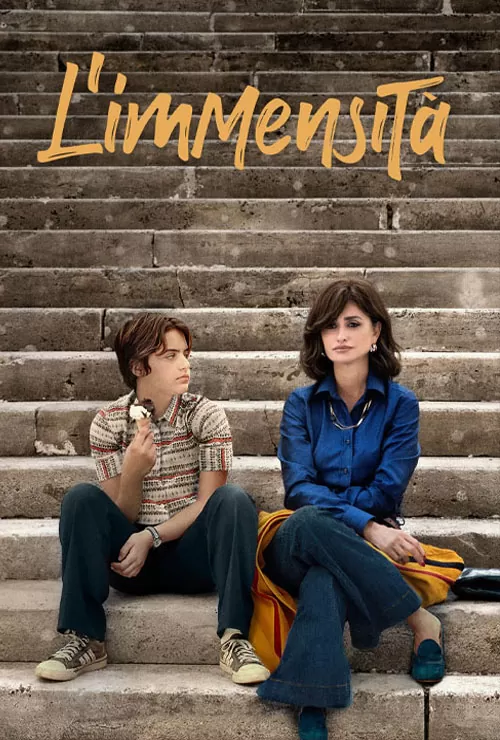
L’immensità: Desires of Identity Blooming Within an Isolated Paradise
Sometimes we dream of becoming someone other than ourselves. That dream may stem from a deficiency in reality, or perhaps from an innate dissonance of the soul. In 1970s Rome, the landscape of a family cooling chillingly under the brilliant sunshine asks us: “Is the wall confining you the gaze of society, or is it your own fear?”
This film, containing Director Emanuele Crialese’s autobiographical confession, does not merely stop at depicting a child’s gender identity confusion. Rather, it is closer to a desperate survival instinct—a longing to be ‘discovered’ by the one closest to them.
🌿 Moments When This Film Deeply Permeates
- On days when you wish to read the truth reflected in a child’s eyes before the norms of the world.
- When you want to understand the solitary dance of a human being hidden behind the title of ‘parent.’
- When the ‘name’ and ‘gender’ defining you feel too narrow to contain your soul.
- The reason to read this review is that it goes beyond the aesthetic afterimages left by the film to provide answers about what dignity we have lost at the boundaries of ‘normalcy’ defined by modern society.
🎞 Note Before Viewing
Rather than physical exposure or provocative imagery, this work is a drama that delicately handles psychological pressure and emotional bonds between characters. While there are scenes implying patriarchal violence, these function as narrative devices that solidify the relationship between the two protagonists.
🎬 Movie Information
- Title: L’immensità (2022)
- Director: Emanuele Crialese
- Screenplay: Emanuele Crialese, Francesca Manieri, Vittorio Moroni
- Country: Italy, France
- Genre: Drama, Family, Coming-of-age
- Running Time: 98 minutes
- Platform: Naver Series On, Apple TV, etc.
- Cast: Penélope Cruz, Luana Giuliani, Luana Vanelli
📖 L’immensità, A Boy’s Name Blooming in a Suppressed Household [No Spoilers]
In 1970s Rome, Italy, Clara’s family, having moved into a modern apartment, appears perfect on the outside but is collapsing internally. Under an authoritative and unfaithful husband, Clara gradually loses her vitality, her only escape being the playful moments shared with her three children.
Among them, the eldest daughter Adriana wishes to live with the identity of a boy, calling herself ‘Andrea.’ While the father regards this as a sickness to be corrected, the mother, Clara, silently watches over the child’s divergent identity.
A meeting with a girl named Sara, encountered in a Romani community near their new neighborhood, becomes the only breathing room for Adriana to exist as ‘Andrea.’ The film depicts a family’s desperate yet beautiful resistance to protect ‘selfhood’ as the crisis of a collapsing home intersects with a child’s exploration of identity.
🎨 Musical Fantasy and Liberation in L’immensità: Breaking the Binary World
The black-and-white TV musical sequences inserted throughout the film are not mere eye candy. They serve as psychological defense mechanisms to forget the pain of reality and as a ‘secret territory’ shared by Clara and Adriana.
Clara must perform the role of the ‘perfect wife’ under her husband’s tyrannical gaze, but she returns to her whole self only when dancing with her children. Adriana likewise concretizes the ‘Andrea’ she wishes to become by projecting herself onto the male singers on the screen.
These fantasy sequences are the essence of the film’s magical realism, showing the paradox that the higher the walls of reality, the more the characters’ inner worlds expand into an ‘immense’ (Immensità) universe. Ultimately, their fantasy is not an escape, but a most brilliant struggle against a colorless reality.
🫂 A Chronological Interpretation of Clara’s Motherhood and Adriana’s Identity
The most noteworthy aspect of this film is the horizontal attitude of Clara’s motherhood. While traditional motherhood seeks to ‘protect’ or ‘correct’ a child, Clara stands side-by-side with Adriana’s confusion, getting lost together.
When Adriana says she came from another planet, Clara does not deny it; instead, she replies, “Then take me to that planet too.” This suggests that the most important element in establishing identity is not ‘approval’ from others, but the ‘affirmation of existence.’
The two are accomplices trapped in the massive prison of patriarchy and mirrors of one another. The oppression Clara experiences as a woman and the conflict of gender identity Adriana faces penetrate a single context—’a society where one cannot live as oneself’—leaving room for deep interpretation.
🔎 Eternal Cracks and Unity Left by a Dancing Soul
In the film’s conclusion, Clara eventually reaches a mental breaking point and is separated from her family, but the ‘gene of freedom’ she planted remains ingrained within Adriana (Andrea). The images shown in the final sequence prove that even if they are physically apart, they have left indelible marks on each other’s souls.
Through the parting with Sara and the absence of her mother, Adriana finally becomes the subject who decides her own name. Although Clara momentarily faltered under the weight of reality, she left her child a legacy: an infinite world of affirmation where it is ‘okay to be different.’
This ending is not a tragic dissolution, but the birth of an individual self breaking out of the shell of a stale family unit. The child’s gaze, looking toward the vast horizon away from the isolated apartment complex, is a declaration of a human being who no longer lives as someone’s daughter, but possesses a universe of their own.
The completion of identity stems not from the understanding of others, but from a relentless truthfulness toward oneself.
❓ Questions Regarding L’immensità’s Ending and Identity Representation
Q1. What is your take on the criticism that the way Adriana’s gender identity is handled is too ambiguous?
Certainly, this film does not define identity with explicit terms or engage in a struggle like a modern queer film. However, this is due to structural necessity—the limitations of the 1970s and the perspective of a young child. The work depicts identity as a ‘process’ rather than a ‘conclusion,’ and that very ambiguity effectively conveys the sense of vast fear and flutter the child feels.
Q2. Isn’t the conclusion where Clara ultimately collapses a limitation for a female-centered narrative?
Clara’s collapse is not a matter of individual weakness, but a denunciatory device showing how the patriarchal system of Italian society at the time destroyed a woman. Her sacrifice becomes the fertilizer that allows Adriana to remain ‘Andrea.’ This should be interpreted not as a reproduction of a typical maternal myth, but as a desperate passing of the baton between the oppressed.
✨ L’immensità, the Immensity of Unnamable Love
This film is a record of a short yet long summer where a child experiencing identity confusion and a mother who lost her way in life struggled to save one another. It shows that relationships can sometimes become sufficiently great just by not denying one’s existence, even if they do not fully understand each other.
In modern society, we still try to trap others in frames. However, as if mocking all those frames, L’immensità awakens the immensity within us through the dance of a girl who wants to be a boy and the song of a mother who wants to be free.
True family is not a collection of blood relatives, but a solidarity of souls that does not turn away from each other’s isolation.
🎡 Finding Your Truth Hidden Behind a Name
When a narrow world forces a wrong name upon you, will you comply in silence, or will you dance to turn your own fantasy into reality?
Between the ‘me’ tailored to the gaze of others and the ‘real me’ inside, whose hand do you want to hold?
📽 Violet Screen Recommendations: Other Faces of Female Narratives
- Aftersun (2022)
- Reason for Recommendation: While L’immensità deals with the relationship between mother and child, this work deals with the memories of a father and daughter. It is good to watch together as the unspoken truths and the gaze of the left-behind child are similar.
- Tomboy (2011)
- Reason for Recommendation: The story of Laure, who spends a summer under the name ‘Mickaël’ while exploring her gender identity in childhood. You can meet a soul that most closely resembles Adriana from L’immensità.
To provide a more stable publishing environment, multilingual content, and better communication with our readers, we have moved our official publication to Substack.
All new film reviews and critical essays will be published on our new platform. This website will be closing down soon, so we would greatly appreciate it if you subscribed to our new space.
TODAY'S QUESTION
Is there a hidden gem you always recommend to friends?
Your answer isn't saved. Feel free to share it in the comments below.


You May Also Like

Jolene Ending Interpretation and Review: The Persistent Survival Narrative of an Unbroken Soul

Head in the Clouds: The Love of Three Bequeathed by a Tragic Era, and the Melancholy of Two Women