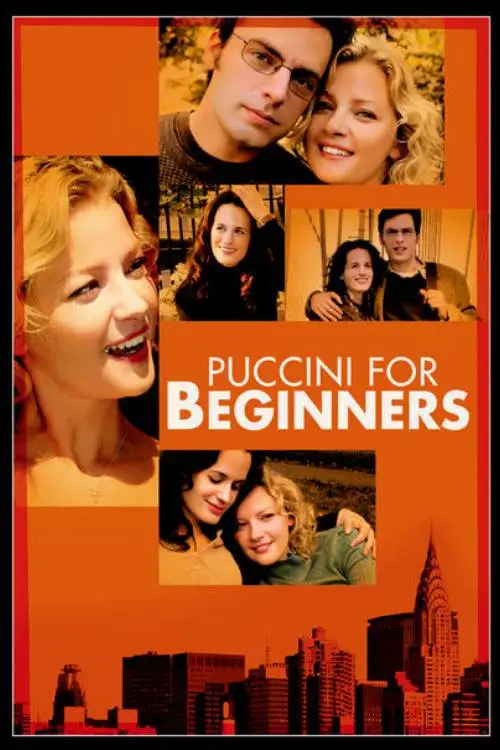
Puccini for Beginners: The Fear of Commitment, Fluidity of Relationships, and Novices in the Opera of Love
Love always summons us to our lowest points, demanding humility. We believe we define ourselves, set our own boundaries, and calibrate our distance from others, but in reality, it may be nothing more than a process of confronting our own deficiencies reflected in the eyes of another.
Puccini for Beginners presents a lighthearted yet chilling portrayal of a woman hiding behind a wall of certainty to avoid the reality of “commitment.” Through a whirlwind of relationships where chance and necessity intertwine, she finally comes face-to-face with her true self.
🌿 Moments When This Film Resonates Deeply
- For those who have felt the bewilderment when the principles of your identity crumble before the variable of another person.
- For those who wish to flee because becoming deeply involved with someone feels like a “constraint” that leads to losing oneself.
- For those who prefer to translate the petty, mundane truths behind the passion of love into elegant humor.
- The reason you should read to the end: This review goes beyond a simple farce about a double-dating romance to unearth the structural irony of why we remain eternal “beginners” in the face of love.
🎞 Notes Before Viewing
While this work addresses the essence of relationships and sexual fluidity, it is a romantic comedy that focuses on intellectual dialogue and emotional resonance rather than explicit depiction. It is perfectly suited for those who enjoy the tangled psychological tension between characters.
🎬 Film Information (2006)
- Title: Puccini for Beginners
- Director: Maria Maggenti
- Screenplay: Maria Maggenti
- Country: USA
- Genre: Romantic Comedy, Drama
- Running Time: 82 minutes
- Cast: Elizabeth Reaser, Gretchen Mol, Justin Kirk, Julianne Nicholson
📖 Puccini for Beginners: The Prelude to a Tangled Triangle Faced by a Writer Rejecting Commitment [No Spoilers]
Allegra, a lesbian writer in New York, loves Puccini’s operas but is a “commitment phobe” incapable of taking a single step forward in the reality of love. After failing to say “I love you” to Samantha, the partner she lived with for nine months, she is finally given notice of their breakup and left in isolation.
Two charming figures appear before the wounded Allegra: Philip, a philosophy professor who understands her novels, and Grace, an elegant woman weeping in front of a cinema over her own heartbreak. Allegra begins a secret double life, navigating her identity while dating both simultaneously. However, in a twist of fate, it is revealed that Philip and Grace are each other’s “exes,” and Allegra’s precarious tower of lies hurtles toward an explosive catastrophe, much like the climax of a Puccini opera.
🎭 Duet of Desire: Why We Must Interpret Puccini for Beginners and the Fluidity of Relationships
The film deconstructs Allegra’s psychological defense mechanisms through the intellectual dialogue characteristic of New York. The setup of her dating a man and a woman at once is not merely a device for provocation. Rather, it is Allegra’s idiosyncratic avoidance strategy—a way to flee from the “responsibility” that accompanies deepening relationships rather than settling into a specific sexual identity.
Allegra defines herself as a lesbian yet feels a heteronormative attraction to Philip, while Grace, who has lived as a heterosexual, awakens to new sensations through Allegra. The point of interest here is the moment the boundaries of sexual orientation collapse. Instead of treating this with grave angst, the director humorously exposes how fluid human desire is and how vulnerable it is to accidental encounters. This suggests that the essence of love depends less on “who” one loves than on “how” one relates.
🎻 The Aesthetic Convergence of Operatic Mise-en-scène and Woody Allen-esque Chatter
Director Maria Maggenti transforms the space of New York into a grand operatic stage. Characters constantly cross paths within the narrow confines of Manhattan, and their conversations are filled with an unending stream of intellectual play. A highlight of the film is the direction where Allegra’s internal monologues are joined by sushi chefs and New York citizens appearing like an operatic chorus to offer advice.
This staging reveals that an individual’s romantic history is not merely a private matter between two people, but a theatrical act constantly reconstructed within social contexts and the gaze of others. The farce, unfolding amid Puccini’s arias, creates a comedic situation contrasted against tragic lyrics, maximizing the irony inherent in the fever of love.
🔎 Reinterpretation of the Ending — The Dignity of Standing Alone Left by the Party of Truth
The engagement party for Samantha, where all truths are exposed, serves as both the cruelest tribunal and a place of salvation for Allegra. As Philip and Grace face each other in the same room, Allegra’s deception meets its end. What matters here is not which person Allegra chooses, but the fact that she chooses to be “left alone.”
Samantha reminds Allegra that commitment is the courage to share oneself with another. Allegra finally confronts her cowardly self, which tried to protect itself by dating two people at once. What she gains at the end is not a lover, but an honest solitude that allows her to acknowledge her own deficiencies. The final scene of her walking the streets demonstrates that defining one’s own attitude toward relationships is more vital than the mere achievement of “romance.”
The ending of this film is not a reconciliation of relationships, but a structural growth where an immature self passes through the fear of commitment to stand as a whole individual.
🧐 Regarding the Ending and Narrative Repetition of Puccini for Beginners
Q. Is there no room to criticize Allegra’s “double-dating” setup within a queer narrative framework?
Some audiences may feel that a lesbian protagonist engaging in a relationship with a man exacerbates identity confusion or portrays it negatively. However, the film’s intent is not to change her identity, but to show how Allegra’s character flaw—commitment phobia—justifies avoidance by crossing all boundaries. In other words, the focus of criticism should be on the character’s psychological cowardice rather than her sexual orientation. Through this, the film adopts an aesthetic stance that actually affirms the fluidity of identity.
Q. Why does Allegra not end up with either Philip or Grace in the finale?
A typical romantic comedy would have her choose one person in the end for a happy finale, but this work focuses on the growth of a novice who has just completed the “beginner’s course.” What Allegra needs is not a new romance, but a break from a past where she could not be sincere with others. Therefore, the ending of remaining alone is the most logical conclusion that aligns with the film’s central theme of self-reflection.
✨ Puccini for Beginners: The Completion of Love is Crossing the Fear of Commitment
We are all novices in the face of love. Allegra’s farce ultimately represents the tightrope walk within us between the “desire to remain unhurt” and the “desire to be connected.” The essence of a relationship is not the establishment of a perfect identity, but the courage of commitment to willingly accept one another’s imperfections.
True love is not about defining the other person, but having the courage to risk being redefined by them.
💬 Do you understand Allegra’s “avoidance”?
Have you ever felt the terror that you might lose a part of yourself the moment you become deeply connected to another? I am curious whether you lean more toward Allegra’s choice to view commitment as a constraint, or Samantha’s advice that one must nonetheless share oneself with someone.
🌐 Violet Screen Curation: Female Narratives Singing of Deficiency and Solidarity
- The Incredibly True Adventures of Two Girls in Love (1995) Reason for Recommendation: The debut feature of director Maria Maggenti, depicting the fresh and fluid love between two girls from different social backgrounds. An early work where one can glimpse the archetypal sensibility of Puccini for Beginners.
- Appropriate Behavior (2014) Reason for Recommendation: Set in Brooklyn, New York, this film humorously and intellectually unpacks the identity confusion and romantic failures experienced by Shirin, a bisexual woman. The clumsiness and growth found in the process of seeking one’s self are standout elements.
To provide a more stable publishing environment, multilingual content, and better communication with our readers, we have moved our official publication to Substack.
All new film reviews and critical essays will be published on our new platform. This website will be closing down soon, so we would greatly appreciate it if you subscribed to our new space.
TODAY'S QUESTION
Is there a hidden gem you always recommend to friends?
Your answer isn't saved. Feel free to share it in the comments below.


You May Also Like

Shiva Baby Review: A Claustrophobic Solidarity of Deficiency and Desire, and its Abnormal Sense of Liberation

Nude Area: An Interpretation of Sensory Liberation Painted by the Gaze of Desire and Isolated Skin