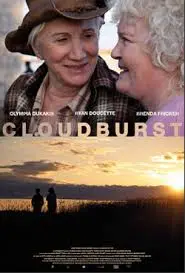
Cloudburst (2011): A Story on Female Same-Sex Love, Dignity, and the Right to Grow Old Together
When did love become something that requires permission from someone? Even though two people who have lived in the same house for many years are the family members who understand each other best, the world may refuse to recognize that relationship as a family.
“Cloudburst” is the story of an elderly lesbian couple setting out on the road to protect their right to live together. It is special in that it is not a story about the moment love begins, but about people trying to protect a love they have sustained for a long time until the very end.
This work does not portray love between women solely through youth or the fluttering excitement of first love. It draws long-term cohabitation and daily life, physical aging, and the possibility of care and loss into the fabric of the relationship.
🌿 Moments Where This Film Resonates Deeply
- Those for whom the reality is not unfamiliar where, despite spending a long time together with a loved one, socially even the name of family is not recognized.
- Those who understand that caring for someone can simultaneously be love, responsibility, and fear.
- Those who believe that desire, love, and the right to choose do not vanish simply because one has aged.
- Those who wish to encounter the relationship between women not as a simple romance, but as a companionship that has endured life together.
- Therefore, the reason you must read until the end is that it makes you rethink what being together with a loved one means—what it protects and what it bears.
🎞 Note Before Watching the Film
Uncensored swearing, sexual jokes, and adult humor appear, but the core of the work is not provocative expression. It is a comedy-drama dealing with the love and care of an elderly female couple, family recognition, and the marriage rights of same-sex couples.
🎬 Film Information
- Title: Cloudburst (Cloudburst, 2011)
- Director: Thom Fitzgerald
- Screenplay: Thom Fitzgerald
- Original Work: Thom Fitzgerald’s play of the same name “Cloudburst”
- Country: Canada, United States
- Genre: Drama, Comedy, Road Movie
- Running Time: 93 minutes
- Platform: Major overseas VOD and independent film streaming services
- Cast: Olympia Dukakis (어올라 켈리), Brenda Fricker (브렌다 프레이커), Ryan Doucette (라이언 두셋)
📖 Cloudburst Plot and Why the Two Women Began Their Journey [No Spoilers]
Living together for 31 years on the coast of Maine, USA, Stella and Dot are lovers who, despite having different personalities, have relied on each other for a long time. Stella, who has developed hearing problems, has a rough and blunt personality, while Dot, who has visual impairment, is calm and affectionate.
Then, Dot’s granddaughter Molly, failing to properly understand the relationship between the two, sends Dot to a nursing facility, shattering their peaceful life. Stella rescues Dot from the facility to find a way to bring her back and live together, heading toward Nova Scotia, Canada, where same-sex marriage is legal.
Along the way, as they pick up Prentice, a young hitchhiker returning to his hometown to see his mother, an unexpected journey of three people begins. This journey goes beyond a simple wedding trip, becoming a time to confront each other’s lives and the meaning of family anew.
🔍 Cloudburst: Why Wasn’t a 31-Year Love Recognized as a Family?
🏠 Long-Term Cohabitation and the Difference in the Name of Family
The first aspect to note in this work is the fact that Stella and Dot’s relationship is already a complete love.
The two know each other’s lifestyle habits and physical vulnerabilities, and having lived together for a long time, they have practically played the role of family. However, precisely because their relationship is not socially recognized, their lives face the risk of being easily separated by the judgment of granddaughter Molly.
The issue raised by the film here is not mere homophobia.
It is the question of whether the time lived together and the actual history of care can be treated more lightly than the status of legal and social family.
For Stella, Dot is neither a friend nor a simple roommate. She is a presence close to a spouse who has constructed her life together with her. Yet, to those who do not recognize that relationship, the two women still remain as a pair that must be explained.
💔 The Power Dynamics of Relationships Generated Under the Name of Care
Molly decides on admission to a nursing facility under the pretext of worrying about her grandmother’s safety.
Pondering what kind of care Dot needs is not wrong in itself. The problem is that Dot’s wishes and Stella’s presence are not sufficiently taken into consideration.
This scene shows that the issue of elderly care overlaps with the social exclusion of LGBTQ+ relationships.
The right to decide on care and the right to choose the person you love cannot be separated from each other.
Particularly for elderly female same-sex couples, it reveals a realistic critical awareness in that situations can arise where the judgment of blood relatives is prioritized over a long-term companion.
🌊 Cloudburst: How a Journey on the Road Changed the Relationships of Three People
🚙 The Road as a Space of Escape and the Beginning of a New Family
The road Stella and Dot take toward Canada is not merely a journey to find a place to marry.
During the trip, the two ponder whether their relationship can be maintained going forward. In particular, Dot’s visual impairment and Stella’s physical limitations reveal the reality that love alone cannot solve all problems of care.
Here, as Prentice joins, the relational structure of the film expands.
Prentice is a young man, yet he carries issues of family and identity in his own life as well. Having worked as a contemporary dancer in New York, he is returning home carrying emotional wounds.
At first, it is awkward due to different generations and personalities, but as they travel together, the three begin to understand each other’s deficiencies.
🤝 Can Non-Blood Relationships Also Become Family?
Prentice’s role is not that of a love triangle character interfering with the love of the two women.
He provides necessary help to Stella and Dot, and the two impart a new perspective on life to Prentice.
In particular, the incident where Prentice helps when Dot is in danger serves as an important turning point. Stella realizes that she wants to protect her loved one, but due to her own physical limitations, she cannot handle it alone.
At this point, the film shows that love and independent living do not necessarily mean the same thing.
In order to live together, not only affection toward each other but also practical help and new forms of care are necessary.
🕊 Cloudburst: The Meaning of Love and Dignity Shown in the Ending
💍 Why the Wedding Was Interrupted and Dot’s Choice
The three finally arrive in Lunenburg, Canada, and Stella and Dot prepare for their wedding.
However, right before the wedding, Molly and her husband Tommy arrive, making the situation complicated again. Dot reveals that Molly has acted unfairly regarding their house and property.
Later at the police station, Dot explains her past married life and her relationship with Stella. Molly too finds it difficult to ignore their relationship any longer.
However, while moving to proceed with the wedding again, Dot’s health suddenly deteriorates sharply.
🥀 A Marriage Granted After 31 Years, Just a Single Day of Honeymoon
Feeling that her condition is serious, Dot asks Prentice to marry the two inside the car.
Prentice performs the wedding ceremony for the two right there, and Stella and Dot finally become a married couple.
However, Dot passes away in Stella’s arms right after the wedding.
For two people who lived together for 31 years, the moment of becoming legally married arrived far too late.
At the end, Stella and Prentice look at the sunset on the beach in front of Dot’s house. Prentice expresses sorrow to the effect that it took 31 years for the two to get married, yet their honeymoon lasted only a single day. Stella replies that that single day was the best day of her life.
🌅 Reinterpreting the Ending — Love Is Not Completed by Death
This ending should not be interpreted simply as a tragic love story of a same-sex couple.
The last thing Dot chose before dying was her marriage to Stella. This is an act of defining her own relationship herself, which society had long failed to recognize.
She cannot start a new life through marriage, but she clearly declares until the very end what her love was.
What is left for Stella is the fact that she has legally become a spouse and the reality of having lost the person she loves. Marriage does not make the two stay together forever. However, it makes it impossible to deny any longer what that relationship was.
Afterwards, Prentice remains by Stella’s side. He is not a person who can replace Dot. Rather, he is an entity who connects Stella so that she can go on living while remembering the life she shared with Dot.
The ending of this work shows not the achievement of love, but the belated realization of the right to have love recognized as a family.
What Stella gained is a single day in which her love was recognized under the name of a married couple, and what she lost is the person to live that single day with.
Therefore, the final ocean and sunset are not simply beautiful sceneries. They leave a lingering resonance that even though one person has departed, the time the two lived together does not vanish.
⚖️ Cloudburst: The Social Limits Revealed by Female Elderly Narratives
👵 Love and Desire Exist for Elderly Women Too
Movies dealing with women’s love often unfold around young women’s discovery of identity or first love.
However, Cloudburst places the love of elderly women, which is handled much more rarely than that, at the forefront.
Stella and Dot are women in their 70s. The two exchange sexual jokes, tease each other, and still express their desires as lovers.
Such depictions create a crack in the gaze that views elderly women solely as objects of care or beings who must be protected.
Even as one ages, the desire to want a loved one and to have one’s relationship recognized does not disappear.
🎭 How Comedy Makes Tragedy Endurable
Stella’s rough speech and Dot’s calm response create humor throughout the work.
The conversation between the two is sometimes explicit and unreserved, but within it lies the intimacy that only a long-term couple can possess.
The method of unraveling emotionally heavy subject matter through comedy prevents the audience from viewing the characters solely as objects of pity.
However, choosing death and parting at the conclusion is a contentious point. The setup where one person disappears at the very moment their love is legally recognized leaves a strong lingering impression, but it can also be read as a tragic narrative that does not allow a happy future for an elderly same-sex couple.
🔎 Questions on the Cloudburst Ending and Female Narratives
Q. Is the criticism that the ending is too tragic valid?
There is sufficient ground for such criticism.
In particular, the setting where one person dies at the very moment a female same-sex couple, who has long received no social recognition, finally marries connects to the problem of tragic endings that has been repeatedly pointed out in queer narratives.
On the other hand, there is room to interpret that the director chose to emphasize the time lived together and the dignity of the final choice rather than negating the two’s love through death.
Depending on the audience, it can be accepted as a beautiful completion of love, or as a story where even the right to be happy was not sufficiently granted.
Q. What kind of person is Prentice in the relationship of the two women in this film?
Prentice is not a figure who shakes the love of Stella and Dot, but a companion who helps them in situations that are realistically difficult for them to handle.
With his appearance, the film expands from a lover-centric story into the possibility of a new family transcending generations and blood ties.
However, the point that accessibility is imparted to the story of the elderly female couple through a young male character is worth pondering together from the perspective of the independence of female narratives.
✨ Cloudburst, Love Is Proved by the Time Lived Together
The reason this film is special is because it shows the love of the two women not as the beginning of a new relationship, but as a life that has already persisted for many long years.
To Stella and Dot, love does not mean only romantic promises. It is understanding each other’s physical limitations, sharing daily life, and growing old together.
Yet society required far too much time to recognize their relationship as a family.
With whom one forms a family and lives should be an individual’s choice. Age, gender, and sexual orientation must not become the grounds for restricting that right.
In particular, the alienation experienced by elderly LGBTQ+ members in care, housing, medical care, and family relations remains an important social task.
The dignity of love does not begin at the moment society permits it; it exists from the very beginning for those who live that relationship.
💬 🌅 Growing Old Together with the Person You Love
Love is not just holding onto each other until the end, but also acknowledging each other’s dignity and choices.
If you knew that the time you could share with your loved one was limited, what choice would you make to protect your relationship with that person?
🎬 Violet Screen Curation — Recommended Female Love Films to Watch Together
- Fried Green Tomatoes (Fried Green Tomatoes, 1991) / Recommended Reason: A masterpiece that warmly and heavily captures the tenacious love and survival solidarity of two women transcending era and oppression through past stories shared by an elderly woman.
- Thelma & Louise (Thelma & Louise, 1991) / Recommended Reason: A classic road movie depicting an unsparing journey breaking free from oppressive reality and patriarchal social frameworks to discover true self and strong female solidarity on the road.
TODAY'S QUESTION
Is there a hidden gem you always recommend to friends?
Your answer isn't saved. Feel free to share it in the comments below.


You May Also Like

An In-Depth Analysis of Boys Don’t Cry: A Gaze of Salvation Born Out of a Cruel Reality

Suspicious Sisters: Female Solidarity and the Aesthetics of Connection Blooming in B-Movie Erotica