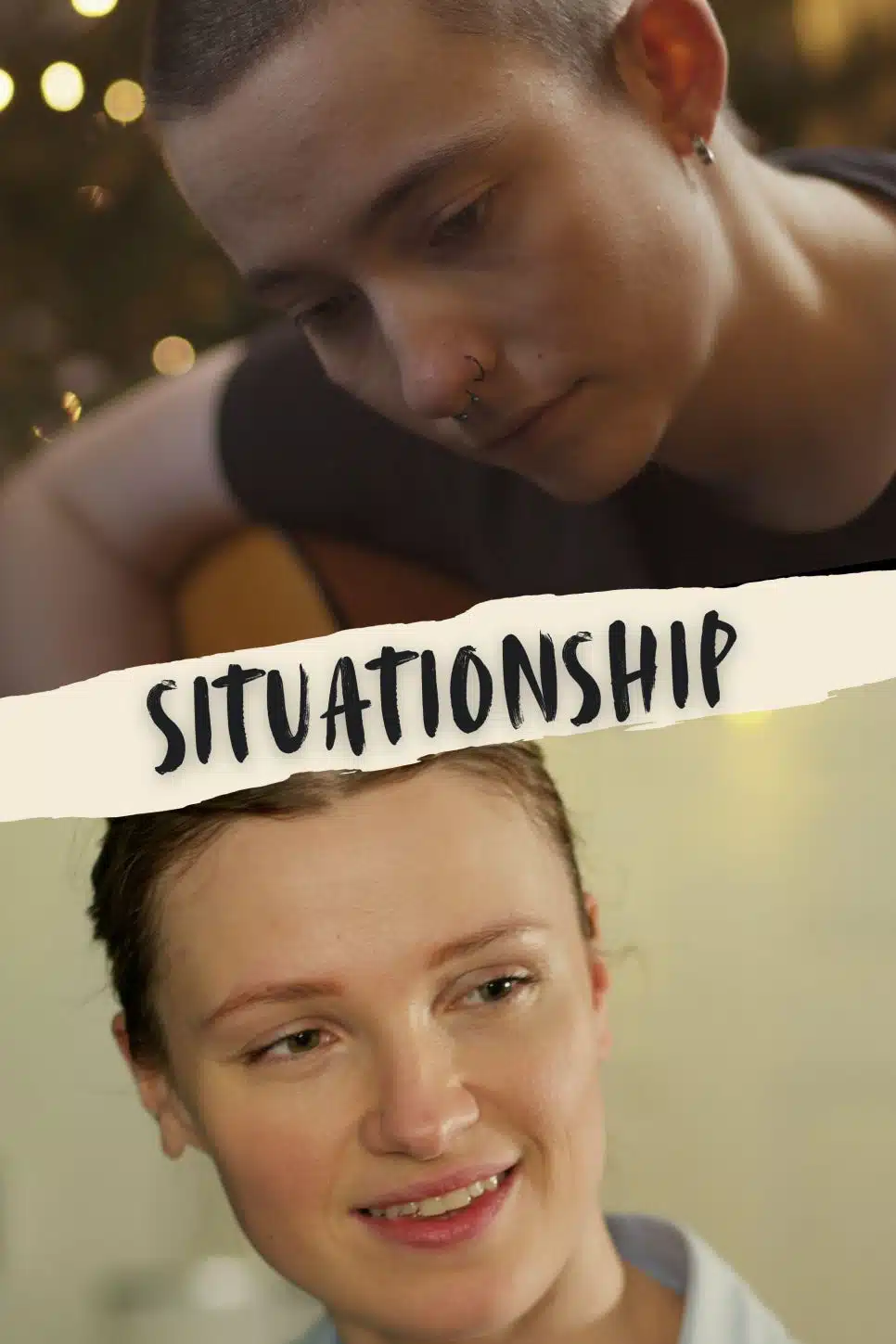
Situationship (2025) Critical Interpretation: A Solidarity of Loss Born of Control and Chaos
For a wounded human being, welcoming another is inherently next to impossible. To hide our own deficiencies, we either remain silent regarding the lives of others or, conversely, condemn their disorder to construct our own safe zones. The obsession with integrating the massive chaos that is another person into one’s own order ultimately becomes the sturdiest wall, preventing us from gazing into each other’s abyss.
The film Situationship densely portrays the growth process of two women with diametrically opposed defense mechanisms who collide and collapse, yet ultimately welcome each other’s imperfections exactly as they are.
🌿 Moments When This Film Deeply Permeates
- It permeates those who wish to confront past trauma hidden behind an outwardly pristine sense of order.
- It permeates those who want to discern the sincerity of mourning a loss amidst the chaos of a wandering artist.
- It permeates those who believe in the impossibility of fully understanding another’s pain, yet still believe in the solidarity that begins despite it.
- Why you must read to the end: Because moving beyond a simple romance, this is a narrative of structural salvation where one learns to relinquish inner obsessions and truly gaze at another’s sorrow.
🎞 Note Before Viewing the Film
This work is a drama centering on the emotional collision and intimate psychological shifts between two women with contrasting dispositions. Rather than relying on provocative or sensational depictions, it focuses on the past traumas of the two characters, the tension within their relationship, and the lyrical interconnectedness through which they commune via the medium of music.
🎬 Film Information
- Title: Situationship (2025)
- Director: Jade Winters
- Screenplay: Jade Winters
- Country: United Kingdom (UK)
- Genre: Romance, Drama
- Running Time: 60 minutes
- Platform: YouTube
- Cast: Nikki (Helen Laurens), Jay (Sapphire Brewer-Marchant)
📖 Situationship, the Romance of a Disordered Musician Crash-Landing into a Controlled Apartment [No Spoilers]
The film begins when Jay, a friend with nowhere else to go, unexpectedly arrives at the apartment of Nikki—a woman who lives under perfect self-control with a meticulous and clean disposition for everything—at the request of Nikki’s older sister, Karen. Appearing drunk and disheveled from the very first day, Jay is a free-spirited musician who constantly clashes with Nikki, who regards privacy and rules as absolute values.
The polar-opposite duo continues an uncomfortable cohabitation by establishing strict living rules, such as cleaning and quiet hours. However, starting from the moment Jay plays a beautiful guitar melody, the invisible wall between them begins to crumble. Spending time together, the two grow rapidly closer and share a night guided by their emotions, evolving into a relationship beyond mere roommates. Yet, soon, Nikki’s past trauma and Jay’s hidden scars of loss surface, foreshadowing a violent emotional catastrophe.
🎵 The Collision of Discipline and Melody: Nikki’s Obsession with Control and Jay’s Artistic Chaos
The first half of Situationship visualizes the psychological power dynamics of the two women over the dominance of space. Nikki’s apartment acts as a sterile room reflecting her will to control life, serving as a defense mechanism against trauma rooted in her mother’s past alcoholism. Conversely, Jay’s drinking and disorder serve as a sanctuary to conceal a massive internal sense of loss. The moment Jay’s music echoes through this hostile space, a fracture occurs in the fortress of discipline Nikki erected.
Music acts as a medium that transcends language to convey the essence of emotion, and Nikki learning the guitar from Jay symbolizes the initial psychological relaxation of accepting another’s world. The sharing of daily life, represented by pizza and movies, elevates their relationship from a simple contractual arrangement to a profound union of desire.
💔 Deviation and Lies: Defensive Alienation and Separation Wrought by Trauma
As the relationship deepens, the two become mirrors that trigger each other’s traumas rather than each other’s saviors. Nikki witnesses her mother’s ruin within Jay’s drinking and reads a distrust toward the permanence of love through the existence of Jay’s past lover, Eevee. Nikki’s radical action of throwing Jay’s alcohol into the trash is both a correction of the other and a self-defensive mechanism of control.
On the day of Jay’s most critical musical performance, Nikki’s choice to evade Jay’s plea to hold onto her, escaping instead with a minor lie about a “cheese tasting event,” demonstrates the mechanism of a typically avoidant person who destroys a relationship first out of a fear of failure. Jay’s letter stating, “I don’t want to get hurt inside someone’s orbit anymore,” clearly exposes the interpretation of an inevitable separation that those who wish to control and those who refuse to be restrained must reach.
🔎 The Truth of Loss and Reinterpretation of the Ending: A Leap of Hospitality Discarding Nagging Sticky Notes
The truth of Jay’s past, revealed later through her older sister Karen, completely restructures the framework of this film. The reality that her former lover, Eevee, was struck and killed by a drunk-driving vehicle in Jay’s arms immediately after they argued proves that Jay’s wandering was not mere irresponsibility, but a consequence of severe Post-Traumatic Stress Disorder (PTSD) and a failure to mourn. Nikki realizes that the reality of the disorder she tried to control was actually the weight of a massive sorrow, achieving humanistic growth by accepting the imperfections of life.
The ending, where the two coincidentally reunite in a scenic location, is not a simple romantic reconciliation. The moment Nikki takes the initiative to propose living together in her new home to Jay—who is trying to rid herself of guilt through counseling—the initiative of the relationship shifts from ‘control’ to ‘hospitality.’ Jay’s condition that “we don’t use nagging sticky notes anymore” and the corresponding kiss signify a mature declaration of solidarity, choosing to accept each other’s wounds as they are rather than attempting to correct them.
In the space where the compulsive order that attempted to control past loss has collapsed, a true space of love that accepts another’s sorrow exactly as it is is finally born.
💬 Narrative Issues and Interpretations Posed by
Q1. Are there any limitations within the narrative structure that justifies Jay’s drinking and wandering?
Some viewers raise the criticism that Jay’s unrestrained behavior and drinking are excessively glorified or justified through the indulgence of her former lover’s death. Although the trauma of alcoholism that Nikki experienced is also a severe psychological wound, a structural imbalance exists in the narrative where Nikki’s pain appears relatively compromised as the film focuses heavily on Jay’s massive tragedy. However, this can be interpreted not as an attempt to rank the moral superiority between the characters, but as a directorial device to structurally demonstrate the human limitation wherein one cannot fully measure the depth of another’s sorrow.
Q2. What are the shortcomings in the representation of women within the brief 60-minute running time?
While the film conveys emotional communion and conflict in a highly compressed manner, there is a divergence of opinions regarding how rapidly the conflict resolution unfolds, relying on the explanation of a third party (Karen) in the latter half. The method through which misunderstandings are resolved via an influx of external information, rather than through direct dialogue or internal exploration, somewhat weakens the density of the narrative as an autonomous female-centered text. Nevertheless, Nikki’s act of independently relinquishing her obsession with control and choosing proactive hospitality at the end meaningfully replicates the expansion of women’s psychological territory. Dear readers, do you view Nikki’s final choice closer to a sacrifice, or closer to genuine growth?
✨ Situationship, a Melody of Salvation Achieved Through the Intersecting of Imperfect Wounds
The film Situationship demonstrates that loving another does not mean adhering to my own perfect rules, but willingly allowing the other’s fractures into my own space. The relationship between Nikki and Jay reflects the fragility of the connections we forge with others in contemporary society. To modern individuals who hide behind a ‘situationship (an ambiguous relationship)’ out of fear of getting hurt, the film posits that salvation is rendered possible not through the complete healing of a wound, but solely through a change in one’s attitude toward that wound. The moment we tolerate another’s disorder, our own closed world is finally liberated.
True solidarity is completed not through the arrogance of perfectly understanding another’s abyss, but through the autonomous decision to silently guard the side of that imperfect abyss.
🪞 What Shape Does Your Defense Mechanism Take?
We often establish rules or distance ourselves from others to avoid getting hurt. When confronted with the imperfections of a relationship, do you build a sturdy wall to exert control like Nikki, or do you deviate from your own orbit and hide like Jay?
🎬 Violet Screen Recommendations: A Screen Curation of Trauma and Solidarity
- 《Gondola》 (2023)
- Reason for Recommendation: Set against the backdrop of Georgia’s beautiful mountainous region, this independent film, bordering on a silent movie, depicts the love that blossoms between two female cable car conductors during the brief moments they pass each other. The process of building deep emotional communion and solidarity through nothing but glances, smiles, and minor actions without a single line of dialogue resembles the resonance beyond language shown in Situationship, leaving a gentle lingering impression.
- 《Flat Girls》 (2025)
- Reason for Recommendation: A well-made Sapphic coming-of-age drama that addresses the friendship, queer romance, and realistic walls surrounding two girls who grew up together within the confined space of a Thai police residential compound. Breaking away from the provocative 연출 of major platforms, it captures the shifting psychological density and relational trajectory of the two women with a delicate and calm gaze, offering a profound sense of immersion.
To provide a more stable publishing environment, multilingual content, and better communication with our readers, we have moved our official publication to Substack.
All new film reviews and critical essays will be published on our new platform. This website will be closing down soon, so we would greatly appreciate it if you subscribed to our new space.
TODAY'S QUESTION
Is there a film whose ending you wish had gone differently?
Your answer isn't saved. Feel free to share it in the comments below.


You May Also Like

Imagine Me & You: Ending Analysis and Review—A Fleeting Desire That Becomes Destiny

Elisa & Marcela: An Eternal Escape Beyond the Barrier of Taboo in 19th-Century Spain
