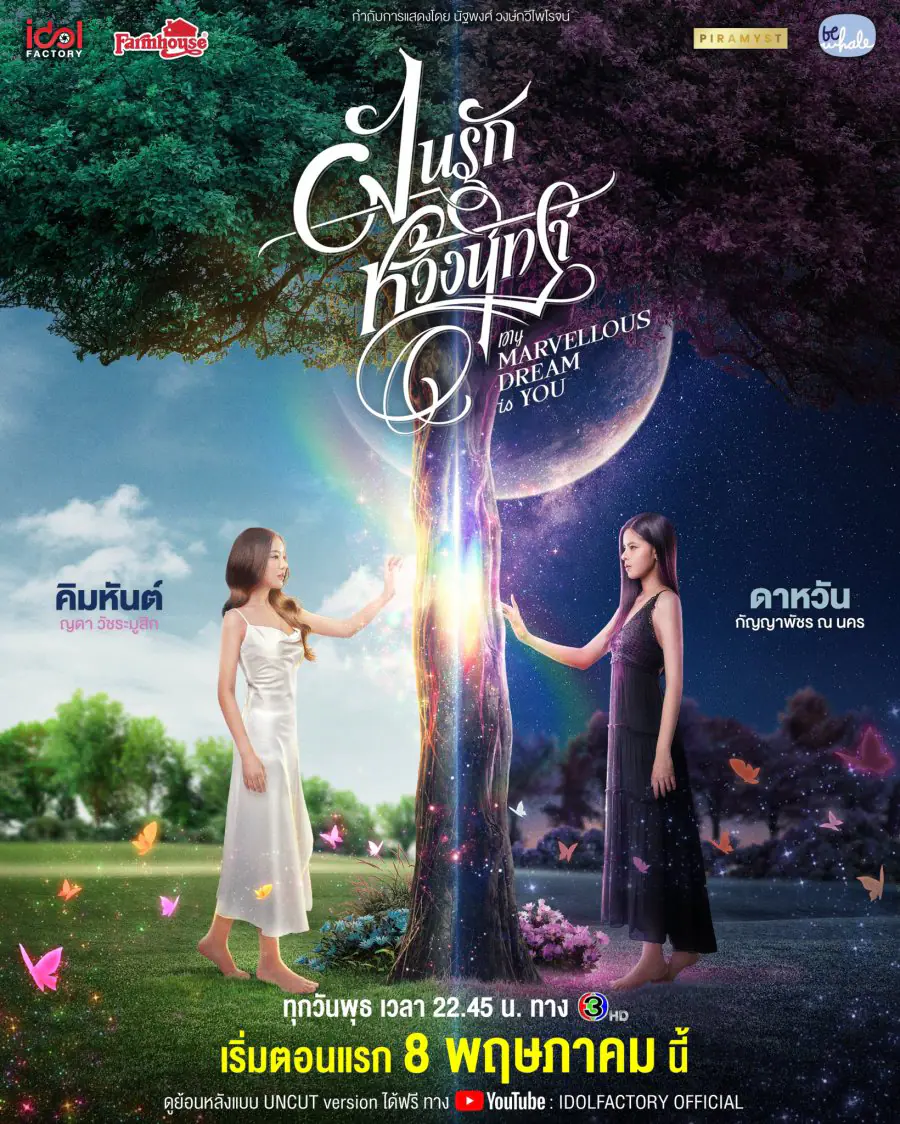
My Marvellous Dream Is You Ending Explained: From the Sanctuary of Dreams to Reality-Based Solidarity
We often retreat into the world of the unconscious—the “dream”—to forget the exhaustion of reality. But if that dream is a sophisticated mechanism shared with another person, and if the only love permitted exists solely within that space, would it be a blessing or a cruel punishment?
Love sometimes becomes clearer within illogical fantasies than through logical language. When repressed desires are projected onto the screen of a dream, we finally face the truths we had failed to confront. This work focuses deeply on that very point: the process by which isolated egos share a mutual unconscious to heal their wounds.
🌿 Moments when this drama deeply resonates
- For those who have lingered by a loved one’s side but could never bring themselves to hold their hand due to a harrowing family history.
- For those who remember mornings when they hated to open their eyes because the tenderness in their dreams felt more real than the coldness of reality.
- For all the “Khamhans” of the world, living through the castration of their own desires because they cannot abandon social scrutiny and parental expectations.
- Why you should read to the end: This review goes beyond a simple queer romance to analyze the structural victory of how an individual secures their dignity amidst generational conflict and legal institutions.
🎞 Note before watching
This work focuses on the emotional tension and poignant relationships between characters, accompanied by the aesthetic cinematography characteristic of the Thai GL (Girls’ Love) genre. It is a sentiment-driven narrative dealing with the psychological shifts of characters and the dissolution and reconstruction of families, rather than provocative depictions.
🎬 Drama Information
- Title: My Marvellous Dream Is You (ฝันรักห้วงนิทรา, 2024)
- Director: Nattapong Wongkwee Piroj
- Screenplay: Idol Factory Team
- Original Work: Novel Dream (Dreaming of a Small Fish)
- Country: Thailand
- Genre: Romance, Drama, Fantasy, Coming-of-age
- Running Time: 12 Episodes (approx. 45 mins per episode)
- Platform: YouTube (Idolfactory Official), VOD
- Cast: Fay Kanyaphat Na Nakhon (as Dawan), May Yada Watcharamusik (as Khamhan)
📖 My Marvellous Dream Is You Synopsis: A Shared Unconscious and the Cracks in Reality [No Spoilers]
Dawan, a famous actress, grows up having mysterious dreams shared with an unidentified girl since childhood. When she encounters Khamhan, who moves in next door, Dawan instinctively senses she is the girl from her dreams. However, their joy is short-lived. An unprecedented event—their fathers falling in love with each other and abandoning their families to flee together—leaves both households in irreparable ruin.
As adults, Dawan works as a glamorous star and Khamhan as her capable stylist. Though prevented from being together by the threats of Dawan’s rival, Jessie, the two remarkably share the same dream every night, where they love each other more passionately than anyone else. Faced with a painful family history, Jessie’s interference, Khamhan’s mother’s illness, and the massive wall of reality in the form of a marriage to Marwin, can they hold hands in the cruel reality outside their dreams?
🌌 Shared Unconscious: The Solidarity of Deficiency in My Marvellous Dream Is You
The most captivating setting in this work is the Shared Dreamscape. For Dawan and Khamhan, dreams are not merely rest; they are the only sanctuary for liberation from reality. The social condemnation and shame following their fathers’ flight isolate the two women in reality, but the unconscious uses that isolation as the catalyst for connection.
Analytically speaking, their dreams serve as a psychological defense mechanism while simultaneously being the manifestation of their purest desires. While the Khamhan of reality is a passive presence who grooms Dawan’s appearance as a stylist, her dream self emerges as an autonomous ego exchanging emotions on equal footing with Dawan. This asymmetrical structure between dream and reality collapses as the play progresses, suggesting that true healing is only possible when the internal truth is pulled into reality.
🎭 The Fetters of Family and an Expanded Interpretation of Women’s Narratives
The work presents a model of traditional family dissolution through the unique setting of the “fathers’ love.” This inflicts double the suffering on Dawan and Khamhan: a subconscious fear that the love they pursue ultimately resembles the path taken by their fathers, which destroyed their homes. Khamhan’s decision to marry Marwin, unable to abandon the expectations of her mother, Mrs. Ae, is close to an obsessive compensatory psychology—an attempt to rebuild a destroyed family through her own sacrifice.
However, the drama does not stop there; it focuses on the solidarity among the women. The process of together tending to the mothers’ illnesses (cancer and alcoholism) and Dawan’s depression is akin to a ritual of staring directly at past wounds. From an interpretative perspective, the point where the two reunite with their fathers and contemplate forgiveness can be called a rite of passage, establishing their identities as independent adults free from the shadows of their parents.
🔎 Reinterpretation of the Ending: Escaping the Wedding and Securing Legal Rights
The wedding escape scene, which many viewers cheered for, transcends simple romantic-comedy tropes. Khamhan’s act of storming out of the wedding hall is a symbolic upheaval, breaking the shell of patriarchal filial piety and social convention that suppressed her. Dawan’s process of realizing the truth after belatedly learning the contents of the letter in the time capsule is a declaration of intent to actively intervene in her fate by summoning buried sincerity (the time capsule) into the present.
The formal wedding held by the two at the conclusion enhances the dramatic completeness by reflecting the trend of same-sex marriage legalization in Thailand. This is an act of declaring that they no longer need to dream in hiding. They now face each other with eyes wide open, becoming a real relationship protected within a social contract (marriage).
The union of Dawan and Khamhan is a subjective victory that sutures the fragmented wounds of the past and replaces fantasy with the rights of reality.
❓ On the Ambiguity of the My Marvellous Dream Is You Ending and Narrative
Q. How should we interpret the moral flaw regarding the past wrongs of the fathers and their impact on the protagonists’ relationship?
Some criticize the use of the parents’ affair and flight as a device to glamorize the children’s romance. However, the aesthetic context of this work lies in severing “guilt-by-association” suffering. It emphasizes that the parents’ choices should not define the children’s lives. Instead, it redefines the meaning of family through the process of two women sharing those wounds and comforting each other. While the point of criticism is clear, the narrative uses it to deepen the internal conflicts of the characters and serves as a catalyst for growth.
Q. Why did Khamhan push Dawan away until the end, going so far as the extreme choice of marriage?
This is a manifestation of Khamhan’s “good daughter” complex and guilt. She likely felt that easing her mother’s worries was an act of filial piety that outweighed her own happiness. While Khamhan’s fragility may frustrate viewers, it represents the actual fears felt by minorities facing social pressure in reality. The twist at the end is a device to show human instinctive free will erupting precisely when that pressure reaches its peak.
✨ My Marvellous Dream Is You: Time to Wake Up and Love the Cold Reality
This drama asks us: is your love only whole when your eyes are closed, or are you ready to fight in the world where your eyes are open? Dawan and Khamhan experienced the miracle of sharing dreams, but what truly saved them was not the miracle, but a “courageous choice.” The essence of a relationship does not lie in staying within a fantasy, but in the solidarity of repairing a cracked reality together.
True love is completed the moment one abandons the paradise in a dream and steps onto the soil of a painful reality.
🌙 Who lives in your dreams?
How far can you sacrifice yourself to protect the one you love? Is it right to protect them with silence, or should you speak the truth even if it leads to hurt?
What are your thoughts? Do you understand Khamhan’s decision to marry, or do you think she should have reached out to Dawan sooner?
💜 Violet Screen Curation: Into the Depths of Other Women’s Narratives
- Blank (2024): A work dealing with the sophisticated psychological warfare and intense emotions between two women overcoming an age gap and challenging social taboos. Recommended if you want to feel “real-world desire” as intense as a “dream.”
- Pluto (2024): Much like My Marvellous Dream Is You, which dealt with “dreams” and the “unconscious,” this drama asks about the essence of relationships through the unrealistic setting of a “false identity substituted for a twin sister.”
To provide a more stable publishing environment, multilingual content, and better communication with our readers, we have moved our official publication to Substack.
All new film reviews and critical essays will be published on our new platform. This website will be closing down soon, so we would greatly appreciate it if you subscribed to our new space.
TODAY'S QUESTION
Is there a film whose ending you wish had gone differently?
Your answer isn't saved. Feel free to share it in the comments below.


You May Also Like

Drama Climax (2026) Analysis and Review: The Solidarity of Loss and the Female Gaze within Political Noir

No abras la puerta (2014): The Fetters of Queer Relationships and the Desire for Family in a Chilean Telenovela