Blue Is the Warmest Color Review: An Interpretation of Radiant First Love, Desire, and Class-Based Isolation
To submerge oneself into the world of another is akin to a process of eternally losing a part of one’s own world. Love is more than a mere exchange of emotions; it is a violent chemical reaction that intermingles skin tones, languages, and even the very atmosphere of the social classes that sustain our lives.
This grand epic by director Abdellatif Kechiche is both a coming-of-age tale of a girl finding her identity and a persistent record of how the temperature of a searingly hot blue slowly cools. Through this work, we witness the moment love ceases to be a salvation and instead becomes the most vivid reason for isolation.
🌿 Moments When This Film Deeply Permeates
- When uncontrollable longing for someone begins to dismantle your daily life.
- For those who have experienced the fractures in “upbringing” and “values” that love alone cannot bridge.
- When you wish to remember a first love from those days when a single, fleeting glance made your heart sink.
- The reason to read this review to the end is that it goes beyond simple melodrama to analyze the hidden power dynamics and social positions of these two women, and how they become the seeds of ruin.
🎞 Note Before Viewing
This work employs a very bold and realistic directorial style in depicting physical intimacy. However, this is not merely a device for provocation; it functions as an essential cinematic language to starkly contrast the moments of emotional peak with the moments of alienation between the two characters.
🎬 Movie Information
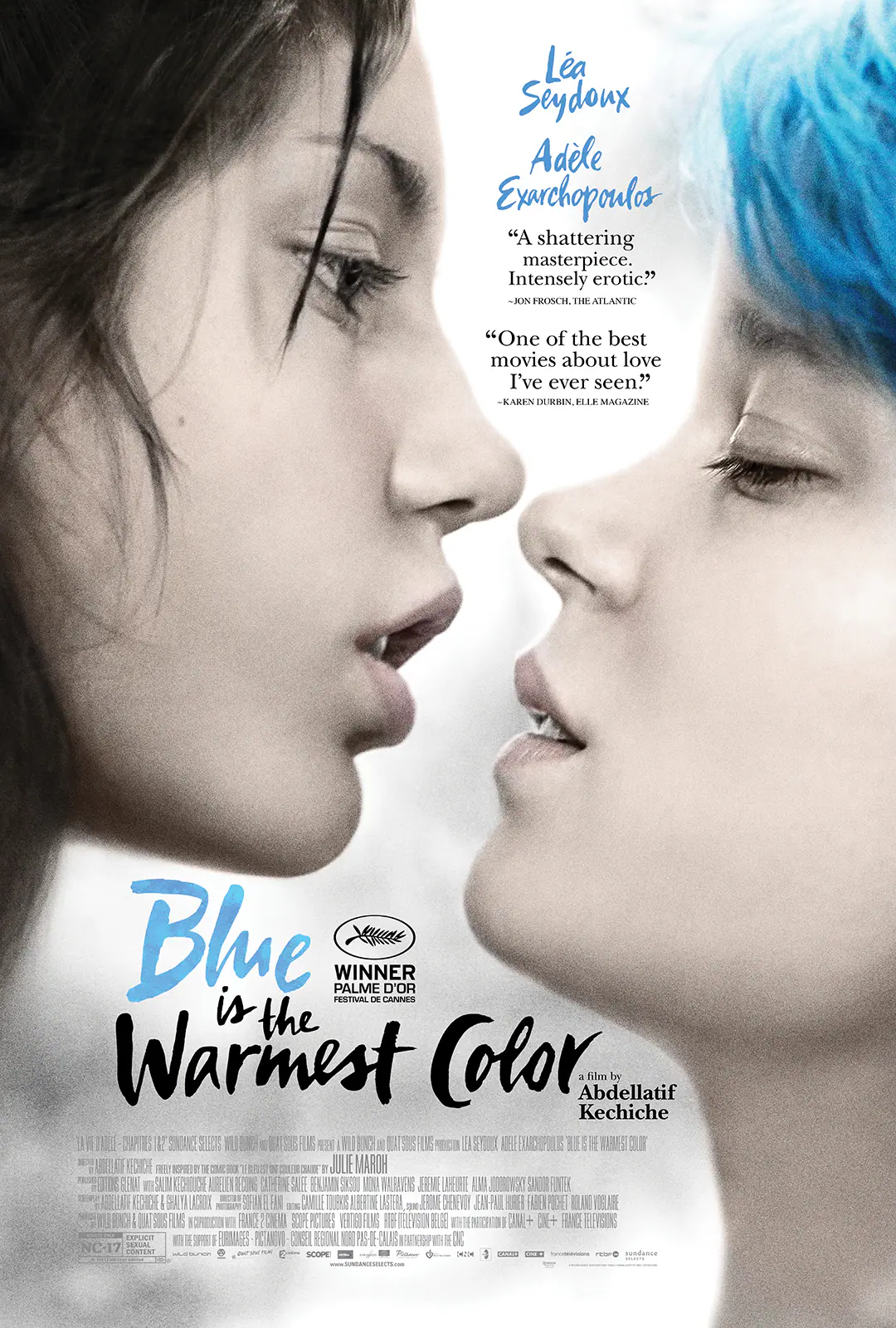
- Title: Blue Is the Warmest Color (La vie d’Adèle – Chapitres 1 & 2), 2013
- Director: Abdellatif Kechiche
- Screenplay: Abdellatif Kechiche, Ghalia Lacroix
- Original Work: The graphic novel Le Bleu est une couleur chaude by Julie Maroh
- Country: France, Belgium, Spain
- Genre: Drama, Romance
- Running Time: 179 minutes
- Platform: Netflix, Catchon, Naver Series ON, etc.
- Cast: Léa Seydoux, Adèle Exarchopoulos
📖 Blue Is the Warmest Color Plot: The Intrusion of Blue into an Ordinary Life [No Spoilers]
Adèle is an ordinary high school student who loves literature and dreams of becoming a teacher. While feeling an inexplicable emptiness in her relationships with male students, she feels an intense attraction to Emma, a blue-haired woman she passes on the street. This chance encounter completely shakes Adèle’s once-solid world.
Emma, a philosophy major with a firm sense of self as an artist, opens up an unknown world to Adèle. The two rapidly become absorbed in each other’s lives, beginning a passionate romance as if they are the only two people in the world. However, as time passes, an invisible gap begins to emerge between Emma, who possesses artistic ambition, and Adèle, who seeks ordinary happiness.
As the time they spend together lengthens, differences in class and values gradually rear their heads—in dinner table conversations, gatherings with friends, and their perspectives on the future. Adèle becomes increasingly lonely within Emma’s world, experiencing the process where the hottest blue transforms into the color of cold isolation.
🎨 Symbolic Interpretation: When Emma’s Blue Erodes Adèle’s Transparency
In the film, the color blue signifies more than just a hue. Starting from Emma’s hair, this color expands into Adèle’s clothes, the interior decor, and the color of the sea she plunges into. It is a device showing that Emma’s existence is “tinting” Adèle’s world.
In the beginning, blue is a symbol of desire and yearning for an unknown world. However, as the relationship deepens, the blue becomes a weight that is difficult for Adèle to bear. Emma wants Adèle to possess an artistic self like her own, but Adèle simply wishes to remain Emma’s muse and lover.
This imbalance in the relationship structure is also revealed visually. At Emma’s exhibition, Adèle feels a sense of alienation while serving food to guests. Here, blue is no longer a warm color but is replaced by the cold wall of an intellectual and artistic upper class that Adèle can never fully integrate into.
🍷 Power on the Table: The Class Gap and Psychological Structure Shown through Oysters and Spaghetti
The act of eating is treated with great importance in this film. The “spaghetti” eaten with family at Adèle’s house symbolizes the simplicity and affection of the working class. Conversely, the “oysters” eaten at Emma’s house represent the culture of the upper class, where sophisticated tastes and intellectual conversations are exchanged.
Adèle experiences a subtle shrinking of her presence when she tells Emma’s parents that her dream is simply to be a “teacher.” Emma constantly urges Adèle to become “something bigger,” but this is less a genuine understanding of Adèle and closer to an unconscious compulsion to fit Adèle into her own intellectual vanity.
Ultimately, the downfall of the two stems from this class-based isolation and the use of different languages, rather than the event of an affair itself. Adèle looks elsewhere to soothe her loneliness, and Emma uses this as a pretext to coldly expel Adèle from her world.
🔎 Reinterpreting the Ending — The Weight of Dignity in Adèle’s Departing Silhouette
The ending of Blue Is the Warmest Color concludes with Adèle visiting Emma’s exhibition after some time has passed. Emma’s hair is now dyed yellow, and she has a new partner by her side. While the “Blue Adèle” remains preserved within Emma’s canvases, the real-life Adèle no longer has a place in that blue space.
Adèle leaves the flamboyant party behind and walks down the street alone. Her silhouette is sorrowful, yet at the same time, it displays the solid dignity of one who has passed through a season of life with their whole body. What remains in the wake of the giant wave that was Emma is not a ruin, but the complete form of a human being named “Adèle.”
Love is a process of entrusting oneself to another, but a breakup is a process of gathering one’s torn self to stand alone. The blue dress Adèle wears is no longer for Emma; it symbolizes the sadness and growth that have now become her own skin.
Adèle has lost the world of Emma, but she has finally acquired the solitude of a subject living her own life, no longer anyone’s muse.
💬 Multi-Dimensional Interpretation of the Female Gaze and Directorial Style
Q. What do you think about the criticism that the long sex scenes in the film are biased toward the Male Gaze?
A. That criticism is entirely valid and has been a point of contention since the time of production. Director Kechiche maintains an observational attitude, capturing the characters’ bodies in extreme close-ups. It is difficult for the film to remain free from the accusation that it objectified love between women. However, at the same time, there is a coexisting aesthetic evaluation that this very persistence conveyed the emotional density and physical communion of the two characters at the most primal level. I encourage readers to judge for themselves through the film whether these scenes are a device proving their bond or the excessive desire of the director.
Q. Why did Emma condemn Adèle’s affair so coldly?
A. To Emma, Adèle had to be a “pure being” who provided inspiration. It is highly likely that Emma’s artistic arrogance led her to view Adèle as a perfect object that filled her world rather than an equal partner. Therefore, Adèle’s affair was more than a simple betrayal; it was an act that shattered the artistic illusion Emma had constructed, which can be interpreted as the reason for such a harsh expulsion.
✨ Blue Is the Warmest Color: We Were All Someone’s Blue
This film speaks of the traces of others left on our bodies like tattoos even after love has ended. Adèle’s narrative goes beyond the story of a minority experiencing identity confusion to penetrate the universal desires and pains of all human beings searching for themselves.
To love someone is to risk being dyed by that person’s color. Even if the end is a chilling isolation, the memory of that searingly hot blue becomes the engine that allows us to live through the next season.
The success or failure of love is determined not by the duration of the union, but by how deeply a human being peered into their own abyss through that relationship.
📧 Facing the Self Left Behind After Loss
“Has there ever been a moment when everything was explained just by looking at each other in silence?”
Sometimes, a single intense gaze changes a person’s life more than a hundred conversations. I wonder if you, too, had a “blue season” when someone was your entire world, painting it entirely in their color. What is the hottest color remaining in your heart?
📽 Violet Screen Curation: Recommendations for Female Narratives of a Different Tone
- Portrait of a Lady on Fire (2019)
- Reason for Recommendation: By subverting the relationship between the “one who sees” and the “one who is seen,” it elegantly portrays artistic solidarity and the memory of love created by an equal gaze. If Blue Is the Warmest Color is tactile, this film offers a visual overwhelmingness.
- The Almond and the Seahorse (2022)
- Reason for Recommendation: It deals with the complex psychology of women staying by the side of partners who are losing their memories. The depiction of the intimate relationships between characters conflicted between past love and present duty is excellent.
To provide a more stable publishing environment, multilingual content, and better communication with our readers, we have moved our official publication to Substack.
All new film reviews and critical essays will be published on our new platform. This website will be closing down soon, so we would greatly appreciate it if you subscribed to our new space.
TODAY'S QUESTION
When did you first feel fully accepted for who you are?
Your answer isn't saved. Feel free to share it in the comments below.


You May Also Like
Nude Area: An Interpretation of Sensory Liberation Painted by the Gaze of Desire and Isolated Skin
Snapshots (2018) Review: Love Shaken by 50-Year-Old Secret Photos and the Solidarity of Three Women