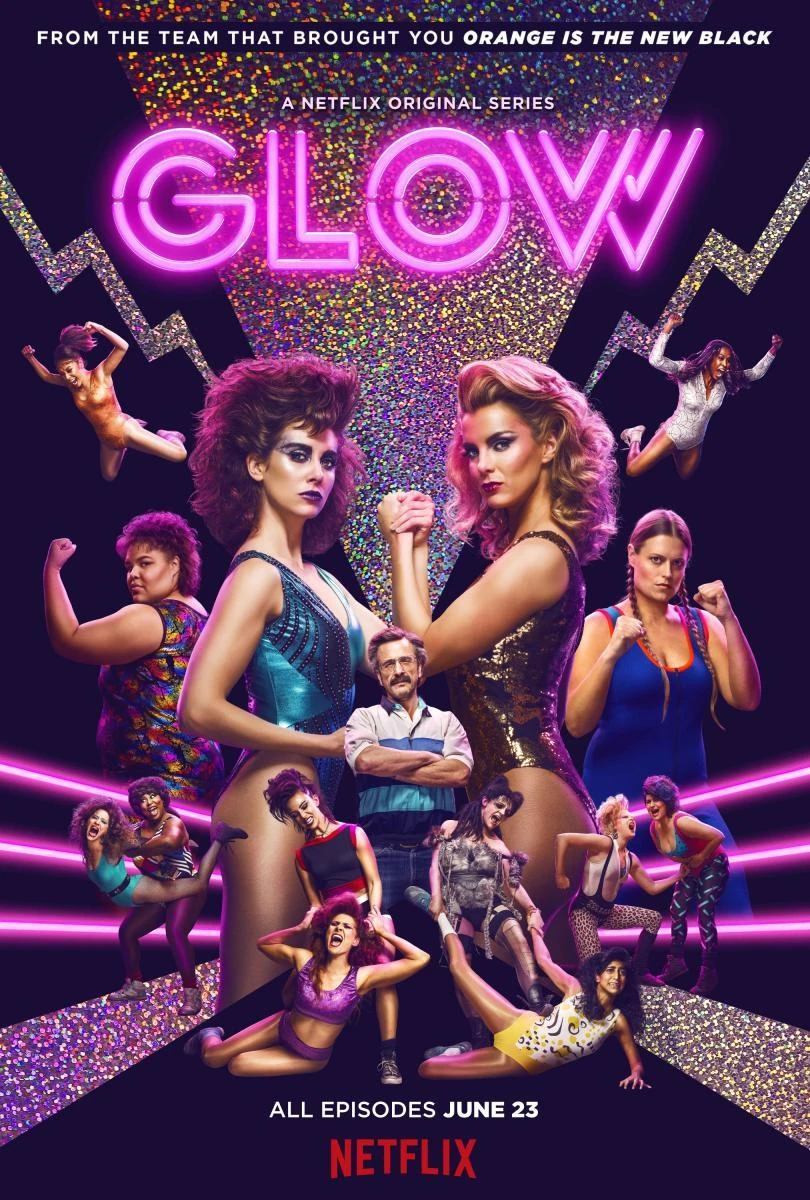
GLOW (2017): Queer Identity Bloomed on the Ring and the Liberation from Isolation
We often discover ourselves through the existence of others. Especially for those trapped within the narrow confines defined by society, the appearance of “the one person” who reflects us as we truly are becomes a matter of survival that transcends simple romance. GLOW, which depicts the raw reality of women hidden behind the flashy spandex and exaggerated makeup of the 1980s, delves deep into this very point.
This work deals with the solidarity of women struggling while embracing their respective deficiencies behind the scenes of a flamboyant wrestling show. Among them, the relationship between Arthie and Yolanda is the axis that most delicately portrays the destructive yet creative power of love, forcing one to face the “self I didn’t even know.” The process of an isolated individual reclaiming their name through the warmth of another is a narrative of liberation that we all crave, regardless of the era.
🌿 Moments When This Drama Permeates Deeply
- When you feel the role of “me” defined by the world is consuming your soul.
- When you wish to observe the process of love becoming a tool for self-reflection beyond mere fluttering excitement.
- When you wander between the desire to be free from the gaze of others and the urge to feel a sense of belonging.
- The reason to read this review is that you can discover the “art of relationships” that dismantles the solid walls of stereotypes and establishes the “true self.”
🎞️ Notes Before Watching
Set against the backdrop of the 1980s professional wrestling circuit, this work realistically depicts character performances based on racial prejudice and the process of exploring sexual identity. Along with the energy characteristic of sports dramas involving frequent physical contact, the emotional communion and physical attraction between the two female characters serve as the core engine of the narrative.
🎬 Series Information
- Title: GLOW (2017–2019)
- Directors: Lynn Shelton, Sian Heder, et al.
- Writers: Liz Flahive, Carly Mensch
- Country: 🇺🇸 USA
- Genre: Drama, Comedy, Sports
- Running Time: Season 3 (30 episodes total, approx. 30–40 mins per episode)
- Platform: Netflix
- Cast: Sunita Mani, Shakira Barrera, Alison Brie, Betty Gilpin
📖 GLOW: A Battleground Where Fake Personas and True Selves Clash on the Ring [No Spoilers]
In 1980s LA, Ruth, an unknown actress, auditioned for a women’s professional wrestling league out of desperation. The “GLOW (Gorgeous Ladies of Wrestling)” team, a collection of women with diverse backgrounds, adopts characters based on extreme stereotypes of race and profession to generate hype for the show.
Arthie Premkumar, an Indian-American, feels an internal dissonance playing the terrorist character “Beirut the Mad Bomber,” regardless of her intellectual nature. Then, in Season 2, the arrival of Yolanda Rivas, a free-spirited former dancer, creates a crack in Arthie’s stagnant world.
Yolanda stimulates Arthie’s suppressed desires, and through her, Arthie begins to question her sexual identity and racial stereotypes for the first time. The series densely portrays the process of these individuals, who continue their fake fights under bright lights, beginning a real struggle outside the ring to protect themselves.
🎡 The Clash and Expansion of Identity: Interpretation of the Relationship Shown by Arthie and Yolanda in GLOW
The relationship between Arthie and Yolanda goes beyond a simple queer romance; it is an in-depth report on how two marginalized individuals sharing social stigma save one another. Arthie is an intellectual and introverted figure who has lived suppressing herself between her parents’ expectations and the social gaze. The wrestling role of “terrorist” assigned to her was the epitome of the racial prejudice she carried.
Conversely, Yolanda is a confident figure who is honest about her desires and feels no shame regarding her past profession as a strip dancer. Yolanda’s appearance acts as a form of “mirror therapy” for Arthie. Looking at Yolanda, Arthie realizes how many “fake roles” she has been performing. The core of the interpretation in their relationship lies in the fact that Yolanda performs the role of a catalyst that liberates Arthie’s ego.
🎭 The Courage of Character Subversion: The Power of Love Rejecting Racist Roles
As the bond between the two deepens, Arthie translates her loathing for her role as “Beirut” into action. Bolstered by Yolanda’s support and love, she rejects the terrorist role and demands a character revision to “The Soul-Searching Scientist.” This signifies that the queer relationship is elevated to a political act that restores individual self-esteem and, furthermore, creates a fissure in the power structures imposed by the system.
However, their journey is not entirely smooth. Yolanda, who has already established her identity, desires stability in the relationship, while Arthie, who has just opened the “door of the self,” remains at a stage of experimenting with and confirming her new desires. The conflict arising at this point realistically captures the “difference in developmental stages” often overlooked in queer narratives, increasing the immersion of the drama.
🔎 Footsteps of Two Women Ending Isolation and Heading into the Wilderness
In the Season 3 finale, the relationship between Arthie and Yolanda does not culminate in either a definitive happy ending or a tragic catastrophe. Instead, the drama shows that Arthie has fully accepted her sexual orientation and is ready to head out into the wider world, using Yolanda as a “secure base.” Arthie discovered the “true me worthy of love” through Yolanda, while Yolanda learned the value of an altruistic relationship that helps someone grow through Arthie.
By the end, their narrative reaches a stage of spiritual union that transcends a simple romantic relationship. Even if realistic constraints and future uncertainties remain, the moment Arthie decides she will no longer imprison herself in the frames set by others, her struggle concludes in victory.
The relationship between Arthie and Yolanda is a structural achievement proving that the establishment of an individual’s identity can finally be completed through deep emotional communion with another.
❓ Questions Regarding the GLOW Finale and Representation in Women’s Narratives
Q: How does the relationship between Arthie and Yolanda differ from typical “coming out” narratives?
A: While general narratives focus on the pain of coming out itself, GLOW analyzes how the discovery of identity connects to the professional self. Arthie’s effort to change her wrestling role shows that the shift in sexual orientation leads to the restoration of agency across all aspects of life. Although the points where Yolanda is hurt by Arthie’s confusion are sometimes criticized, this can be interpreted as prioritizing the weight of the personal task of “self-discovery” rather than a mere immaturity in the relationship.
Q: How does the 1980s setting affect the interpretation of their relationship?
A: Living as a queer woman of color in the 1980s, an era rampant with AIDS-related fear and conservative values, signified a double marginalization. The work does not erase this social context, yet it delicately captures how the physical confidence they gained on the ring translates into internal courage. It achieves an aesthetic feat by breaking through the limitations of the era via individual solidarity.
✨ GLOW: The Most Flamboyant Counterattack of Souls Who Kicked Out of the Oppressive Ring
This drama asks: is the role we are performing truly “me,” or is it a mask we have put on for survival? Through the process of confirming each other’s raw selves, Arthie and Yolanda showed how isolated individuals can form a solid community. A relationship is not simply a means to soothe loneliness, but a process of manufacturing weapons to fight against the world that oppresses us.
True solidarity stems from the courage to choose to stay by one’s side even after witnessing their most vulnerable self.
💬 To You, Between Silence and Utterance
Are you a liberator like Yolanda, bringing out someone’s hidden truth, or an observer like Arthie, building your own room within the gaze of others?
Sometimes, there exists a territory of the self that must be protected even at the cost of hurting a loved one. Do you modify yourself for the sake of the relationship, or do you change the form of the relationship for the sake of yourself?
📽️ Violet Screen Curation: Searching for Other Women’s Solidarity
- A League of Their Own (2022, Prime Video)
- Reason for Recommendation: Set against the backdrop of a 1940s women’s baseball team, it deals with racism and queer identity. Much like GLOW, one can feel the passionate friendship of women finding their true selves through sports despite the oppression of the era.
- Feel Good (2020–2021, Netflix)
- Reason for Recommendation: A masterpiece dealing with the relationship between protagonists Mae and George, who suffer from addiction and identity confusion. It keenly and humorously captures the clumsiness and realistic conflicts of the process of establishing sexual identity, similar to Arthie and Yolanda.
To provide a more stable publishing environment, multilingual content, and better communication with our readers, we have moved our official publication to Substack.
All new film reviews and critical essays will be published on our new platform. This website will be closing down soon, so we would greatly appreciate it if you subscribed to our new space.
TODAY'S QUESTION
If you could say one thing to someone today, what would it be?
Your answer isn't saved. Feel free to share it in the comments below.


You May Also Like
Spartacus: Gods of the Arena—The Destructive Craving and Isolation of Lucretia and Gaia
The Bold Type: Kat Edison’s Identity Awakening and the Reconstruction of ‘Desire’