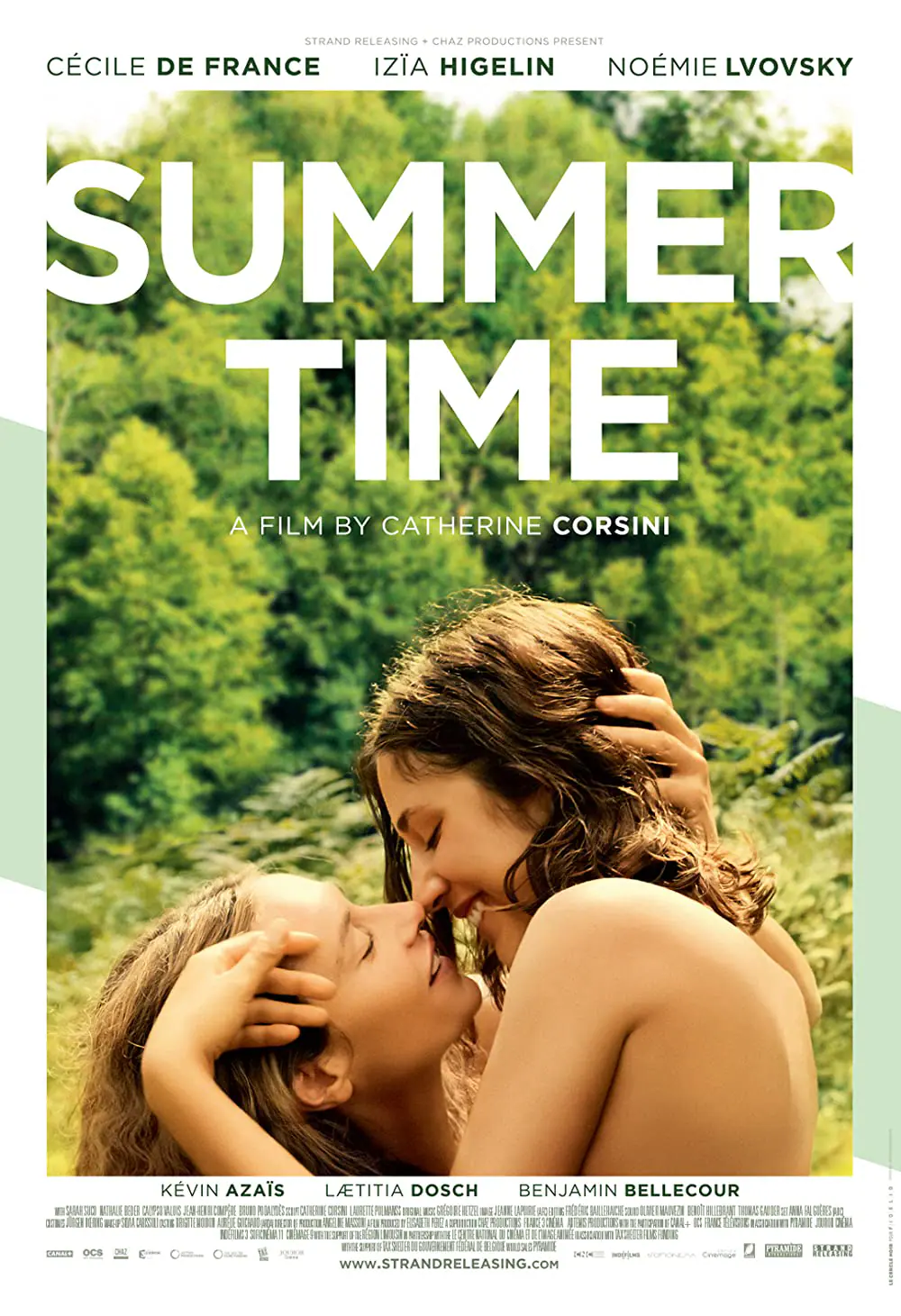
summertime, La Belle Saison Review: The Radiant Memory of Liberation and the Weight of Choice
At some point in life, every human being confronts an intense desire to break through the rigid walls confinement has built around them and step out into an entirely different world. This is not merely a spatial relocation—leaving a familiar place behind—but an existential liberation where the suppressed ego finally begins to breathe fully.
Through love, we discover another person while simultaneously confronting the immense deficiency we had long ignored. The relationship between two women that blossomed amidst a turbulent era transcends personal romance; it records a sublime journey of an individual proving their dignity against the currents of their time.
🌿 The Moments This Film Deeply Permeates
- For those who feel suffocated by living according to the mold of normalcy prescribed by the world while concealing their true selves.
- For those who vacillate between societal oppression and individual freedom, deeply contemplating the political and social weight inherent in the emotion of love.
- For those who hold the lingering resonance of a radiant past love but choose to carve out their own life paths rather than remaining anchored in past regrets.
- To understand the structural meaning and profound resonance left by the choices of two women who sought to save each other despite the limitations of their era, you must read this text to the end.
🎞 Note Before Viewing
This work densely depicts the turbulent era of the 1970s French feminist movement and the passionate love between two women that flourished within it. Physical contact and emotional communion are expressed honestly and boldly, serving as essential narrative devices that illustrate the process of self-discovery and liberation. Rather than relying on provocative direction, the film focuses on emotional nuances, centering on the psychological shifts of the characters and the atmosphere of the era.
🎬 Film Information
- Title: La Belle Saison (Summertime:La Belle Saison, 2015)
- Director: Catherine Corsini
- Screenplay: Catherine Corsini, Laurette Polmanss
- Country: France
- Genre: Romance, Drama
- Runtime: 105 minutes
- Platform: Wavve, Watcha, Apple TV
- Cast: Izïa Higelin, Cécile de France, Noémie Lvovsky
📖 La Belle Saison: The Narrative of Two Women’s Liberation and Realistic Fracture Beginning in Paris, Away from the Oppressive Countryside [No Spoilers]
Raised in a conservative agrarian household in Limousin, France, in 1971, Delphine suffers through family pressure to marry and the failure of a secret relationship before abruptly leaving for Paris to find a life of her own. Amidst the unfamiliar air of the city, she happens upon Carole, an activist fiercely shouting feminist slogans in the street. Drawn to her confident, untamed charm, Delphine joins the women’s liberation movement.
Bound by ideology and solidarity during this intense period, the two experience a potent physical and emotional attraction, developing a passionate romantic relationship. Their happiness is short-lived, however, as the situation changes rapidly when Delphine’s father suffers a stroke. Delphine must return to the farm to take over the family business, and Carole journeys down to the conservative countryside to find her. In front of the rural, insular gaze and patriarchal power structures that contrast sharply with the freedom of Paris, gradual fractures begin to surface.
☀️ The Mise-en-Scène of Space: The Clash of Parisian Liberation and Rural Patriarchy
The spaces within the film serve as crucial devices that visually contrast the psychology of the two protagonists and the degree of societal oppression they face. Paris is a space of freedom for Delphine to release her hidden identity, and a plaza of revolution for Carole to practice her ideology.
Conversely, the Limousin farm is a space of oppression ruled by patriarchy and conservative traditions beneath its beautiful natural landscapes. When Carole travels to the countryside to meet Delphine, the wide, golden fields offer a temporary sense of release, but they soon transform into a vast prison filled with the surveillance and mockery of the villagers.
The mise-en-scène of these spaces vividly demonstrates how the relationship between two women extends beyond a personal emotional matter, showing how it can be constrained and destabilized by the historical and social environment.
🕊 The Process of Agency Formation Where the Feminist Movement and Homoerotic Desire Intersect
Director Catherine Corsini organically integrates the historical context of the 1970s French women’s liberation movement (MLF) with the romance between the two women. Through Carole, Delphine encounters social discourses surrounding contraception, abortion rights, and homosexuality, evolving from a simple country girl into an autonomous woman.
Carole, on the other hand, had been dedicated to theoretical and political activism, but meeting a concrete individual like Delphine causes her to completely revise her heterosexual life, undergoing an internal revolution as she awakens to her identity as a lesbian.
Their solidarity does not stop at private love but expands into political action, offering a profound examination of how deeply personal emotions can become the driving force for generating the most potent form of political agency.
🍂 La Belle Saison Ending Interpretation: The Aesthetics of Dignified Growth Left by the Farewell at the Station
After their relationship is discovered by her mother, Delphine ultimately fails to break free from the realistic shackles of her family and farm, turning back at the train station after seeing off Carole, who is returning to Paris. On the surface, this ending of La Belle Saison appears to be a tragic separation brought on by the limitations of the era. Structurally, however, it represents a necessary rite of passage for both women to preserve their mutual dignity and grow into their authentic selves.
In the epilogue set five years later, Delphine—though not with Carole—has finally emerged from the shadow of her parents to autonomously run her own farm in the south of France, moving forward with her life. Carole also continues her dignified life, sustaining her convictions at a women’s clinic.
Their separation is not an absolute failure of the relationship, but rather an aesthetic of dignified growth, where each carves out a life as an independent woman based on the agency they acquired through one another. Though their love failed to achieve a physical union, it carved an indelible milestone of liberation within their respective interiors.
🔎 Interpretation of Realism Limits and the Representation of Women in La Belle Saison
Q. Is Delphine’s ultimate choice to remain in the countryside instead of leaving for Paris with Carole a limitation or a regression of the queer women’s narrative?
A. While Delphine initially flees to Paris to escape her patriarchal household, her return to the countryside after her father’s collapse transforms her into an active figure who defends the interests of the farm using the agency she learned from the feminist movement. For Delphine, the farm was not merely an oppressive space to flee from, but her root and the very foundation of her life for which she felt responsible.
Therefore, choosing not to follow Carole at the station should be viewed as a realistic decision to face the weight of her reality and fulfill her familial duties, rather than simple weakness or narrative regression. Instead of judging this, the film honestly observes the dilemma of choice that women confront within historical limitations.
Q. How should we interpret the criticism that the film polarizes audiences by depicting rural society in an excessively conservative and violent manner?
A. The scene where the mother, Monique, expels Carole, along with the pressure from Antoine, a local youth, may appear somewhat flat or villainous through a contemporary lens. However, in the remote rural societies of provincial France in 1971, homosexuality was an existential sin and a surreal phenomenon that signified the ruin of a lineage.
The film structures and displays their violence not as individual malice, but as a defense mechanism operated by an agrarian patriarchal society to preserve its system. Aesthetically, this device realistically exposes the thickness of the wall Delphine confronted. Through this, the audience witnesses that the barrier faced by the women’s movement at the time was not just a matter of reforming legal systems, but a battle against deeply rooted local customs, leaving the judgment entirely to the reader who navigates that era.
✨ La Belle Saison: Love Blooming Through Oppression Ultimately Becomes the Spark That Saves Each Life
Through the relationship between two women navigating the turbulent 1970s, this film clearly demonstrates how love can completely reconstruct an individual’s identity and fracture patriarchal oppression. Transcending the conventions of mere melodrama, it captures through a rigorous structural lens how private emotions expand into political agency when intersecting with history.
Though the barriers of their era forced them to choose divergent paths, the memory of that radiant season became an eternal force of salvation, enabling both women to live as their authentic selves. Past love does not vanish; it remains the most beautiful legacy that awakens human agency.
💌 When Love and Responsibility Collide, Could You Turn Your Back on the World to Protect Me?
We sometimes encounter moments in front of the immense wall of reality where we must let go of the hand of the one we love. Between the choice to defer love to protect one’s responsibilities and foundation like Delphine, and the choice to plunge into the partner’s world by risking all of one’s convictions like Carole, which attitude toward life evokes your deeper empathy?
🔮 Violet Screen Curation: Other Narratives of Solidarity Shaking the Atmosphere of an Era
- Amantes (2025): An independent French film that garnered significant attention for its all-lesbian cast, tracing the intertwined love stories of three couples lost between certainty and doubt. Breaking away from the heavy, solemn framework of traditional period dramas, it offers a fresh variation by wittily and honestly unpacking realistic dialogues and subtle power dynamics within contemporary lesbian relationships.
- The Firefly (La Luciérnaga, 2015): This film deeply portrays the process of two women, bound by a shared grief of loss, healing their wounds through each other and awakening to new emotions. A hidden gem rarely found on major platforms, this independent drama stands out for the intimate psychological shifts of its characters and its dense communion.
To provide a more stable publishing environment, multilingual content, and better communication with our readers, we have moved our official publication to Substack.
All new film reviews and critical essays will be published on our new platform. This website will be closing down soon, so we would greatly appreciate it if you subscribed to our new space.
TODAY'S QUESTION
Which ending has stayed with you the longest?
Your answer isn't saved. Feel free to share it in the comments below.


You May Also Like
Boys on the Side: Solidarity of Isolated Souls and the Salvation of Chosen Family

Submerge (2016): The Boundary Between Control and Indulgence, an In-Depth Analysis of Youthful Desire’s Cruel Drift