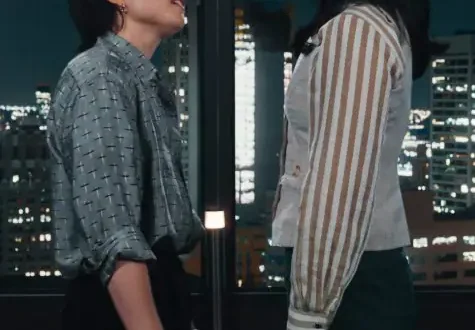
Moonshadow (2026): Shadows of a Relationship Forged by Love and Lack
Love is sometimes not about rescuing someone, but about confronting how long you have lived turning away from your wounds. The desire to be loved by someone and the fear of being hurt again can collide within the same heart. The Thai GL drama Moonshadow (เงาใต้พระจันทร์) unfolds around the relationship between two women who understand love in different ways: Chan and Key. What matters in this work is not who loves whom more. It is how two people who begin love like a transaction confront each other’s lack and past, and remake the meaning of their relationship.
🌿 Moments When This Drama Resonates Especially Deeply
Moments when you want to be loved but fear offering your heart first — if you have ever approached someone while hiding your true feelings, the dynamic between the two will not feel unfamiliar. Moments when past wounds shake present love — recommended for viewers who want to examine what shadows memories thought finished cast over a new relationship. Moments when the boundary between money and emotion blurs in a relationship — a work that prompts questions about whether love and dependence, or protection and possession, necessarily mean the same thing. Moments when you want to see a relationship between women as more than simple romance — recommended for viewers who want to read the power structures of love through the two characters’ lack and choices. That is why the reason to read to the end is that the work’s real question lies in how the relationship transforms the two women, rather than how it begins.
🎞 Before Watching the Drama
A Thai GL drama dealing with relationships between adult women, emotional intimacy, past romance, and a love triangle. Some depictions of adult relationships appear, though the central narrative rests on character psychology and shifts in the relationship.
🎬 Moonshadow (2026) Drama Information
- Title: Moonshadow (2026) / เงาใต้พระจันทร์
- Director: Kanittha Kwunyoo (Fon)
- Screenplay: Lalil Kittitanaphan
- Source Material: Novel of the same title by Flower of Memory
- Country: Thailand
- Genre: GL, Romance, Drama
- Runtime: Approx. 50–67 minutes per episode, 10 episodes total
- Platform: GMM25, oneD
- Broadcast Period: August 12, 2026 – October 14, 2026
- Cast: Emi Thasorn Klinnium (Chan), Bonnie Pattraphus Borattasuwan (Key), Film Rachanun Mahawan (Jay), Apasiri Nitibhon (Janya)
📖 Moonshadow Plot – How Love Begun as a Transaction Confronts the Past [No Spoilers]
Successful businesswoman Chan is a woman who does not easily open her heart to new relationships due to wounds from past romance. One day, she spends a night with an attractive woman named Key whom she meets by chance, and Chan tries to treat the encounter as a one-time affair. Key, however, does not back down. Instead, she makes the unexpected proposal to become Chan’s “sugar baby”—a relationship in which she is cared for. The two begin a relationship driven by terms rather than emotion, and as their time together grows, feelings that cannot be explained by the initial arrangement begin to sprout. Then Chan’s first love and ex-lover, Jay, reappears. Conflict forms between Jay, who wants to turn back the past relationship; Key, who wants to protect her present love; and Chan, who must sort out her own feelings. The relationship among three women with different wounds and desires asks what love is, and how far the past can determine the present.
🌙 Moonshadow: The Imbalance of Love Begun Under the Name of a Transaction
The Starting Point of the Relationship Was Need, Not Love
What is most intriguing about Chan and Key’s relationship is that the two did not want the same thing from the start. Chan wants to make the relationship into a form she can control. She believes that under terms without emotional involvement, getting close to someone is also possible. Key, on the other hand, accepts those terms while not wanting the relationship to stop there. For her, the arrangement is less an end than a way to draw closer to Chan. There is a clear imbalance of economic and emotional power here. Chan, who holds financial comfort and social standing, can set the rules of the relationship, while Key is placed in the position of stepping inside those rules. Over time, however, this power structure shifts bit by bit.
Protection and Possession Are Not the Same Feeling
What Key wants from Chan is not simply financial support. It is closer to an assurance that chooses her, acknowledges her existence, and keeps her from being pushed out of the relationship. In the process of caring for Key, Chan also confronts the reality that the economic advantage she holds cannot stand in for the other person’s feelings. The first shift in this work is that a relationship defined by money begins to be renegotiated through emotion.
🌑 Moonshadow: Wounds Formed by Key’s Past and Sense of Self-Responsibility
Someone Who Doubts Her Qualification to Be Loved
An important backdrop in Key’s narrative is her family history. Key is a daughter born to a concubine of an influential family. Her birth mother took her own life, and Key lives carrying guilt that she is responsible for that death. This past is not merely an unfortunate family history. It is a fundamental wound affecting how Key views herself and how she demands love from others.
Guilt Prevents One from Fully Accepting Another’s Love
A character who doubts whether she is worthy of being loved cannot easily trust another’s goodwill. Key’s bright and confident demeanor contrasts with the anxiety existing within her. Outwardly, she approaches first and takes the lead in the relationship, yet she is vulnerable when it comes to revealing her deepest wounds. What matters here is the difference between guilt and responsibility. Just because Key as a child took her mother’s death as her own responsibility does not mean she is actually responsible for that death. Yet blaming oneself can linger longer than objective facts. Her relationship with Chan lets Key experience a new love, while also preventing her from turning away from her past.
A Process of Re-Understanding Oneself, Not Being Rescued
Key’s change should not be read as a process in which all wounds disappear because someone loved her. True change begins when one does not equate the tragedy one experienced with one’s worth as a human being. In this respect, Key’s arc is not a secondary setup for romance, but a significant psychological axis of the work.
🌘 Moonshadow: Jay’s Return and the Power of Past Love
Is First Love Superior to Present Love?
Jay is a character who symbolizes Chan’s past. The two once loved each other, but the relationship ended. Afterward, Jay goes through marriage and divorce before appearing before Chan again, trying to restore their past relationship. Jay’s arrival cannot be viewed merely as a device to create a love triangle. She is a figure who draws out feelings Chan has long left inside her heart and memories she has not yet put to rest.
Remembering the Past Is Different from Returning to the Past
That Chan wavers toward Jay is because past feelings have not completely disappeared. Yet the fact that old feelings remain does not mean that relationship is still valid in the present. Here, the work shows the difference between two kinds of love.
Jay’s love moves toward reconnecting relationships and memories formed in the past. Key’s love moves toward accepting Chan in the present and building a future together. The more Jay tries to win back the past, the more Chan must choose whom she wants to live with now. This contrast is meaningful in that it does not reduce love between women to a competition over who is more attractive. At the same time, Jay’s feelings do not need to be interpreted solely as one-sided malice. Love one cannot let go of can be sincere, yet the moment it fails to respect the other person’s choice, that sincerity can turn into obsession that hurts others.
🌕 Moonshadow: Choosing Love and Family Approval Are Separate Matters
Chan Chooses Key, but Family Opposition Remains
Chan’s mother, Lady Chanya, does not accept the relationship with Key. Despite her mother’s opposition, Chan states clearly that she will marry Key. Her mother proposes a final test for Key on the condition of approving the marriage. Key accepts the terms of spending a week living with her mother and being evaluated. A restriction is even attached that she will not contact Chan during that period. In a situation where she must gain family approval to protect her love with Chan, Key must show who she is.
The Relationship with Jay Also Heads Toward a Period
In the ending, Jay decides to let Chan go. She apologizes for her actions holding onto the past and asks Chan for forgiveness. Chan also forgives Jay and hopes the two can become friends someday. The meaning of this scene does not lie simply in one person stepping back from a love triangle. By accepting that she has lost Chan, Jay finally gains the possibility of moving beyond past romance. This ending shows that love does not erase past wounds, yet someone who carries those wounds can still choose her own future.
The Meaning of Shadows Left Under Moonlight
The work’s title, Moonshadow, calls to mind the relationship between moonlight and shadow. Shadows do not vanish just because there is light. Rather, because light exists, shadows are also revealed clearly. Key’s past, Chan’s loss, and Jay’s lingering attachment are all shadows left in each of their lives. Even though the two marry, those shadows do not disappear. What matters, however, is that a relationship is formed in which they no longer have to bear those shadows alone.
🔎 Moonshadow Ending Interpretation – Completeness of the Happy Ending and Limits of Female Representation
Q1. Is Key and Chan’s marriage a sufficiently convincing ending?
There is room for disappointment. In particular, the part where Chan’s mother changes her attitude relatively quickly in the final stage despite opposing the relationship for a long time can feel lacking in emotional persuasiveness. Compared to building up the major conflict of family opposition across multiple episodes, one can criticize that the process leading to reconciliation was not shown enough. However, the core the work seeks to convey lies less in the process of obtaining parental permission itself than in an adult woman’s right to decide her own romance and marriage. Therefore, even if one agrees with the direction of the ending, the completeness of that process needs to be evaluated separately.
Q2. Is Jay simply a villain obstructing the two’s love?
Jay’s arc is somewhat more complex to interpret that way alone. Jay is Chan’s first love and someone who ended the relationship in the past. She wants Chan again, yet those feelings move in a direction that fails to respect the other person’s present choice. This character shows that the fact that love is real and the claim that one has the right to keep demanding that love are different things. Still, there is also regret that Jay’s emotions and changes are not expanded enough as an independent narrative. Whether her story remains a function reinforcing Chan and Key’s relationship or can be read as a new beginning for one woman is an important point of evaluation for the work.
✨ Moonshadow – Love Does Not Erase the Past, It Makes You Choose the Future
Moonshadow is a Thai GL drama showing how much more complicated sustaining love is than beginning it. For Chan, love is a choice that risks being hurt again; for Key, love is a process of confronting the guilt and lack that have long tormented her. Jay is someone who must let go of past love, and Chan’s mother is a figure torn between the standards she has set and her daughter’s choice. In this way, the work addresses love, family, economic imbalance, self-responsibility, and lingering attachment to the past together around a single romantic relationship. Of course, there are shortcomings in the narrative progression and resolution of the final conflict. In particular, the fact that the mother’s shift in attitude did not go through sufficient emotional accumulation is an element that lowers the work’s completeness. Also, if Key’s psychological wounds had been treated more deeply as a more independent narrative, the character’s growth would have been all the more convincing. Even so, the theme of women’s choice shown through Chan and Key’s relationship holds clear significance. Love is not the right to erase the other person’s past, but the act of choosing a future together with the person who holds that past.
💭 How Far Should One Compromise to Protect Love?
If you have to give up your own choices for the reason that you love someone, is that really love? Chan chose her own heart over family expectations, and Key wanted to be accepted within the relationship instead of hiding her wounds. What would you do? Would you risk family opposition to protect a relationship with someone you love, or would you hold back your own choice so as not to lose both family and lover?
🎬 Violet Screen Curation – Works Dealing with Love Between Women
- 23.5 (2024) A work depicting two female students awakening to unfamiliar feelings. You can experience worries about identity and the flutter of first love in a softer, more delicate atmosphere.
- The Secret of Us (2024) A Thai GL drama in which two women hurt by a past breakup meet again and confront issues of love, forgiveness, and trust. Recommended if you want to examine closely what traces past love leaves on a present relationship.
TODAY'S QUESTION
What changed the most for you after coming out?
Your answer isn't saved. Feel free to share it in the comments below.

You May Also Like
Verbotene Liebe Carla and Stella (Starla) Review: A Women’s Narrative of Salvation and Liberation, the Healing Psychology of Relationships in a German Soap Opera
Person of Interest (2011–2016): Anthropological Salvation Forged from the ‘Obsession’ of Isolated Souls