The Tunnel: Sabotage (2016) — The Fracture of a Rational World and an In-Depth Interpretation of Abyss-like Queer Romance
In an isolated worldview, the existence of another person sometimes approaches not as salvation, but as an omen of destruction. When an unpredictable other invades a rigid daily life woven solely from rules and logic, we finally come face-to-face with our deepest deficiencies.
Although this work wears the outer shell of a crime thriller set against the cold backdrop of the Eurotunnel, it essentially deals with the emotional dynamics of two deficient beings who break orbit, drawn by each other’s gravity. We follow the intimate trajectory of how human solitude and desire, which cannot be explained in the language of the system, alter the course of a massive narrative.
🌿 Moments When This Drama Seeps Especially Deep
- When you wish to witness the causality of a life lived under thorough rationality and control being completely shaken by the single gaze of one person
- When you want to sense the chilling yet devastatingly beautiful queer tension between women blooming within the crevices of a cold genre piece
- When you want to confirm that amid the grand justifications of greater causes and beliefs, the ultimate salvation chosen by an individual was, in the end, love
- To obtain the structural answer to how the relationship between two women, tearing through the outer shell of a thriller, completely reorganizes the characters’ world, you must read this text to the end.
🎞️ Notes Prior to Viewing the Drama
This work contains the rough expressions and tension inherent to the investigation and terrorism aspects typical of the British-French co-produced crime thriller genre. However, it does not rely on provocative sensationalism; rather, it is a relationship-centered narrative that depicts the emotional communion and psychological shifts between two female characters with an aesthetic of extreme restraint.
🎬 Drama Information
- Title: The Tunnel: Sabotage (Season 2, 2016)
- Director: Mark Evans et al.
- Screenplay: Ben Richards et al.
- Original Work: Swedish-Danish co-produced drama The Bridge
- Country: United Kingdom, France
- Genre: Crime, Thriller, Drama
- Running Time: 8 episodes total (approx. 45 minutes per episode)
- Platform: Amazon Prime, BritBox
- Cast: Clémence Poésy, Laura de Boer, Stephen Dillane
📖 The Tunnel: Sabotage, Fractures Arriving in Controlled Reason and the Thriller-Like Encounter of Two Women [No Spoilers]
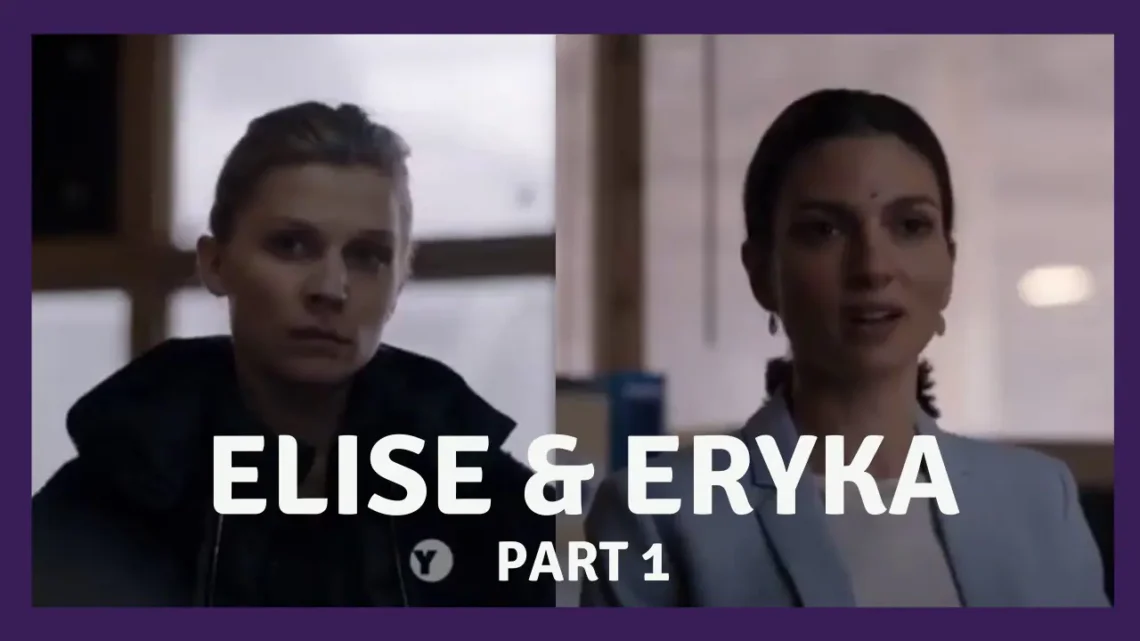
Elise Wassermann, a cold and detached detective with the French investigative authorities, is a character who lives with rules and reason as her absolute guideposts. Her rigid world, characterized by autism spectrum traits, begins to shake in an unexpected direction when she encounters the veiled human rights activist Erika Klein while investigating a plane crash.
Erika, who hides a past of trauma and a radical political background, neutralizes Elise’s defense mechanisms and stirs unfamiliar emotional ripples within her. As the investigation into the mastermind behind the incident progresses, suspicions surrounding Erika deepen. Elise faces a severe dilemma between her thorough professional duty as a police officer and the personal desire toward Erika that she is encountering for the first time in her life.
In the very center where the truth of the system and private attraction collide, their relationship moves beyond mere investigative cooperation toward a dangerous turning point that shakes the very existence of one another.
🧊 Thawing a Frozen World, Elise Wassermann’s Emotional Awakening and Interpretation of Queer Narrative
In The Tunnel: Sabotage, the character of Elise Wassermann symbolizes the realm of pure reason devoid of emotion. Her relationships with others have always been functional and mechanical, but the appearance of Erika Klein as a variable completely subverts the internal order she has constructed.
The scene where Elise attempts a private conversation by confessing her birthday is a decisive signal showing that a character who used to communicate only through the language of the system has, for the first time, come to long for an autonomous emotional connection. Erika is not merely an object of romance, but a mirror reflecting the internal deficiency that Elise could never bring herself to look into.
Erika’s dark past, punctuated by abuse and loss in Germany, stimulates Elise’s defensive walls, injecting the plot with the possibility of a strange mutual salvation between the two. Their attraction generates a sharper queer tension within the dry air characteristic of genre pieces, establishing itself not as a simple subplot but as the emotional core dominating the entire drama.
🥀 A Night Postponing Ruin, the Aesthetics of Tragic Melodrama Forged by Duty and Desire
From the moment the reality of the terrorist incident comes to light and Erika’s potential involvement becomes visible, the drama begins to deal in earnest with the clash between duty and desire. For Elise, rules were a means of survival, but as her feelings toward Erika deepen, she dismantles the boundaries of those rules herself.
The dialogue between Elise’s confession that she has “never been in love” and Erika’s quiet acceptance of it is the pinnacle of sorrowful communion shared by characters who foresee their tragic fate. The grace period of “just one more night” requested by Erika right before leaving is the sole and private sanctuary obtained by the two amidst the external pressures of a massive political conspiracy and investigative dragnet.
Erika’s ultimate choice to betray her own faction and vanish in order to save Elise proves that this relationship was not a temporary impulse, but a sublime desire that reorganized a human being’s worldview. Their night, finalized while harboring the inevitability of parting, elevates the tension of the genre into the aesthetics of tragic melodrama.
🔎 Autonomous Disappearance and Left Behind Traces, a Structural Reinterpretation of the Conclusion of The Tunnel: Sabotage
In the final episode, the ending where Erika Klein completely chooses erasure to evade the pursuit of MI5 and Russia after rescuing Elise signifies an eternal fracture in the relationship, yet simultaneously a spiritual bond. Instead of being judged in the courtroom of the establishment, Erika preserves her dignity and her love for Elise eternally by exiting the narrative on her own terms.
The direction showing Elise, who has awakened in a hospital bed, encountering Erika through a dream suggests that even if physical union failed, the existence of Erika has been etched into Elise’s interior as an indelible guidepost. The protagonist, Elise, has lost her perfect control as a police officer, but in return, she achieves growth by acquiring the humanity to love another and grieve a loss.
Erika’s disappearance is not a narrative incompleteness, but an aesthetic of salvation that leaves Elise’s closed world open forever. Through this tragic liberation, the character breaks away from being a component of the system and is finally reborn as a whole agent. Erika’s voluntary disappearance is the most perfect form of union, existing in Elise’s world through the method of eternal absence.
💬 Regarding the Controversy of the Instrumentalization of Queer Romance in Crime Thrillers and Narrative Necessity
Q. How do you evaluate the criticism that Erika’s narrative and the queer coding were used consumptively to maintain the tension of a genre piece?
Some audience members criticize that, given the structure where Erika is set up as a mysterious figure involved with the masterminds behind the crime and ultimately flees, the queer relationship was used as an instrument to induce narrative tension. However, this work does not consume their relationship as a simple twist card. Rather, it uses it as the core driving force that leads the internal awakening and growth of the character Elise, precisely depicting the clash between rational judgment in the investigative process and private emotion.
While the points of criticism largely stem from genre conventions, structurally it cannot be denied that the relationship between the two women functioned as the most fundamental axis determining the emotional texture of the drama.
Q. Isn’t the ending where Erika saves Elise and disappears ultimately a polarizing point that demonstrates the failure of autonomous solidarity?
For those who anticipated an ending where the two overcome the limitations of the system and show solidarity together, Erika’s departure may feel powerless. However, this should be interpreted not as a failure of solidarity, but as the best choice made to protect each other in their own ways. Erika practiced love while obscuring the truth, and Elise faced the truth within her own world as a police officer while harboring love.
Because it was a decision made to save each other within the structural limitations each faced, this open exit does not contain mere defeat, but carries the implication of dignity chosen by the characters, leaving the judgment ultimately to the audience.
✨ The Tunnel: Sabotage, an Anthropological Declaration of Emotion Beyond the Boundaries of Law and Institutions
The lingering resonance left by Season 2 of The Tunnel: Sabotage lies in its narrative proof that the cold system of laws and institutions can never control fundamental human emotions and attractions. Through Elise’s transformation, the work precisely tracks how private desire breaks into a social structure dominated by reason, creates fractures, and ultimately moves human beings.
Their relationship goes beyond a mere subplot of a genre piece, eloquently demonstrating that in an oppressive reality, the only channel through which an individual can prove themselves was, in the end, unconditional love for another. Human beings are saved not by the laws of the system, but solely by the gravitational pull of emotion that touches another’s solitude.
🦋 The Place Left by Loss, and Your Choice
Even after a relationship ends and completely vanishes, my interior altered by that existence never returns to how it was before.
Between a life of suppressing emotions for the safe comfort of the system, and a life of facing a love that will completely shake you even if ruin and loss are foretold, which side would you choose? Please let us hear your deep thoughts in the comments.
🔮 Violet Screen Recommendation: A Curation of Female Narratives Dealing with Intimate Gazes and the Abyss of Relationships
- Reason for Recommendation: It depicts the intense solidarity between Xu Youyi (played by Zhang Nan), a star author whose life is completely ruined by the betrayal of her trusted husband and best friend, and Yan Wei (played by Sun Yi Han), an assassin disguised as a photo studio owner who hides a cold secret. The process of the two becoming each other’s sole haven—one bearing the wounds of betrayal, the other wrapped in blood-stained secrets—is mesmerizing. The secret, tight emotional bond shared by the two women under closed social pressures perfectly aligns with the traumatic attraction demonstrated by Elise and Erika in The Tunnel.
- Reason for Recommendation: A complex and meticulous lesbian narrative involving Detective Amy Silva (played by Suranne Jones), who investigates a mysterious death that occurred in the extreme confined space of a nuclear submarine, and her partner Kirsten Longacre (played by Rose Leslie), who assists her from land. The deep past trauma and claustrophobia carried by Amy, alongside the emotional fractures and secrets entangled between the two, unfold in tandem with the urgency of the investigation. Moving beyond simple romance, the psychological curve of the two women supporting each other’s wounds and standing in solidarity amidst a massive national conspiracy leaves a profound resonance.
To provide a more stable publishing environment, multilingual content, and better communication with our readers, we have moved our official publication to Substack.
All new film reviews and critical essays will be published on our new platform. This website will be closing down soon, so we would greatly appreciate it if you subscribed to our new space.
TODAY'S QUESTION
Which ending has stayed with you the longest?
Your answer isn't saved. Feel free to share it in the comments below.


You May Also Like

GLOW (2017): Queer Identity Bloomed on the Ring and the Liberation from Isolation

ANNE+ Review: A New Milestone in 20-Something Female Narrative, the Trajectory of Growth Left by Love