Benedetta Interpretation: A Sacred and Provocative Holy War of Two Women Who Substituted Desire for Faith
In a turbulent era when every regulation controlled humanity in the name of God, there existed an individual who justified her most secret desires through the holiest language of divinity. The relationship between two women that blossomed within the enclosed space of an isolated convent transcends mere taboo; it assumes the form of the most destructive solidarity, fracturing male-centric religious power. This article is an in-depth cinematic journey tracing the psychological trajectories of two figures standing on the ambiguous boundary between faith and desire.
🌿 Moments This Film Deeply Penetrates
- Those who feel a spiritual thrill when sacred divine duty collides with raw, unrefined human instinct.
- Those who wish to witness the destructive power of an agentic female narrative that cracks the solid walls of the patriarchal religious order.
- Those who want to sharply deconstruct the contradictory, binary worldview of salvation and damnation, the sacred and the profane.
The reason to read until the very end extends beyond mere religious controversy; it allows one to confront the profound essence of power and liberation concealed within the relational structure of the two women, Benedetta and Bartolomea.
🎞 Notes Prior to Viewing
This work includes bold visual depictions that combine religious symbolism with physical intimacy. This is not a device employed for mere stimulation; rather, it serves as a core emotional and relational mode of expression that illustrates the process by which a woman reclaims sovereignty over her body and desire within a space governed by patriarchal rules.
🎬 Film Information
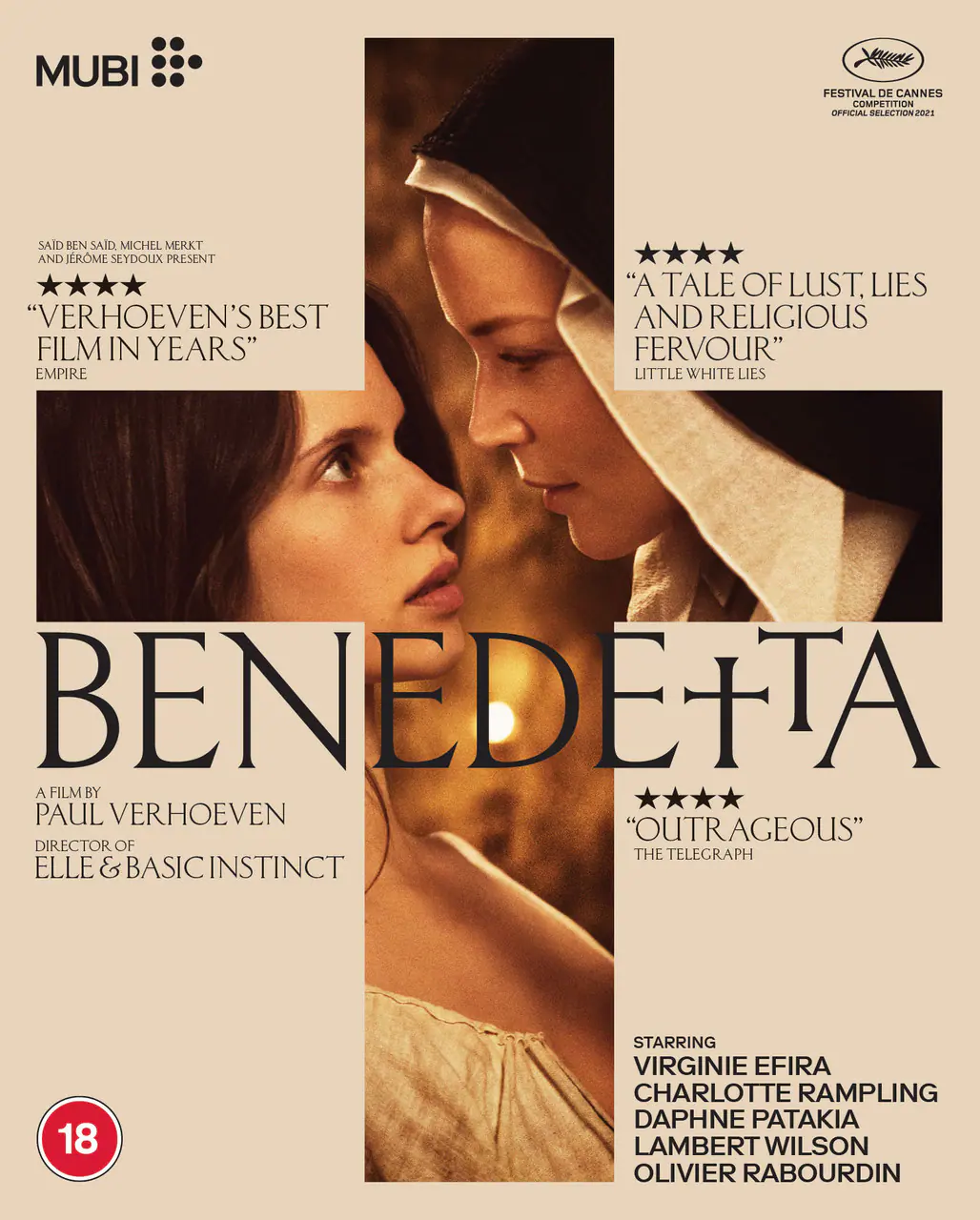
- Title: Benedetta (2021)
- Director: Paul Verhoeven
- Screenplay: Paul Verhoeven, David Birke
- Original Work: Judith C. Brown, Immodest Acts: The Life of a Lesbian Nun in Renaissance Italy
- Country: France, Netherlands
- Genre: Biography, Psychological Drama, History, Religion, Queer
- Running Time: 127 minutes
- Platform: Watcha, Naver Series On, Apple TV (VOD)
- Cast: Virginie Efira, Daphné Patakia, Charlotte Rampling, Lambert Wilson
📖 Benedetta: Power Struggles Within the Convent Where Divine Revelation and Forbidden Longing Intermingle [Spoiler-Free]
In a 17th-century convent in Pescia, Italy, Bartolomea—a woman brimming with wildness—intrudes into the rigid world of Benedetta, who from childhood never doubted her position as the exclusive bride of Christ. Fleeing domestic violence, Bartolomea’s unrestrained demeanor begins to intensely stimulate the suppressed human desires latent within Benedetta.
Amid strict regulations enforcing chastity, the two rapidly become emotionally and physically close, disrupting the serenity of the convent. Concurrent with the deepening of this secret relationship, supernatural phenomena—namely visions of Jesus and the stigmata—manifest in Benedetta, instantly elevating her to the status of a holy woman and granting her absolute religious power.
However, as the sharp surveillance of the former Abbess Felicita and the Papal Nuncio, both skeptical of her divinity, targets the hidden secret of the two women, the convent heads directly into a massive vortex of ruin.
⛪️ Sacred Visions and Physical Liberation: A Multi-Layered Interpretation of the Relationship Between Benedetta and Bartolomea
🔮 Agentic Solidarity Flowing Between Divinity and Desire
The ecstasy Benedetta experiences in the film presents a unique form in which the fulfillment of the religious holy spirit and raw eroticism are sophisticatedly combined. To Benedetta, Bartolomea acts not merely as a lover, but as a medium of liberation that awakens the physical agency she possessed as a human being, which had been hidden behind her transcendent alter ego as God’s instrument.
🪵 Appropriation of Symbols and Deconstruction of Patriarchal Authority
The use of an implement fashioned from a statue of the Virgin Mary—the most controversial element in the film—signifies the most radical resistance enacted within the holiest space. Within the Catholic order constructed through male language and law, the two women appropriate the very symbols instilled by the Church into tools to confirm their own sexual agency, thereby completely disrupting the system of religious oppression from within.
🔎 Reinterpretation of the Ending — An Eternal Crack Left Within a Complete Myth
Piercing through the crisis of execution at the stake and the chaos of the plague, Benedetta’s ultimate choice to walk back into the convent alone leaves a poignant resonance. Bartolomea begs Benedetta to shed the grand illusion of God and leave together to find ordinary human freedom, but Benedetta resolutely refuses.
For Benedetta, the survival of the self was possible only within the transcendent authority of the “Bride of God” she had constructed; Bartolomea, conversely, chooses to leave the walls filled with falsehood and illusion to remain a human being of the intact earth. This ending demonstrates that the two individuals, who once shared body and soul, faced an eternal fracture due to an irreconcilable, fundamental difference in belief.
Benedetta preserved the dignity of religious authority but gained a prison of solitude to confine her for life, while Bartolomea lost her love but gained the path of absolute freedom. The return to divinity chosen by the protagonist, Benedetta, represents the completion of a thorough self-mythologization achieved at the cost of human truth.
❓ Regarding the Benedetta Ending and the Ambiguity of Female Representation
Q1. How should we view the criticism that director Paul Verhoeven’s directorial approach excessively consumed women through the male gaze?
The criticism that certain bold visual depictions in the work leaned toward sensory stimulation is valid, and it is a point where audience responses may naturally diverge. However, it is difficult to dismiss this as mere commercial exploitation because those explicit descriptions operate strictly within a context that derides and destroys the solemnity of the patriarchal religious order. The director can be interpreted as having made an aesthetic choice, deliberately utilizing a visually shocking level of discomfort to question the boundaries between the sacred and the profane for the audience.
Q2. Was Benedetta a true saint, or was she a hypocritical fraud who coveted power?
The film refrains from offering a clear, binary answer to this question until the very end, and that ambiguity itself constitutes the narrative core of this work. Benedetta sincerely believed herself to be an instrument of God, while simultaneously operating as a clever politician capable of sophisticatedly controlling situations to protect her position. Rather than defining her as either a saint or a fraud, it comes closer to the essence to understand her through the historical limitations of an era where a woman had no choice but to borrow the pretext of “God’s voice” to survive, and the deceptive agency manifested within those constraints.
✨ Benedetta: The Most Rebellious and Holy Name Blooming Atop the Walls of Oppression
This film demonstrates how a patriarchal power system, which attempted to control the human body in the name of faith, shakes powerlessly before the secret alliance and desire of women deemed the most vulnerable. The love and conflict between the two women transcended mere romance to become a struggle for identity and power, and the communion they shared was the sharpest weapon breaking the taboos of the era.
The most potent force fracturing a massive system designed to control the female body is the solidarity of agentic longing germinating from within.
🔮 Between Silence and Declaration, Where Does Your Choice Reside?
“Would you entrust your soul to a life that maintains absolute dignity within a false myth, or to the raw freedom of walking out into the wilderness, stripping away all illusions?”
🎞️ Violet Screen Recommendation: Female Narrative Collections with Different Nuances
- The Duke of Burgundy (2014)
- Reason for Recommendation: A masterpiece that depicts the intricate psychological power games and emotional codependency of two women, set against the unique backdrop of entomology, utilizing fluid and aesthetic mise-en-scène.
- Thelma (2017)
- Reason for Recommendation: A sensory thriller tracking the process by which a protagonist raised in a strict Christian family awakens suppressed supernatural abilities upon experiencing an irresistible attraction toward a female classmate.
To provide a more stable publishing environment, multilingual content, and better communication with our readers, we have moved our official publication to Substack.
All new film reviews and critical essays will be published on our new platform. This website will be closing down soon, so we would greatly appreciate it if you subscribed to our new space.
TODAY'S QUESTION
If you could say one thing to someone today, what would it be?
Your answer isn't saved. Feel free to share it in the comments below.


You May Also Like
Gigola (2010): An In-Depth Interpretation of Female Narrative, A Solitary Walk Between Greed and Freedom
Jolene Ending Interpretation and Review: The Persistent Survival Narrative of an Unbroken Soul