Verbotene Liebe Carla & Susanne Review: The Flawed Legacy of Institutional Union and Deep Interpretation
At the precipice of loss, humans are generally confronted with two choices: to lock the doors forever, or to reach out once more toward another’s warmth despite knowing it may end in shattering. The narrative of Carla and Susanne in the German drama Verbotene Liebe burns with immense brilliance, yet ultimately leaves the deepest of scars. It encapsulates both the zenith of institutionalized love and the inevitable fractures simmering beneath its surface.
🌿 Moments When This Drama Intensely Permeates
- When you are building walls of fear after a devastating loss, believing you can never love anyone again.
- When you wish to witness the exact moment feelings hidden behind the safe boundary of friendship shift into uncontrollable desire.
- When you want to comprehend the complex psychological dynamics of why the attainment of an institutional union can never serve as a permanent safety net for a relationship.
- Therefore, the reason to read this article to the end is that it transcends a simple tragic romance, utilizing a sharp editorial lens to completely dissect the structural catastrophe of how social mistrust and internal deficiency dismantle a household that once appeared utterly impregnable.
🎞 Notes Prior to Viewing the Drama
This work is an arc within a long-running German soap opera, capturing the sensual and passionate tension between characters through a sensory yet artistic direction. Rather than focusing merely on provocative depictions, this relationship-centered narrative concentrates on the psychological tug-of-war, the escalating emotional curves between two women, and the emotional communion experienced while constructing the framework of a family.
🎬 Drama Information
- Title: Verbotene Liebe (Forbidden Love) — Carla & Susanne Storyline (2005~2007)
- Director: Paul Meyer, Frank Heinemann, et al.
- Screenplay: Christiane Sadlo, et al.
- Country: Germany
- Genre: Romance, Drama, Soap Opera
- Platform: ARD (German Broadcast)
- Cast: Claudia Hiersche – as Carla von Lahnstein, Claudia Scarpatetti – as Susanne Brandner
📖 The Plot of Verbotene Liebe from Carla and Susanne’s Friendship to Catastrophe [No Spoilers]
Susanne (Claudia Scarpatetti), a resilient taxi driver raising two children, appears before Carla (Claudia Hiersche), an aristocrat wandering through a profound sense of loss after losing her past lover. Living in completely separate worlds, the two begin with a pure friendship. However, as Susanne develops uncontrollable feelings toward Carla first, the boundaries between them begin to shift tempestuously.
Carla eventually dismantles her inner walls to take Susanne’s hand, leading them to a glorious milestone: the first lesbian wedding in German television history. Yet, at the very moment they seem to achieve a complete family by having a child through sperm donation, the presence of the donor, Lars, alongside misunderstandings brought by figures from the past, triggers latent mistrust and jealousy. Fatal fractures begin to manifest within their seemingly solid fortress.
🔑 Institutional Binding Force and Internal Deficiency: An Interpretation of the Relational Structure between Carla and Susanne in Verbotene Liebe
In the narrative of Carla and Susanne, marriage functions as more than a mere ritual proving their love; it acts as a defense mechanism to shield themselves from social pressure and personal trauma. Carla required the stable sanctuary of Susanne to fill the massive void left by past outing wounds and the death of her lover.
Conversely, Susanne, having recently confronted her identity after escaping a male-centered marital life, could not entirely gauge the invisible walls of Carla’s aristocratic family or the depth of Carla’s guarded heart. While their union stood as a highly progressive legal triumph, it paradoxically harbored a structural vulnerability—hastily erecting the external form of a family without fully healing each other’s internal deficiencies.
🎨 Sensual Mise-en-scène and the Power of the Gaze: A Review of the Breakdown of Trust Eroded by Doubt
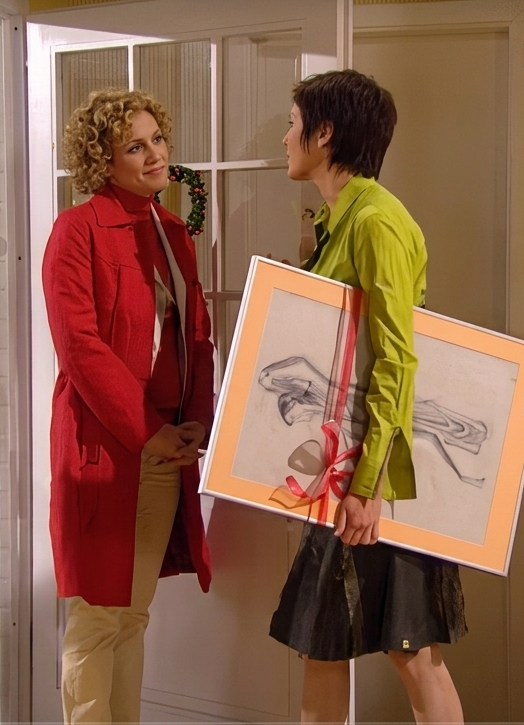
The nude drawing sessions and the birthday surprise scenes directed at the peak of their romance are not merely for visual stimulation; they serve as metaphors for the power dynamics and emotional subordination between the two women. Carla capturing Susanne on canvas is a gaze intended to possess and control her partner, while simultaneously functioning as an artistic defense to conceal her own vulnerability.
However, as they enter the pragmatic trajectory of childbirth and household maintenance, this sensual mise-en-scène curdles into a toxic jealousy. Carla suspecting Susanne’s subtle shift in gaze toward the donor, Lars, and Susanne guarding against the seduction of Carla’s old friend, Frederike, both stem from an anxiety over the inability to completely control one another. Possessiveness devoid of trust ultimately transforms into a weapon of mutual destruction.
🔎 Reinterpretation of the Ending — A Conclusion of Eternal Fractures Left by Institutional Perfection
The divorce of Carla and Susanne, culminating in Susanne’s eventual departure for Marseille, might seem like a melodramatic catastrophe typical of soap operas. In reality, however, this is a cold, structural declaration proving the ‘limitations of a heterogeneous union’ rather than an expiration date on love. Despite passing through the institutional frameworks of legal marriage and childbirth, the ending—where Susanne ultimately unites with Lars, the seed of mistrust that shook her—demonstrates the precarious foundation upon which their vows were built.
Through this catastrophe, Susanne departs having entirely concluded the wandering of her chaotic identity. Carla, though losing her loved one, gains dignity by acquiring maternity through her child, Sophia, growing into a more mature and resilient subject. Their conclusion implies that love is not finalized by institutions, but sustained solely through the absolute internal independence of each individual. Their marriage failed, yet it was an inevitable deconstruction for the establishment of Carla’s identity and her autonomous maternal growth.
💬 In-Depth Analysis Surrounding the Carla and Susanne Narrative
Q. How do you view the criticism that soap opera tropes, such as “conflict for the sake of conflict” and sensational elements, undermined the authenticity of the two characters?
The suspicion, allegations of infidelity, and the sudden union with Lars definitely display the provocative narrative repetitiveness unique to daily dramas. It is undeniable that such progression severed the deeper emotional lines of the characters, rendering it a polarizing point for audiences. However, structurally, this reflects the limitations common in media of that era when depicting women’s narratives. Simultaneously, it can be read in an aesthetic context that paradoxically reclaims ordinary humanity, demonstrating that ‘lesbian couples can collapse from realistic jealousy and selfishness just like heterosexual couples.’ Being depicted as subjects navigating muddy, realistic conflicts rather than a flawless fantasy romance is a point worth considering.
Q. How should we understand the ambiguity in interpreting the ending, where Susanne ultimately leaves for Marseille and connects with Lars?
Many fans felt a sense of betrayal regarding Susanne’s final choice, drawing criticism that it constituted a betrayal of the women-centered narrative. Yet, this functions as a device demonstrating that Susanne’s inherent instability and identity confusion were never fully resolved. The alienation she experienced within Carla’s monolithic world (the Lahnstein family) ultimately pushed her outside of that universe. Whether this ending compromised the narrative integrity or offered a realistic conclusion that candidly presented human imperfection remains an open question, depending on which character’s deficiency the viewer emphasizes.
✨ Verbotene Liebe, The Cruel Traces of Growth as Women Break Free from Institutional Illusions
The narrative of Carla and Susanne etched a monumental history with ‘the first wedding’ despite the temporal constraints of the mid-2000s, while honestly depicting the dissonance that occurs when love is confined within institutional frameworks. In contemporary society, many still attempt to secure the permanence of relationships through forms of union (marriage, registered partnerships). However, this drama poses a fundamental question: a union not preceded by internal trauma healing and absolute trust in the partner is merely a house of cards.
To modern individuals wandering between identity, desire, and the value of family, their catastrophe is not a simple tragedy, but a mirror demanding that one confront oneself entirely. Love can never be defined by institutions, and the survival of a relationship is possible only within the courage to face each other’s abyss without fear.
👁 When an Isolated Heart Yearns for Another, How Far Can You Fall?
The desire to be saved by another person turning into a shackle that restrains them is an experience almost everyone has encountered at least once. Between Carla’s choice to seize control to avoid being hurt, thereby ruining the relationship, and Susanne’s choice to escape suffocating boundaries by choosing catastrophe—which hand would you hold if placed in the same situation? Please share your thoughts in the comments on what you believe constitutes the true completion of a relationship.
🎬 Violet Screen’s Curated Recommendations to Prolong the Afterglow
- Tipping the Velvet (2002)
- Reason for Recommendation: Set against the backdrop of the 1890s Victorian era, this series follows an ordinary woman who falls in love with a male impersonator, awakens to her own identity, and subsequently navigates a tumultuous journey through brilliant heights, devastating ruins, and eventual resurgence. It will offer deep immersion for those who enjoy transitions from friendship to romance alongside passionate narrative fluctuations.
- Parallel Mothers (2021)
- Reason for Recommendation: A narrative where two women who give birth alone meet at a hospital, becoming entangled through solidarity, secrets, and the central value of maternity. It presents a warm yet intense drama moving toward profound connection and historical healing rather than catastrophe.
To provide a more stable publishing environment, multilingual content, and better communication with our readers, we have moved our official publication to Substack.
All new film reviews and critical essays will be published on our new platform. This website will be closing down soon, so we would greatly appreciate it if you subscribed to our new space.
TODAY'S QUESTION
Which couple, on screen or in real life, are you rooting for right now?
Your answer isn't saved. Feel free to share it in the comments below.


You May Also Like

Reverse 4 You Analysis: Temporal Obsession and Sublime Sacrifice Mending the Cracks of Fate

Gap The Series: Theory of Pink, an Interpretation of Radical Attachment Breaking Through Class Gaps
