Verbotene Liebe: The Aesthetics of Identity and Tragedy in the Narrative of Carla and Hanna
When the emotion of love shakes an individual’s ontological identity, its trajectory is often consummated in its sharpest form: tragedy. Orchestrating a powerful chapter in early 2000s German television, the narrative of Carla and Hanna in Verbotene Liebe is a work that precisely captures the intersection where social oppression and internal awakening collide, transcending a simple queer romance.
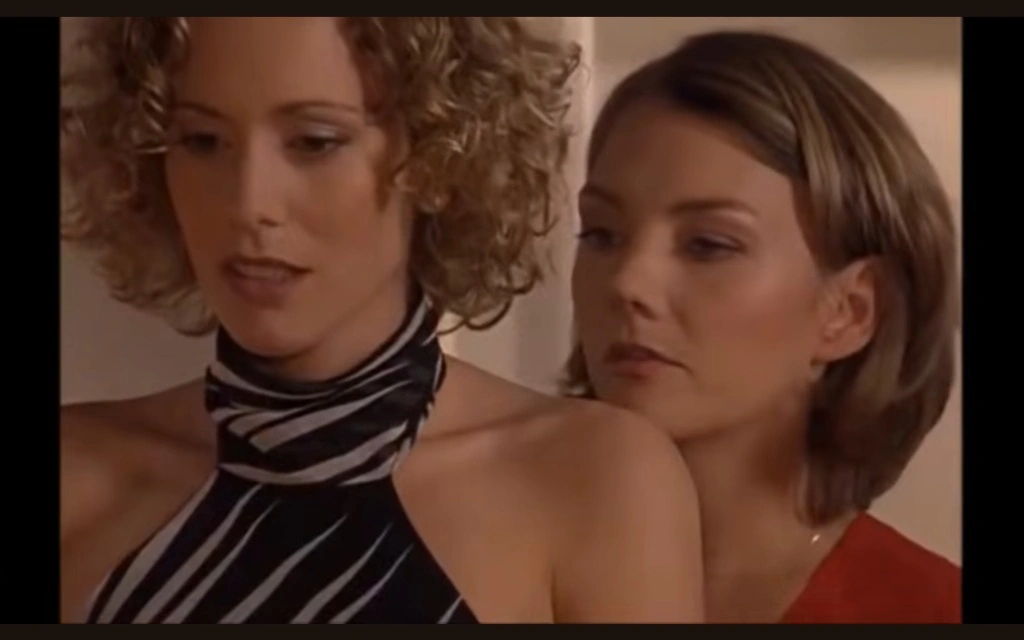
The encounter between Carla, a countess’s daughter who had to rigorously camouflage her exterior, and Hanna, who faced an unexpected vortex of emotion within her ordinary daily life, was in itself the beginning of a massive rupture. This article traces the curve of emotional shift from their meeting to their tragic destination, looking deeply into the essence of the sorrowful lingering resonance they left behind.
🌿 Moments When This Drama Deeply Permeates
- When one suddenly encounters a profound solitude, feeling isolated within their true identity amidst a routinized daily life.
- When one wishes to understand the desire for forbidden emotions that irrepressibly bloom despite the gaze of others and social pressure.
- When one wants to see how the shadow of loss, arriving at the most radiant and happy moment, forces a human being to grow.
- Because one desires to cherish deep in their heart the absolute union of two women who overcame the limitations of their era to become each other’s salvation.
🎞 Note Before Watching the Drama
This narrative follows the grammar of the early 2000s German soap opera, developing around a dense emotional exchange and shifting relationships between characters. Rather than focusing on provocative or sensational depictions, this is an emotion-driven work that densely portrays the psychological process of two women permeating each other’s lives and their conflicts within social constraints.
🎬 Drama Information
- Title: Verbotene Liebe (Focusing on the 2003–2004 narrative)
- Director: Bodo Fürneisen et al.
- Screenplay: Andreas Füsser et al.
- Country: Germany
- Genre: Drama, Romance, Melodrama
- Platform: ARD (Broadcast locally in Germany)
- Cast: Claudia Hiersche – as Carla von Lahnstein, Katharina Dalichau – as Hanna Novak
📖 Verbotene Liebe: Carla and Hanna’s Secret Love and Fated Conflict [No Spoilers]
Carla von Lahnstein, a business woman and the daughter of a count’s family, lives under strict secrecy while hiding her sexual identity. Then one day, she meets Hanna Novak—a woman with an ordinary yet resilient interior—at the club ‘No Limits’, and Carla’s rigid world begins to fracture.
Because Hanna already has a heterosexual partner, Carla cannot easily approach her and only builds a deep friendship. However, when Carla’s irrepressible emotions are eventually exposed to the world, Hanna falls into confusion and displays a defensive rejection. Yet, watching Carla distance herself, Hanna also realizes that the unfamiliar emotion inside her is love, not friendship. Amidst the strategic pressures of Carla’s family and malicious exposure from those around them, the two finally confirm their hidden feelings for each other.
Their secret romance, initiated as if escaping from the social gaze, deepens passionately and romantically. However, the jealousy of an ex-partner, an unexpected tragic accident, and a health crisis that strikes Hanna place their love upon a massive crucible of fate.
🔒 Fractures in the Power Structure: Where Social Masks and Internal Awakening Collide
The narrative of Carla and Hanna in Verbotene Liebe subverts the class power of an aristocratic family and the hierarchical difference of an ordinary individual through the mirror of identity. Carla possesses immense wealth and prestige but is a psychologically vulnerable agent who must suppress her essence for the reputation of her family, whereas Hanna is not materially affluent but possesses the freedom to be honest with her emotions.
The relational structure initially appears to be led by Carla, but it advances into an equal alliance from the moment Hanna breaks through her defense mechanism—declaring “I am not bisexual”—and affirms her own desire. The forced outing perpetrated by her secretary, Evelyn, was a ruinous crisis for Carla, but paradoxically, it becomes a crucial turning point that makes Hanna step out of her social comfort zone and walk into Carla’s world.
This is an aesthetic direction proving how love between women, blooming within an oppressive structure, neutralizes external violence and becomes a mutual salvation.
🔎 Reinterpretation of the Ending — The Eternal Bond and Dignity Left by the Dawn of the Rhine
Hanna’s sudden death, which shocked many viewers, is not a simple melodramatic ending, but demonstrates the purest and most complete form of union that this agonizingly secret romance could attain. Intuiting the unexpected signs of death after her kidney transplant, Hanna chooses to fill her final vacation with Carla entirely with love rather than trembling in fear.
The romantic night spent along the banks of the Rhine in Düsseldorf was a utopian space completely liberated from the familial pressure, social prejudice, and vengeance of the ex-partner surrounding them. The next morning, the peaceful death of Hanna confronted by Carla upon waking appears to be an eternal rupture of the relationship; paradoxically, however, it encapsulates their love within eternity so that no hardships of reality can defile it any longer.
Carla lost the greatest love of her life, but through Hanna, she finally gained the dignity to grow into a subjective human being rather than a puppet of her family. Hanna’s death established a monumental milestone within Carla’s interior, altering her life permanently.
💬 Regarding the Interpretation of the Queer Narrative in Verbotene Liebe
Q. How should we evaluate the criticism and limitations regarding the typical soap opera tragedy (death ending) of the era?
A. The criticism that Hanna’s death is a ‘punitive tragedy’ or a ‘sad ending cliché’ frequently seen in lesbian narratives of that era remains valid. It is a point indicating that the show avoided the continuation of the relationship by killing off one of the protagonists at the peak of their happiness. However, structurally, this tragedy functions as a tool to complete Carla’s character arc.
The drama does not treat Hanna’s death as a punishment, but secures an aesthetic context by sublimating it into a catalyst for internal awakening, prompting Carla to execute a full coming out against her family and seek her subjectivity afterward. Readers will be able to reflect for themselves whether this is a tragedy trapped within historical limitations or an artistic device that rendered love eternal.
Q. What was the psychology behind Hanna’s initial strong denial of her identity?
A. Hanna’s rejection was a manifestation of human fear regarding deviating from the orbit of ‘normality’ prescribed by society. To her, having lived an ordinary heterosexual life, the tremor toward Carla was a threat shaking the foundation of her existence, leading her to erect a shield with the declaration, “I am not bisexual.”
Critically speaking, the character’s confusion could be seen as handled somewhat abruptly, but consequently, because this stage of denial existed, the nobility of her subsequent confession—walking out toward Carla on her own accord—achieved a maximized structural effect.
✨ Verbotene Liebe, A World Called the Whole Self Faced Through the Pain of Loss
The question this old review of the drama poses to us today is clear: to what extent can we be honest with our own identity amidst the gaze of others and social constraints? The narrative of Carla and Hanna does not merely remain a provocative drama subject of the past, but demonstrates how the emotion of love liberates a human being from oppression and bestows dignity.
Even if the physical parting was tragic, Carla’s narrative, having gained the courage to step out into the world through Hanna, implies that the essence of love lies in growth rather than possession. True love remains an eternal driving force that expands my world even in the absence of the other.
💭 Have you ever faced your ‘true self’ through someone else?
It makes one look back on whether there was an existence that broke into your tightly closed world and drew out the internal truth that even you did not know. Was that intense encounter that completely shook your life a ‘sweet stability,’ or was it a ‘forbidden leap’ that was terrifying yet unstoppable?
🗂 Violet Screen Recommendations: Two Other Period/Contemporary Female Narratives Highlighting Generational Agony
- Fingersmith (2005)
- Recommendation Reason: Set in the British Victorian era, this is a period drama dealing with the intense deception and fascination blooming between two women under a harsh fate where they must deceive each other. It is a major-oriented classic masterpiece where you can feel the barriers of social class and the thrill of a secret romance at its peak.
- Chaser Game W: My Evil Boss is My Ex-Girlfriend (2024)
- Recommendation Reason: Set against a global game development project, this office melodrama depicts the intense emotional confrontation that occurs when former lovers, who parted due to past misunderstandings, reunite as a boss and a subordinate. By densely expressing the love-hate and lingering attachment that cannot be hidden despite workplace power structures and social pressures, it serves as an excellent variation for readers who enjoy the precarious tension and dramatic narrative characteristic of ‘Canna’s’ secret romance.
To provide a more stable publishing environment, multilingual content, and better communication with our readers, we have moved our official publication to Substack.
All new film reviews and critical essays will be published on our new platform. This website will be closing down soon, so we would greatly appreciate it if you subscribed to our new space.
TODAY'S QUESTION
Is there a film whose ending you wish had gone differently?
Your answer isn't saved. Feel free to share it in the comments below.


You May Also Like
LAS DE LA ÚLTIMA FILA: Lost Pieces Between Confession Without Regret and Eternal Friendship

My Only Sunshine: A New Pinnacle of GL Melodrama Born of Secrets and Imperfection