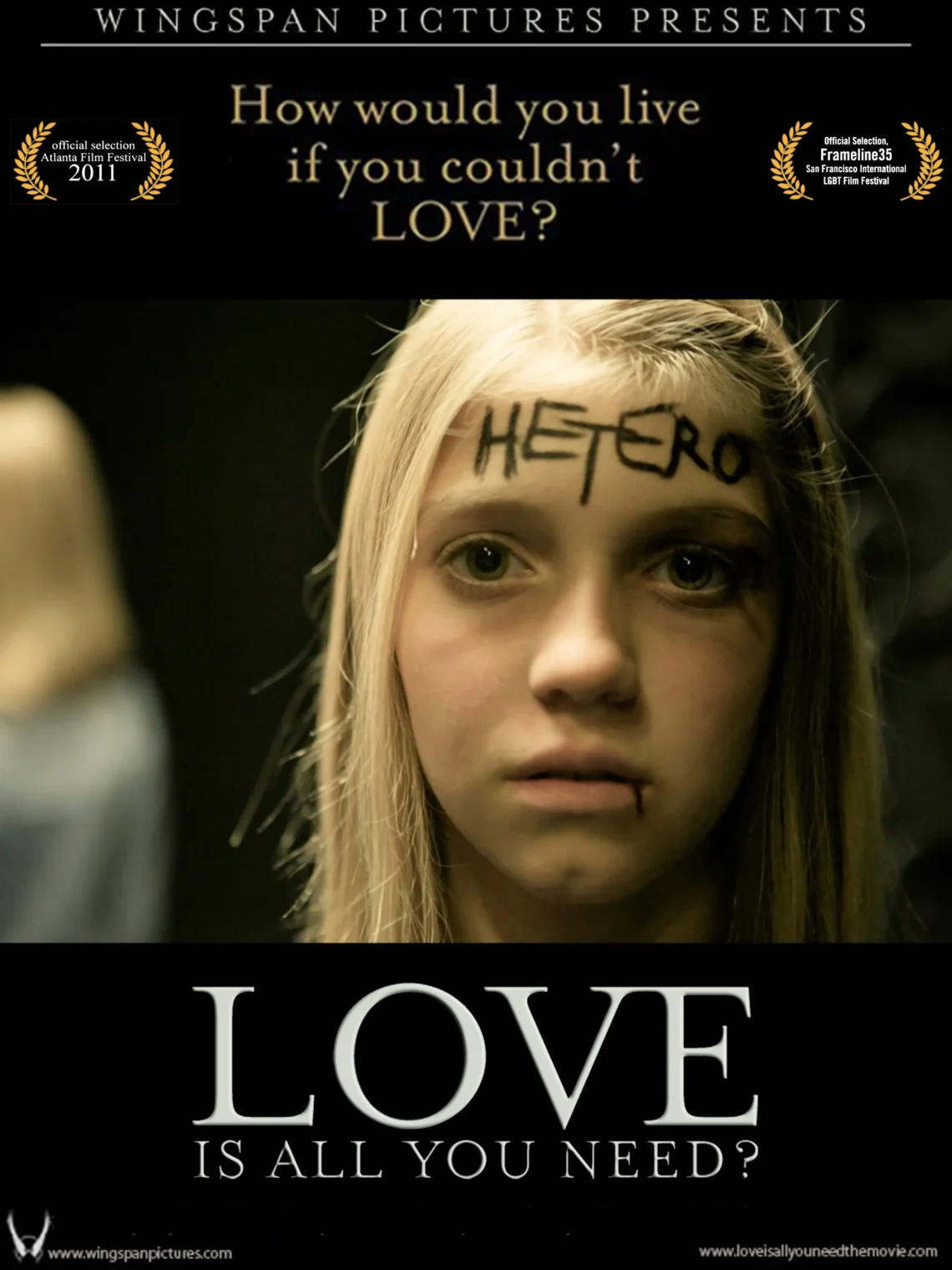
Love Is All You Need? (2016) – A World Where Heterosexuality is a Crime: The Structure of Hatred and Relations Exposed by a Mirror-Image Society
Isolation and deficiency always germinate outside the standardized frameworks constructed by the majority.
If the central axis of the world we have taken for granted were to tilt by a mere 180 degrees, could we truly survive as fully autonomous subjects?
The film Love Is All You Need? ruthlessly and exquisitely upends the boundary between the normal and the abnormal, serving as a powerful text that mirrors humanity’s fundamental desire for solidarity alongside the true nature of hatred.
🌿 The Moments This Film Deeply Permeates
- Facing the terror of a clandestine gaze directed at only one person, hidden behind warning lights that seem entirely unshakeable.
- Witnessing how a conviction named “justice,” proclaimed by the majority, crushes individual dignity in the most rationalized manner.
- Tracing the chilling trajectory of bystanders who remain silent in the face of others’ suffering, ultimately complicit as perpetrators in their own world.
- Why You Must Read to the End: This film is not a simple romance set in a fictional universe; it is a sociological manual that completely deconstructs and reconfigures the core of power structures and relationships within the reality we currently occupy.
🎞 Note Before Watching
This work explicitly depicts the social persecution and psychological violence endured by heterosexuality within a worldview where homosexuality is the mainstream norm. While the relationship-driven emotional line forms the backbone of the narrative, caution is advised as it includes highly conflictual depictions of collective bullying and social exclusion capable of inducing emotional distress.
🎬 Film Information
- Title: Love Is All You Need? (2016)
- Director: Kim Rocco Shields
- Screenplay: Kim Rocco Shields, Johnny Remo
- Country: USA
- Genre: Drama, Dramatic Suspense
- Runtime: 121 minutes
- Platform: Prime Video, Apple TV
- Cast: Briana Evigan, Tyler Blackburn, Kyla Kenedy, Ana Ortiz
📖 Forbidden Attraction and the Crusade of Hatred: The Prelude to an Inverted World [No Spoilers]
Jude Klein, a star quarterback for a local university football team living a life of perfect normalcy demanded by society, is caught in an unexpected emotional vortex upon meeting Ryan Morris, a sports journalism major. In this world where homosexuality stands as the absolute mainstream and moral standard, the heterosexual attraction they experience is a fatal taboo, representing social ruin by its very existence.
While maintaining a clandestine relationship that must remain hidden from everyone, their romance faces an abrupt outing due to the suspicions and eyewitness accounts of surrounding individuals. As their relationship comes to light, the small college town is engulfed in immense shock and fury. A prominent local religious leader defines the affair as the collapse of family and a social evil, initiating a massive social crusade against heterosexuals.
Amidst verbal abuse and violent marginalization fueled by media and church incitement, the film weaves a brutal parallel narrative of an 11-year-old girl stigmatized at school for experiencing her first heterosexual crush, driving the characters toward a massive catastrophe.
⚖️ The Mirror Image of Power Structures Exposed: The Hypocrisy of Mainstream Society
The structural core of Love Is All You Need? does not merely rest on the novelty of its inverted premise, but rather in unmasking how the power of normalcy is constructed. The status Jude enjoyed as a football star was a conditional power, valid only as long as she remained within the socially sanctioned homosexual framework.
The film meticulously tracks the process through which the mainstream group institutionalizes verbal and systemic violence to safeguard their vested interests. The agitation by religious leaders and the distortions of the media precisely align with the mechanisms of minority discrimination in the real world. Through this, the audience realizes that the positions of perpetrator and victim can be reversed at any moment, depending solely on the majority status of numbers and the direction of power.
💔 The Mise-en-scène of Oppression and the Timeline of Internalized Fear
Director Kim Rocco Shields effectively conveys the isolation felt by the characters through visual composition. The spaces where Jude and Ryan meet are consistently confined to closed or dark, hidden environments, which visualizes the social pressure exerted upon them through the frame itself.
In particular, the process by which the open space of the university campus instantly transforms into a massive prison and surveillance ground following the outing runs parallel to the psychological collapse of the characters. The terror experienced by the individual in front of collective violence delivers a palpable sense of suffocation beyond the screen, highlighting the weight of oppression over the beauty of the relationship.
🔎 Reinterpreting the Ending: Complete Fracture and the Loss of Dignity Left by Catastrophe
The ending of the film mocks the conventional plot of “love conquers all,” halting as it demonstrates how collective madness and prejudice utterly pulverize the individual soul. The union of Jude and Ryan concludes not in complete integration, but in an irreparable, eternal fracture in the face of the violence of the religious and social crusade. What the protagonists gain amidst the catastrophe is a painful awareness of the world’s cruelty, while what they lose is the secure ground to love safely and their fundamental trust in humanity.
Going beyond a simple tragic love story, this conclusion chillingly proves how narrow the space is for an individual to resist once institutionalized hatred begins to operate. The film leaves a deep resonance, prompting the audience to imagine the shattered interiority and the life as an outcast that the survivors must face even after the credits roll.
The conclusion of this film is not a record of solidarity where minority love triumphs, but a field report of structural homicide engineered by the silence and instigation of the majority.
💬 Interpretation of the Direct Worldview and Modern Representation
Q1. How should we interpret the criticism that the “mirror-image setting,” which directly reverses real-world discrimination, is somewhat aggressive and didactic?
It is entirely valid that some audiences and critics point out that the setting is overly direct and that the dialogue or depictions of violence are exaggerated. Escaping direct metaphors and symbols to deliver real-world hate speech verbatim, merely substituting the terms, can act as an element that reduces aesthetic sophistication.
However, this direct approach is also the core framework of the shock therapy intended by the director. By forcing the majority group to confront the verbal and physical harm they usually inflict without thought as their exact mirror image, it functions as a humanistic device that intuitively registers the weight of discrimination previously ignored. Therefore, this is more appropriately interpreted as an intentional choice to convey the urgency of the message rather than a lack of aesthetic refinement.
Q2. What functional role does the tragedy of the 11-year-old girl perform within the overall narrative of the multi-stranded plot?
While Jude and Ryan’s college romance deals with the choices and resistance of adult subjects, the parallel narrative of the 11-year-old girl is a structural device showing how social prejudice is inherited by the most vulnerable entities through the system.
The image of a child stigmatized while being forced into “normalcy” within the space of a school proves that hatred is not merely a political and religious debate among adults, but a toxin that destroys the soul during childhood. This multi-stranded narrative simultaneously imparts dimensionality to Jude’s conflict and multi-layered depth to the cruelty of the entire worldview. Which of these two generations’ tragedies do you, the readers, believe lies closer to the true nature of structural violence?
✨ Love Is All You Need?: A Chilling Question Posed to Us from the World Behind the Mirror
The catastrophe shown in this film is not simply a story of a fictional city on a screen, but precisely intersects with the chronic identity politics of modern society, which seeks to validate its own normalcy by excluding the Other. By inverting the positions of heterosexuality and homosexuality, the film structurally demonstrates how fragile the sandcastle of all social morals and norms we blindly believe in truly is. Moving beyond mere appreciation, this work asks what attitude we must adopt to cause a fracture in the system of hatred.
When the majority monopolizes justice, the love of the minority is always the first to be found guilty.
⚖️ Between Silent Bystanding and Complicity, Where Lies Your Choice?
When those closest to you are swept away by the hatred of the majority, is remaining silent a lesser evil for safety, or is it acquiescence toward perpetration? If you were the sole friend who discovered the secret of the two individuals in this inverted world, would you choose silence to protect your own safety, or would you choose solidarity where ruin is foretold? Please share your thoughts in the comments.
🎞 Violet Screen Curation: Another Perspective Piercing the Essence of Relationships
If you have experienced the inversion of gaze, we recommend two female-centered narrative works that trace the microscopic textures of emotion and cause internal ripples. These are hidden masterpieces that break away from the grammar of mainstream platforms to leave a deep afterimage.
- Blue Is the Warmest Color (2013)
- Reason for Recommendation: A masterpiece that intensely explores the essence of love through the profound emotional trajectories of two women and aesthetic mise-en-scène, illustrating how one person’s world expands and collapses upon meeting another’s.
- Blue Jean (2022)
- Reason for Recommendation: Set in the UK during the 1980s under the Thatcher government, when the homophobic “Section 28” clause was enacted. It portrays the internal conflict and social pressure of Jean, a physical education teacher who must hide her identity, in an extremely restrained tone, addressing the issue of social stigma raised by Love Is All You Need? through an entirely opposite, precise aesthetic.
To provide a more stable publishing environment, multilingual content, and better communication with our readers, we have moved our official publication to Substack.
All new film reviews and critical essays will be published on our new platform. This website will be closing down soon, so we would greatly appreciate it if you subscribed to our new space.
TODAY'S QUESTION
If you could say one thing to someone today, what would it be?
Your answer isn't saved. Feel free to share it in the comments below.


You May Also Like

Nothing Like the Sun: The Violence of Salvation, the Temperature of Truth Blossoming at Its End

Loving Highsmith 2022: A Record of Desire and a Deep Interpretation of an Isolated Soul
