The Wedding Banquet 2025 Interpretation: Reconstructing Desire and Solidarity Through Chosen Family
The process by which isolated individuals encounter others to form a collective “us” always entails a fierce struggle. We dream of safety within the vast yoke of blood ties, yet sometimes those very fences become the sharpest thorns, piercing the heart.
Director Andrew Ahn’s The Wedding Banquet (2025) is a record—at once tender and chilling—of dismantling those thorny fences to build a new “Home” with those one has chosen. This work does not merely remain confined within the generic framework of queer cinema; it tenaciously tracks a portrait of modern individuals using deficiency as a propellant to reach the destination of solidarity.
🌿 Moments When This Film Deeply Permeates
- For those who wish to build a home with a loved one but have felt a sense of helplessness before the realities of capital and institutions.
- For those who have experienced swallowing their own truth hidden beneath the “pleasant pressure” of parental expectations.
- For those contemplating what form of community might save us following the dissolution of the traditional family.
- The reason you must read to the end: This review anatomizes the structural necessity of the “chosen family” hidden behind the commotion of a fake marriage and the subversive hope offered by the ending through a humanistic lens.
🎞 Note Before Viewing
This work deals with the realistic conflicts surrounding the daily lives and pregnancies of same-sex couples and includes a certain level of adult depiction in physical contact and verbal expression. However, these are not devices for provocation; they function as essential narrative tools that prove the deep bonds and emotional fissures between the two couples.
🎬 Film Information
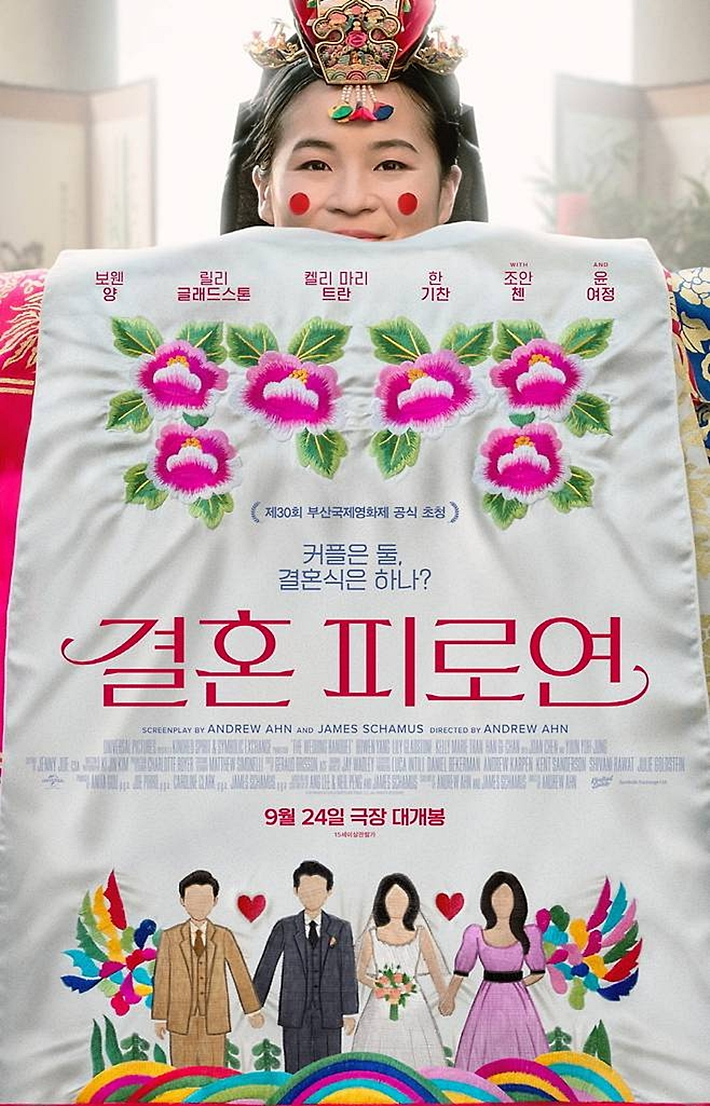
- Title: The Wedding Banquet (2025)
- Director: Andrew Ahn
- Screenplay: Andrew Ahn (Based on a story by James Schamus, Ang Lee, Neil Peng)
- Original Work: The film The Wedding Banquet (1993, Dir. Ang Lee)
- Country: USA
- Genre: Drama, Comedy, Romance
- Running Time: 1 hour 43 minutes
- Platform: Scheduled for theatrical release and major OTT services
- Cast: Lily Gladstone, Kelly Marie Tran, Bowen Yang, Han Gi-chan, Youn Yuh-jung, Joan Chen
📖 The Wedding Banquet: Real Conflict and Choice Blooming Beneath a Fake Ceremony [No Spoilers]
On a single property in Seattle, lesbian couple Lee (Lily Gladstone) and Angela (Kelly Marie Tran) living in the main house, and gay couple Chris (Bowen Yang) and Min (Han Gi-chan) living in the detached garage, constitute a perfect community fully sharing each other’s identities. Lee and Angela desperately want a child and prepare for their third round of in-vitro fertilization (IVF), but the exorbitant costs and repeated failures gradually erode their relationship.
Meanwhile, Min, the grandson of a Korean chaebol family, is caught between the practical crisis of visa expiration and pressure from his grandmother, Jayoung (Youn Yuh-jung), who demands he succeed the family business. Their desperation eventually leads to an extreme agreement: Min and Angela will enter a fake marriage so Min can obtain permanent residency, while Lee and Angela receive full funding for IVF from Min.
The plan, which they thought would end as a simple paperwork procedure, turns into a massive storm when Grandmother Jayoung makes a sudden entry into the United States. As a grand traditional Korean wedding and “wedding banquet” are prepared under her lead, the four individuals plunge into a bizarre play where they must act as the spouses of others in front of their own lovers.
🎎 A Variation on 1993: Andrew Ahn’s Reconstructed Queer Survival Strategy
If Ang Lee’s original film focused on the clash between “family face” and “individual identity,” the 2025 The Wedding Banquet shifts its center of gravity toward economic survival and reproductive rights. For Lee and Angela, a child is not a mere desire but an existential struggle to extend their existence into the future.
Through the process of merging “Capital (Min)” and the “Womb (Angela),” Director Andrew Ahn sharply captures the opportunity cost minorities must pay to constitute a family in modern society. The comedy arising from this process invites laughter, yet beneath it lies the desperate struggle of those standing outside the system to force their way in.
🤱 Angela and Lee: Fissures and Unity Wrought by the Conviction of Pregnancy
The most densely explored point within the work is Angela’s psychological transformation. While Lee attempts to prove the completeness of the relationship through pregnancy, Angela feels suffocated by the weight of the fixed role of “mother.” In particular, the “enthusiastic support” shown by Angela’s mother, Mae (Joan Chen), acts instead as another form of heteronormative compulsion for Angela.
Angela’s confession that she is “afraid of becoming a mother” invites isolation within her relationship with Lee. However, through an unexpected accident and successful pregnancy, they come to accept parenthood based on “will and coincidence” rather than “blood.” This is a superb interpretation of how motherhood can be newly defined within a narrative between women.
🍵 Grandmother Jayoung’s Gaze: The Aesthetics of Silent Love
Jayoung, played by Youn Yuh-jung, is the most powerful plot twist and savior of this drama. She already knew Min’s identity and is depicted as a pioneering figure who sent him to America to protect him. The lavish banquet she leads is not a deceptive play, but an act of drawing a “splendid curtain” under which her minority grandson can safely hide from the eyes of the world.
Jayoung uses the tool of tradition to embrace subversion. Her silence is not bystanderism, but the most active form of affirmation, suggesting that reconciliation between generations does not necessarily occur only through a “complete confession.”
🔎 Reinterpretation of the Ending — A Utopia of ‘Main House and Garage’ Built Upon Fissures
The film concludes by showing the four individuals living together and co-parenting on a single property. This is a clear rejection of the traditional patriarchal nuclear family model and a victory for the “Chosen Family.”
Angela’s pregnancy is not a simple coincidence, but a miraculous mutation created as the play that began as a lie permeated into real life. Despite witnessing each other’s flaws and feeling disillusionment, the two couples who were on the verge of breaking up eventually reunite, sharing the fragile truth that one cannot survive alone.
They now become a community of destiny as “sharers of secrets and love,” a bond thicker than blood. Though the banquet hall at the end is empty, the house where they live is filled with the cries of children, declaring that a queer future is by no means sterile.
🏮 Issues in The Wedding Banquet and Ending Interpretation
Q1. Isn’t the one-night stand between Angela and Chris and the resulting pregnancy a narrative convenience?
This is certainly a point where opinions may diverge. In queer narratives, a structure where an incidental heterosexual relationship becomes the key to conflict and resolution risks blurring the essence of identity. However, the work clearly defines this not as “love,” but as “wandering fueled by loss and intoxication.” From a critical perspective, it may feel like an excessive narrative leap, but aesthetically, it is interpreted as a device to emphasize the paradox that a true “new family” can only be born upon the ruins where all plans have collapsed.
Q2. What is the significance of the setting where Grandmother Jayoung knew everything?
This demonstrates the point of compromise between “filial piety” and “self-determination” within Korean sentiment. The grandmother acknowledges Min’s true self while simultaneously performing the practical constraint of maintaining the family order. This duality emphasizes how sophisticated the “pretending not to know” and “acting” must be for a minority to keep their place within a family, reminding us that in modern society, issues of possession and survival are as important as identity.
✨ The Wedding Banquet: When the Name We Choose Becomes Family
This film shows that family is not something one is born into, but something one creates, and that the process necessarily entails someone’s sacrifice, love, and a great deal of inclusion. Andrew Ahn brings the question Ang Lee posed 30 years ago to modern-day Seattle, writing a new form of survival report where capitalism and queer lifestyles intersect.
The true completion of a family stems not from the matching of blood, but from a social consensus to willingly fill each other’s deficiencies.
💭 Family or Strangers? Our Tender Cooperation to End Isolation
All interference conducted under the name of family sometimes becomes violence, but the isolation that remains once even that interference disappears withers us away. Are you bound to the person beside you by blood, or by a silent promise to protect each other’s secrets?
Is your ideal community a “relationship where all truth is told,” or a “relationship where one willingly deceives for the sake of each other’s peace”?
📺 Violet Screen Curation: Other Forms of “Us”
- Affinity (2008): The fatal bond and betrayal of two women blooming within the extreme isolation of a prison. It deeply explores the power dynamics of relationships.
- Shiva Baby (2020): A dense independent film that unpacks female desire, lies, and the confusion of identity occurring within the closed space of a funeral in the form of a black comedy.
To provide a more stable publishing environment, multilingual content, and better communication with our readers, we have moved our official publication to Substack.
All new film reviews and critical essays will be published on our new platform. This website will be closing down soon, so we would greatly appreciate it if you subscribed to our new space.
TODAY'S QUESTION
Which film feels like your 'first love' story?
Your answer isn't saved. Feel free to share it in the comments below.


You May Also Like

Intimates (1997): An Interpretation of the Salvific Ending Reached by Female Solidarity and Queer Narrative

Kyss Mig (2011): On the Transparent Truth Encountered at the Threshold of Desire