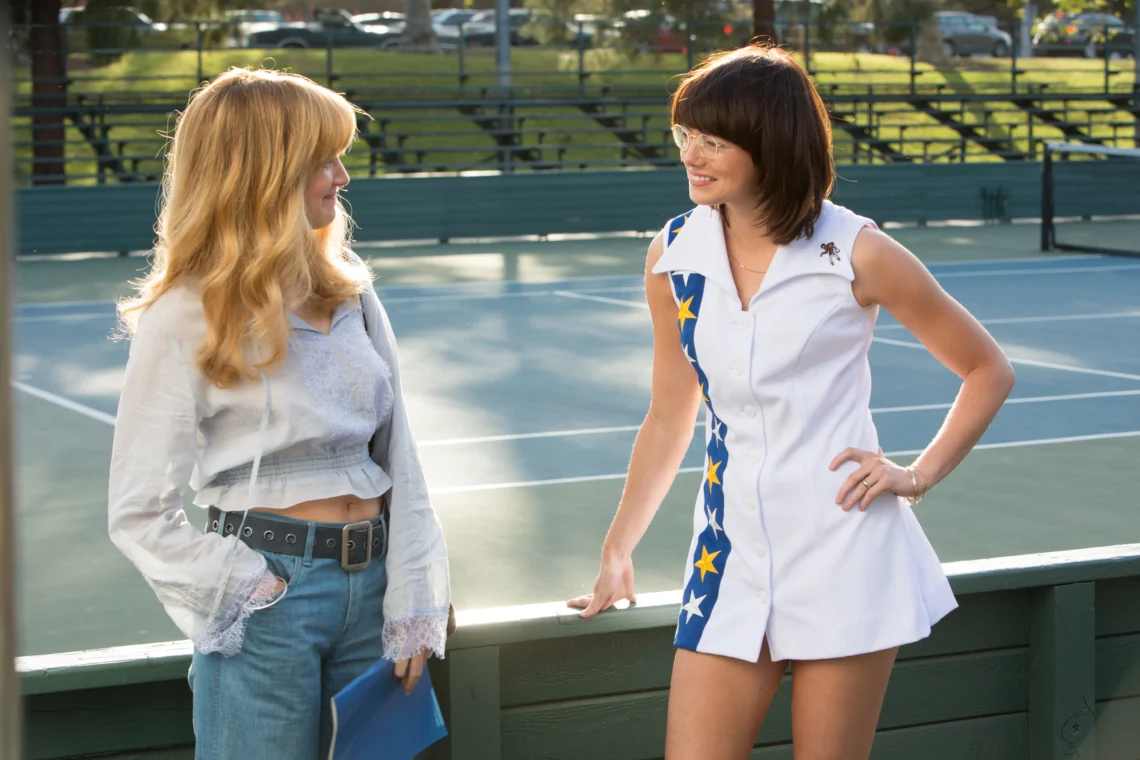
Battle of the Sexes: A Silent Revolution and the Search for Identity Beyond the Court
The world sometimes resembles a vast arena. We are expected to move only within the white lines drawn by others, proving our worth through victory or defeat according to fixed rules. Yet, some triumphs are never recorded on a scoreboard.
The isolation of a woman who bore the weight of the world’s expectations while hiding her true face, and the unfamiliar warmth that shattered that isolation—this film is not merely a sports movie about hitting a ball back and forth. It is a poignant record of the process of breaking out of the frames that confine us to become the master of one’s own court.
🌿 Moments when Battle of the Sexes sinks in deeply
- When you wish to reject the value defined by others and prove your own place.
- When you confront the solitary truth of an individual hidden beneath the glamorous veneer of social achievement.
- When you wish to witness the small but intense spark of solidarity discovered within an oppressive system.
- The reason to read this article to the end: To understand the historical significance and the true weight of the ending, found in the tears Billie Jean King sheds alone in the locker room after the cheers of victory have faded.
🎞 Note before viewing
This work realistically portrays the conservative social milieu and gender discrimination of the 1970s sports world, delicately handling the characters’ emotional arcs and identity struggles. It is a drama that focuses on emotional density and the shifting balance of relationships rather than physical exposure.
🎬 Film Information
- Title: Battle of the Sexes (2017)
- Director: Jonathan Dayton, Valerie Faris
- Screenplay: Simon Beaufoy
- Country: USA, UK
- Genre: Drama, Comedy, Sport
- Running Time: 121 minutes
- Platform: Disney+, YouTube Movies
- Cast: Emma Stone, Steve Carell, Andrea Riseborough, Sarah Silverman
📖 Battle of the Sexes Summary: A Racket Against Discrimination and the Trajectory of Hidden Love [No Spoilers]
Billie Jean King, having conquered the world of tennis, rebels against the blatant prize money disparity for female players and establishes the independent Women’s Tennis Association (WTA). The moment she declares war against the system, Bobby Riggs—a retired former champion and gambler—appears.
With provocative remarks such as “Women belong in the kitchen, not on the court,” Bobby proposes a “Battle of the Sexes” with hundreds of thousands of dollars in prize money at stake. Billie Jean initially refuses, but as the livelihoods of her colleagues and the social status of women are threatened, she eventually grips her racket once more.
While a massive spectacle draws the world’s attention, Billie Jean meets hair stylist Marilyn and experiences an emotional upheaval she has never felt before. Her conflict between public victory and private identity deepens until she finally steps onto the court of destiny.
🎾 A Modern Interpretation of a Female Narrative Tearing Through the Court of Oppression
While Battle of the Sexes is based on the actual events of 1973, its direction maintains a thoroughly progressive perspective of the post-2010s era. In particular, the way it handles Billie Jean King’s interiority cleverly deviates from the archetypal “hero narrative” of conventional sports films.
Within the work, the tennis court serves as the only permitted outlet for women, yet it is simultaneously a prison subordinate to a prize system created by the male power structure. The hair salon where Billie Jean meets Marilyn stands as the antithesis to this prison.
The process of facing oneself in the mirror and awakening one’s senses through the touch of another is as revolutionary as the powerful smashes Billie Jean unleashes on the court. From the perspective of a review, this film emphasizes that social struggle and the establishment of personal identity can never be separated.
✂️ Mise-en-scène and Symbolism: The Haircut as a Prelude to the Ending
Throughout the work, the camera captures the characters’ faces in tight shots, expressing psychological pressure. The most striking symbol is the scene where Billie Jean has her hair trimmed.
Choosing to maintain short, active, and autonomous hair instead of the long hair that symbolizes tamed social femininity is a declaration of her refusal to compromise with the world. The tension that arises when Marilyn touches her hair functions as a ritual of affirming her essence, which had been considered taboo, moving beyond mere attraction.
This interpretation explains the source of the overwhelming concentration she demonstrates in the latter half of the match against Bobby Riggs. She does not hit the ball simply to defeat a man, but to preserve all the pieces of herself intact.
🔎 Reinterpretation of the Ending — A Solitary Declaration Left Behind the Cheers of Victory
The ending of the film superficially concludes with Billie Jean King’s overwhelming victory. Her image, crossing the court amidst the cheers of women after defeating Bobby Riggs, is radiant. However, instead of a victory parade, the film captures Billie Jean from behind, sitting alone in a corner of the locker room, sobbing.
These tears are not of relief, but a realization of how harshly she had to push herself to seize this victory, and how much longer the struggle must continue. Victory is sweet, but by her side remain a lover whose identity must still be hidden and a husband who supports but does not fully understand her.
In her life after the conclusion, Billie Jean becomes a hero to the public, yet her freedom as an individual is deferred. At this point, the film illuminates the “cost of silence” that had to be paid to sustain the glory of victory rather than the glory itself.
While Billie Jean King’s victory was an event that cracked the system beyond personal advancement, an unfilled abyss of identity still exists within her.
🧐 Deep FAQ on the Ending and Historical Representation of Battle of the Sexes
Q. How do you view the criticism that the character of Bobby Riggs was portrayed too caricatured or sympathetically?
The work portrays Bobby Riggs not as a simple villain, but as a multi-dimensional character lost in gambling addiction and a need for display. This serves as a device to show that the system of patriarchy also destroys individual men by forcing upon them the illusion of the “strong male.” By allowing Bobby to acknowledge his limits rather than depicting his defeat as miserable, the film reaches an aesthetic conclusion that it is a victory for “historical justice” rather than a battle between man and woman.
Q. Some argue that the relationship with Marilyn was overemphasized, blurring the cinematic essence of the actual history.
On the contrary, this relationship is the very essence of the film. Had the narrative with Marilyn been omitted, the work would have remained a mediocre biographical film. The pressure Billie Jean felt to hide her sexual identity shares the same roots as the social discrimination she faced on the court. By showing the process in which a private secret becomes the engine for public courage, the work completes the thesis that “the personal is the most political.”
✨ Battle of the Sexes: A Single Stroke That Shattered the Barriers of an Era
This film summons records of the past to pose questions to us in the present. It reminds us not to forget that the rights we naturally enjoy were built upon someone’s solitary tears and desperate struggles. The work proves that the essence of a relationship is not about possessing one another, but about a solidarity that helps each person live as their whole self.
It is not merely a gratifying sports story of a woman defeating a man. It is a story about the sacred labor of a human being who threw her entire life into proving her existence.
True victory is not completed by the numbers on a scoreboard, but in the silence of the moment when one finally comes to love the self in the mirror.
📢 The Moment You Rejected the World’s Frame and Wrote Your Own Score
Faced with the solid wall of the world’s prejudice, are you the type to collide head-on like Billie Jean, or the type to wait for your time while cultivating your own secret forest?
Please tell us about the most courageous “racket moment” you have swung in your life to protect your true self.
🎬 Violet Screen Curation: Other Journeys Seeking Female Solidarity and Self
- Tell It to the Bees (2018): Set in 1950s Scotland, this work depicts the lyrical and firm solidarity of two women who foster a forbidden love while healing each other’s wounds in a closed-off village.
- Summerland (2020): A magical healing drama where Alice, a writer living in isolation during World War II, takes in a young evacuee, reconstructs memories of her past lover Vera, and recovers the warmth of life.
To provide a more stable publishing environment, multilingual content, and better communication with our readers, we have moved our official publication to Substack.
All new film reviews and critical essays will be published on our new platform. This website will be closing down soon, so we would greatly appreciate it if you subscribed to our new space.
TODAY'S QUESTION
What's the most memorable new release you watched this year?
Your answer isn't saved. Feel free to share it in the comments below.


You May Also Like
I, Olga Hepnarová (2016) — A Massacre Become a Silent Scream, A Chilling Record Gazing into the Abyss of Alienation

Stupid Wife (2022): Intense Desire and the Reconstruction of a Relationship Born from Memory Loss