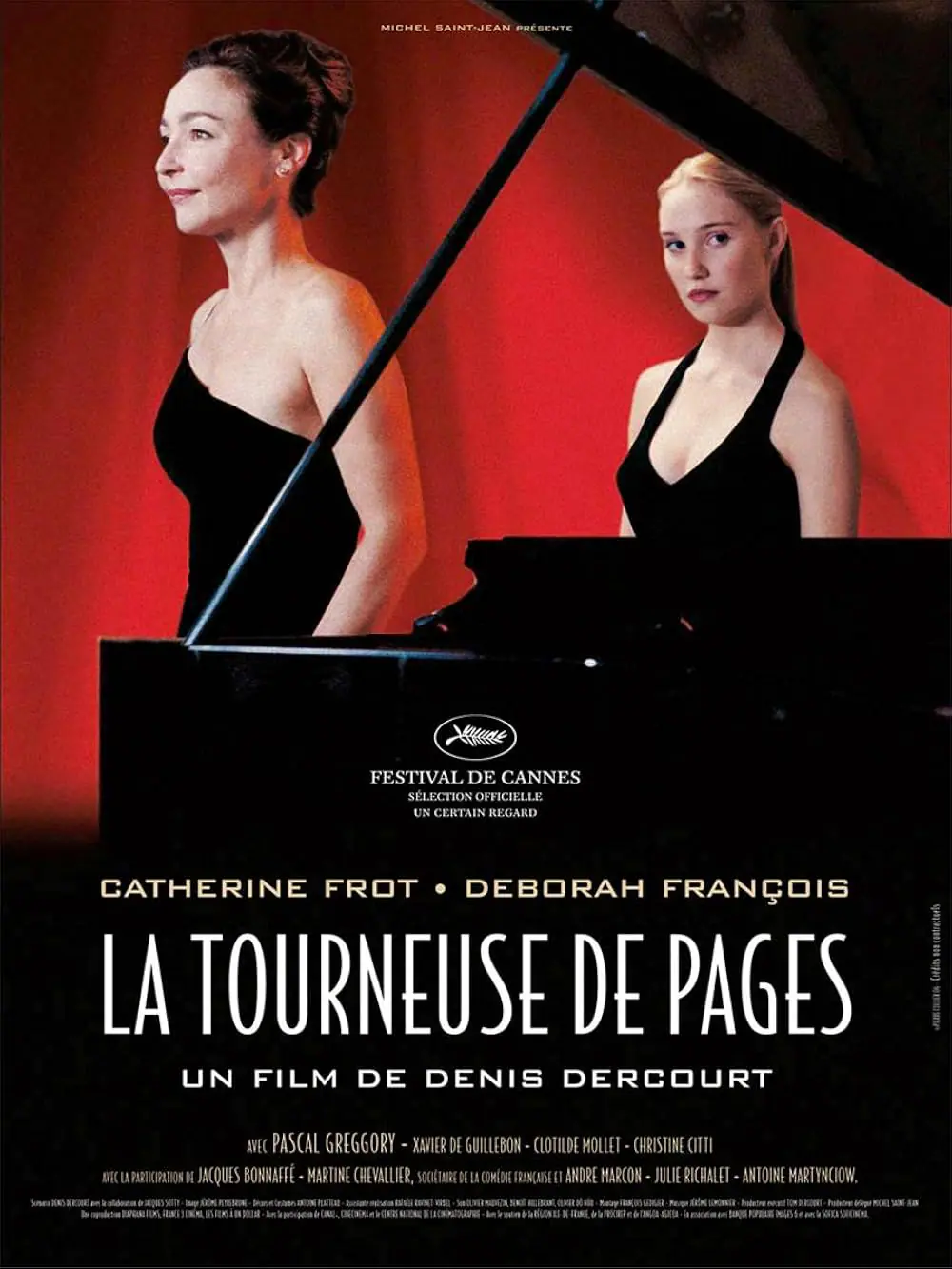
The Refined Melody of Revenge Born from Denied Existence: 《The Page Turner》
A memory of having one’s existence denied does not simply vanish; it stagnates in the corners of the soul, turning into poison. An act that was a moment of indifference for one person can become the collapse of the world that sustained another. The 2006 film La tourneuse de pages (The Page Turner) is an elegant yet chilling record of a revenge that germinated within the cracks of such a collapse.
This film does not explode with loud fury. Instead, it forces an overwhelming tension into the silence above the keyboard and the minute tremors of fingers turning a score. The fact that the process of gracefully destroying another’s life can be so refined compels us to peer into the abyss of human obsession.
🌿 Moments where this film resonates deeply:
- For those living with a sense of debt, feeling that another’s minor rudeness stifled their potential.
- For those who enjoy a cold psychological tension hidden behind elegant classical melodies.
- For those who desire an intellectual revenge drama where one slowly intoxicates the opponent behind a mask of kindness.
The reason to read until the end is to analyze the catharsis of “power reversal”—where the perpetrator becomes emotionally subordinate to the victim—beyond the simple thrills of a revenge plot.
🎞 Notes before viewing
Rather than physical violence or provocative gore, this work is a psychological thriller that builds suffocating suspense solely through the gaze between characters and the flow of the atmosphere. It is noted that the subtle tension and emotional indulgence between two women are the core engines of the drama.
🎬 Film Information
- Title: La tourneuse de pages (The Page Turner, 2006)
- Director: Denis Dercourt
- Screenplay: Denis Dercourt
- Country: France
- Genre: Psychological Thriller, Drama
- Runtime: 83 minutes
- Platforms: Naver Series On, Google Movies, etc.
- Cast: Déborah François, Catherine Frot, Pascal Greggory
📖 La tourneuse de pages: An Exquisite Melody of Revenge Crafted by Ten Years of Silence [No Spoilers]
As a child, Mélanie, who showed prodigious talent for the piano, ruins her performance at the National Conservatory entrance exam and abandons her dreams due to the indifferent attitude of Ariane, a jury member. Ten years later, Mélanie, now an intern at a law firm, successfully enters the mansion of Ariane’s husband, Jean, as a babysitter under the guise of coincidence.
The key to interpreting La tourneuse de pages lies in the “imbalance of the gaze.” When she reappears as a babysitter a decade later, Ariane does not recognize her at all. In that gap of time—where the perpetrator forgets and the victim preserves the moment—the relationship is already prepared to swap the positions of predator and prey.
Ariane has been suffering from stage fright and heightened sensitivity following a past car accident, and Mélanie gains her trust by performing the role of the “page turner,” perfectly flipping the scores by her side. As Ariane becomes increasingly emotionally dependent on and fascinated by Mélanie’s quiet presence, the trap of ruin designed by Mélanie begins to slowly tighten around Ariane’s music, her family, and her soul.
🎹 The Right Helper at the Right Time: The Art of Silence Dominating Space and Psychology
From the moment she steps into the Fouchécourt family mansion, Mélanie chooses to erase herself and become the very air of the space. Her revenge does not begin with a loud strike, but by meticulously filling the parts the family needs most.
She reads Ariane’s thirst first but never smiles first. This peculiar expressionlessness paradoxically provides a sense of stability to the performer suffering from anxiety.
The symbol of the “page turner” here is highly polysemic. The presence that breathes and assists from the closest proximity to the performer is, in fact, an act of acquiring the control to hold and shake the performer’s professional life. Mélanie disguises her existence as a perfect “tool,” thereby subordinating Ariane’s survival to herself.
🫧 The Aesthetics of Cold Isolation Perfected by Mise-en-scène and Music
Director Denis Dercourt, true to his background as a musician, maximizes the tension of the performance scenes. The camera focuses on the backs of characters’ hands, their gazes, and the texture of the turning scores rather than a flashy concert hall. Mélanie’s neat attire and unfaltering posture visualize the solid vengefulness lurking within her, contrasting with the precariousness of Ariane’s lavish space.
The way Mélanie absorbs the other’s emotions as she encroaches upon Ariane’s son, husband, and her musical ego is akin to a form of psychological vampirism. This is an exquisite psychological mise-en-scène showing the process of an isolated individual infiltrating another’s world and shaking its foundations.
In this relationship, Mélanie occupies the position of a passive seducer. Without a single warm word, she incites Ariane’s thirst through silence and precise execution alone. As Ariane feels love for and relies on Mélanie, Mélanie absorbs that energy to fuel her revenge; the affectionate postcard Ariane hands her becomes merely the final puzzle piece to complete that vengeance.
🔎 Reinterpreting the Ending — An Eternal Crack Left Upon a Lost Score
Mélanie’s revenge is completed on the day of Ariane’s comeback concert by vanishing without any notice. This is not a simple departure, but an act of pulling out the sole pillar supporting Ariane’s world. By leaving the affectionate postcard Ariane gave her on the husband’s desk, Mélanie exposes Ariane’s secret desire and collapses even the fence of her family.
After the conclusion, Ariane’s life can never be the same. She has now lost the opportunity to overcome her stage fright forever and has had her “incompetence” revealed to the world—a fact even more terrible than being betrayed by the one she trusted entirely. At the moment her revenge is complete, Mélanie leaves the scene without lingering, leaving an irreparable, eternal crack in Ariane.
Mélanie’s revenge is not a plea for an apology from the perpetrator, but a period that concludes her own past by tearing down the perpetrator’s world.
🎭 Interpretations of Narrative and Female Representation in La tourneuse de pages
Q. Can Mélanie’s actions truly be viewed as a justified revenge?
While it is true that Ariane’s rudeness changed Mélanie’s life in the initial setup, the meticulous sabotage Mélanie carries out ten years later may strike some viewers as excessive. However, the film focuses on the cold law of cause and effect rather than a moral yardstick. It demonstrates that a small indifference the perpetrator cannot even remember can become a lifelong resentment for someone else, weighing the inevitability of revenge over its justification.
Q. How should the homoerotic undertone between the two protagonists be interpreted?
The emotions Ariane feels for Mélanie go beyond trust in an assistant and involve physical and emotional attraction. Mélanie utilizes this as a tool for revenge. While this follows a typical narrative of seduction and betrayal, it is depicted as a strategic choice for power reversal rather than seduction from a male-centric perspective. Rather than defining their relationship, the work emphasizes the precariousness hidden within its ambiguity, leaving the judgment to the audience.
✨ The Page Turner: The Most Elegant Funeral March Dedicated to an Indifferent Perpetrator
This film warns of what kind of monster is created by the “trivial rudeness” often committed by those with power in modern society. The price of reducing another to a mere background while standing in a position of superior class and talent eventually returns as the loss of one’s most precious things.
We may become an unexpected “page turner” in someone’s life, or sometimes the protagonist on the stage. However, what is clear is that the price of treating another’s desperation lightly must eventually be paid.
Trivial arrogance becomes a trigger that twists another’s life, and its recoil inevitably aims for the heart of the one who fired.
💬 Sharp Intent Hidden in Silence
If someone indifferently trampled on your most desperate moment, would you choose an “elegant revenge” that takes ten years to destroy that person’s most precious things, or would you use that anger as fuel to save yourself through a completely new life?
📽 Violet Screen Curation: The Aesthetics of Twisted Attachment and Revenge
- The Handmaiden (2016): A strange solidarity and revenge blossoming within a relationship of mutual deception. It is more flamboyant than The Page Turner, but its trajectory of psychological tension is aligned.
- Notes on a Scandal (2006): A masterpiece depicting the obsession and ruin of an isolated human who seizes a woman’s weakness and encroaches upon her life.
To provide a more stable publishing environment, multilingual content, and better communication with our readers, we have moved our official publication to Substack.
All new film reviews and critical essays will be published on our new platform. This website will be closing down soon, so we would greatly appreciate it if you subscribed to our new space.
TODAY'S QUESTION
What changed the most for you after coming out?
Your answer isn't saved. Feel free to share it in the comments below.


You May Also Like

Submerge (2016): The Boundary Between Control and Indulgence, an In-Depth Analysis of Youthful Desire’s Cruel Drift

When Time Got Louder: Choosing Yourself Between Love and Care