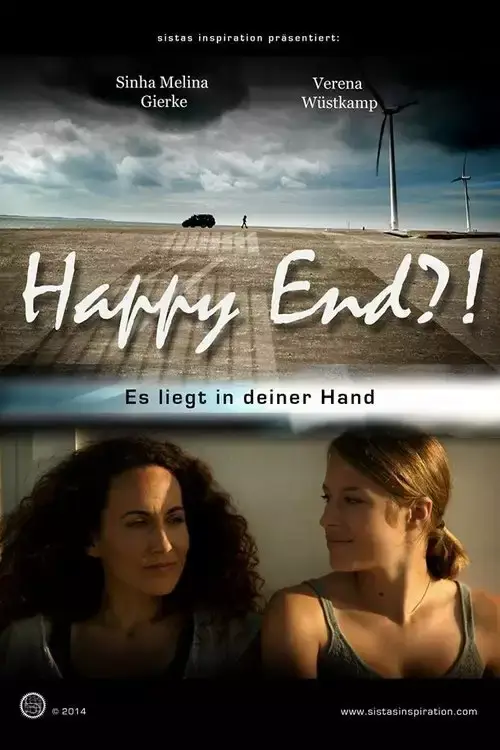
Happy End?! (2014) Review: Departing an Isolated Orbit to Find Life’s Radiant Desire Beside Death
When every destination in life is mapped out by others, do we call it ‘stability’ or ‘incarceration’? When the obsession with self-validation and the fear of failure corrode the soul, destiny sometimes casts the most extreme form of freedom before us.
That freedom often arrives alongside a premonition of loss, asking us: “In the face of a love with no tomorrow, are you finally prepared to live for today?” This film is a record of that agonizing yet brilliant question.
🌿 Moments When This Film Resonates Deeply
- When a perfectly structured future feels suffocating, sparking a desperate urge to flee toward the unknown.
- When you feel the voice of your ‘authentic self’ has been drowned out by the effort to meet the expectations of others.
- When you need the courage to dive into the flames of a relationship, even knowing its end is already written.
The reason to read this analysis to the end is to examine the essence of a narrative where love, blooming upon a tragic premise, redeems a human being and guides them toward autonomous existence.
🎞 Note Before Viewing
This work is a drama that probes the essence of emotion and connection, characterized by high psychological density between characters. Rather than physical contact, it focuses on the resonance of souls and existential angst, calmly depicting a poignant bond that flourishes on the boundary between life and death.
🎬 Movie Information
- Title: Happy End?! (2014)
- Director: Petra Clever
- Screenplay: Petra Clever
- Country: 🇩🇪 Germany
- Genre: Drama, Romance, Queer
- Running Time: 95 minutes
- Platform: Vimeo On Demand, DVD
- Cast: Sinha Melina Gierke (as Lucca), Verena Wüstkamp (as Valerie)
📖 Happy End?! Plot: A Road Trip Where Controlled Routine Collides with Uncontrollable Love [No Spoilers]
Lucca, a model student whose “winner’s future” at Harvard Law is already predestined, suffers an identity crisis under her father’s rigid control. While she appears perfect on the outside, her interior is filled with an unnamed melancholy and a stifling lack of exits. One day, due to a minor accident, Lucca is assigned community service at a hospice facility, where she meets the free-spirited Valerie (hereafter referred to as Val).
Val, who shares her daily life with death by singing in the hospice, represents an entirely unknown world to Lucca. To honor the final wish of her deceased friend Herma, Val plans a reckless journey to steal the funeral urn and head for the Dutch sea. Impulsively, Lucca joins this dangerous escape.
During the cross-border road trip away from her father’s surveillance, the two women feel a powerful attraction. However, as they draw closer to their destination, the chilling truth Val has been hiding slowly begins to surface.
🎡 Mise-en-scène of Stripping Away the Social Mask: Interpreting Relational Symbols in Happy End?!
The sentences recorded on Lucca’s laptop are not mere scribbles; they symbolize the fracture between the social ego and the primordial self. Her confession—”I want to leave a trace, but the floor remains clean”—represents Lucca’s helplessness: a desire to achieve something while simultaneously conforming to the system and failing to create even a single ripple.
Conversely, the hospice where Valerie resides is paradoxically portrayed as the most vibrant space. It is because ‘pretension’ finally dissipates in a place where death is imminent.
The act of the two women stealing the urn is a clear rebellion against the order of the older generation. Specifically, scattering Herma’s ashes in the sea she loved rather than a family plot is an expression of the will to remain a complete individual, rejecting even a ‘posthumous identity’ determined by others. Observing this process, Lucca realizes that her own life must also head toward ‘her own sea’ rather than ‘her father’s cemetery.’
🔎 Reinterpreting the Ending: A Sanctuary of Eternal Freedom Built Upon Mortality
In the latter half of the film, Valerie’s confession that she is terminally ill brings a massive sense of loss to both the audience and Lucca. However, this ending should not be dismissed as a mere sentimental tragedy. Val’s death serves as the most powerful catalyst for life delivered to Lucca. Through her own disappearance, Val personally demonstrates how futile a deferred life—the ‘later’—truly is.
Ultimately, Lucca’s choice to give up Harvard and forge her own path is the result of the total union left behind by her brief love with Valerie. Though Lucca has lost Val, she has succeeded in transplanting Val’s ‘courage to live in the moment’ into her own interior. While physical separation was unavoidable, Valerie’s existential attitude transfers into Lucca’s life, allowing their relationship to acquire a continuity that transcends time and space.
Lucca’s departure is not the wandering of one who has lost a loved one, but an existential leap—generating her own orbit independent of the desires of others.
❓ Happy End?!: On the Ambiguity of the Ending and the Representation of Women’s Narratives
Q1. Does Valerie’s terminal illness follow the typical tragic grammar of queer cinema (Bury Your Gays)?
From a critical perspective, Valerie’s death could be seen as a functional device that sacrifices a queer character to promote the protagonist’s growth. However, this film focuses more on the ‘attitude toward death’ than death itself. Valerie is not a passive victim; she maintains her agency by using even her own death as a means of resisting established authority (the family plot). Therefore, it is more valid to interpret this as an inquiry into the dignity an individual can achieve within a finite life, rather than a simple repetition of tragedy.
Q2. Is Lucca’s decision to give up Harvard at the end a realistically irresponsible choice?
From a traditional perspective of success, it may appear so. However, the film subverts the hierarchy between ‘social success’ and ‘personal truth.’ For Lucca, Harvard was an extension of the prison designed by her father. Her abandonment is not irresponsibility, but an act of fulfilling the highest responsibility toward herself. Through this, the film suggests that the criteria for happiness lie in internal conviction rather than external indicators, leaving the judgment to the viewer.
✨ Happy End?!: A ‘Real’ Story of the Self Beginning Only After Heart-Aching Loss
This film vibrates between the question mark (?) and the exclamation point (!) attached to its title. This punctuation criticizes social conventions regarding ‘happiness.’ It creates a coexistence of doubt (?)—asking if happiness only counts when marriage, success, and eternal companionship are guaranteed—and the conviction (!)—that if one has found the self even amidst loss, that is indeed a happy ending.
The director paradoxically suggests to the audience that true happiness can be the growth accompanied by pain, rejecting the comfort provided by traditional narrative structures.
While the parting with Valerie is a sad conclusion, it is an unparalleled happy ending in that Lucca has finally begun to sing of life in her own voice. We often only begin to light our own path with the glow left behind by someone after they have departed.
Love may flare up briefly and vanish, but upon the wreckage of the past burned away by those flames, a new self that can never return to what it was is bound to stand. A true happy ending is not the absence of pain, but the confrontation with oneself, finally reached by crossing through that pain.
🌊 For your final road trip, will you still head toward a destination set by someone else?
We often live by deferring ‘current’ desires for the sake of ‘later.’ But the moment we realize that tomorrow is not guaranteed, what is most precious becomes clear.
If you knew today was the final road trip of your life, would you still drive toward a destination someone else decided for you?
🌌 Violet Screen Recommends: Other Perspectives Probing the Essence of Relationships
- Summerland (2020): Set against the backdrop of WWII, featuring a writer living in isolation, a young boy, and a forgotten past lover. It lyrically depicts a woman’s narrative of opening a closed world through loss.
- Blue Jean (2022): Set in 1980s Britain, it portrays a teacher who must hide her identity facing her own truth through a student. It resonates deeply with Lucca’s journey in terms of finding the self within an oppressive system.
To provide a more stable publishing environment, multilingual content, and better communication with our readers, we have moved our official publication to Substack.
All new film reviews and critical essays will be published on our new platform. This website will be closing down soon, so we would greatly appreciate it if you subscribed to our new space.
TODAY'S QUESTION
What's your favorite line from a WLW movie or show?
Your answer isn't saved. Feel free to share it in the comments below.


You May Also Like
My Dear Girl, Jin-young (2013): Adolescence at Thirty, a Narrative of Self-Redemption Embracing One’s Whole Being
Elisa & Marcela: An Eternal Escape Beyond the Barrier of Taboo in 19th-Century Spain