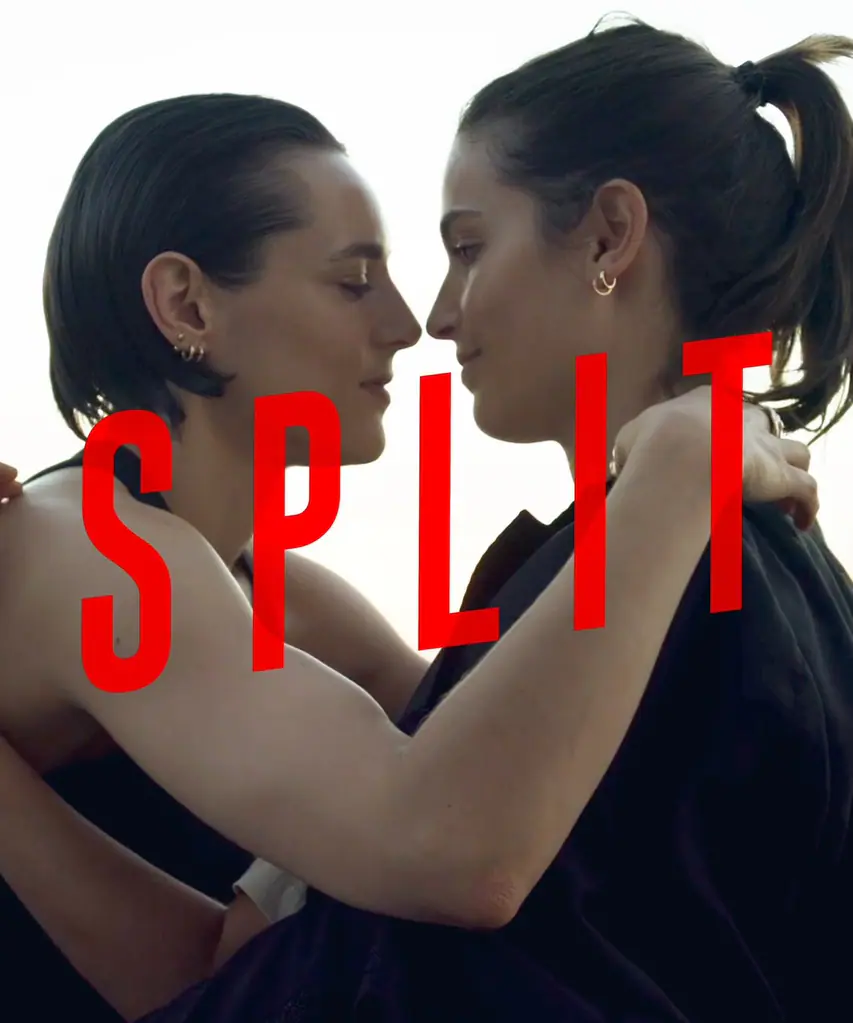
Split (2023): The Aesthetics of Fragmentation—Escaping the Gravity of Heterosexuality and Entering the Orbit of Desire
The awakening of an isolated self usually begins with the gaze of another. The moment we realize that the trajectory of life we believed to be natural is, in fact, an inertia maintained by sheer habit, the world begins to crack. That fracture is not destruction; it is a gap of liberation that finally allows us to face our true selves.
In her directorial debut, Split, renowned French film theorist Iris Brey exquisitely and sensuously depicts a woman’s transition from a rigid world of heteronormativity to a utopia pointed to by her own desire.
🌿 Moments when this drama resonates deeply
- When the garment of ‘normalcy’ prescribed by the world suddenly feels ill-fitting on your body.
- When the tension shared with a stranger feels more authentic than the stability found with a longtime partner.
- When you wish to define your physical sensations and desires through your own language rather than the gaze of others.
- The reason to read until the end: This work is not a simple tale of infidelity; it proves the process of a woman restructuring her identity through the unique cinematic grammar of the ‘Split Screen.’
🎞 Notes before viewing
This work includes very explicit and honest depictions of the female body and desire. These scenes are not a display for voyeuristic provocation but a directorial choice to express the intimacy of relationships and the transference of sensations. An adult rating is recommended.
🎬 Drama Information
- Title: Split (2023)
- Director: Iris Brey
- Screenplay: Iris Brey
- Country: France
- Genre: Drama, Romance, Queer
- Running Time: 5 episodes (approx. 18–19 minutes per episode)
- Platform: France.tv Slash
- Cast: Alma Jodorowsky, Jehnny Beth, Ralph Amoussou
📖 Split: Irresistible Attraction and the Reconstruction of Identity [No Spoilers]
Anna, a 30-year-old stuntwoman, has maintained a stable relationship for ten years with her partner, Natan, and is planning to have a child. Her life is peaceful, predictable, and close to the ‘standard of happiness’ defined by society. However, while working as a stunt double for the famous actress Ève on the set of a biopic about silent film icon Musidora, a strange vibration begins within Anna.
The encounter with Ève awakens realms of sensation that Anna had previously failed to perceive. To Anna, who has lived by substituting for the bodies of others as a stuntwoman, Ève’s gaze forces her to confront herself not as a ‘double,’ but as her ‘original self.’ Between a stable heterosexual relationship and an irresistible homosexual attraction, Anna experiences an intense internal fragmentation. The work visualizes this confusion through the split-screen technique, tracing Anna’s journey as she leaves her old life behind and moves step-by-step toward her true desire.
🎞️ Interpreting Internal Cracks and Liberation Captured via Split Screen
The most striking element of Split is undoubtedly the split-screen technique. This transcends being a mere technical device for showing two scenes simultaneously; it formalizes Anna’s psychological fragmentation. The left screen features the familiar, comfortable daily life with Natan, while the right screen captures the awakening of unfamiliar desires through her communion with Ève.
Due to her profession as a stuntwoman, Anna constantly lives by mimicking the bodies of others. Her identity was once completed only when borrowing the outward form of another, but within her relationship with Ève, she begins to focus solely on her own senses. Director Iris Brey unfolds this as the essence of the Female Gaze.
The camera’s eye does not voyeuristically consume Anna’s body; instead, it shares her sense of touch, her tremors, and the shifts in her breathing. In this process, the ‘vertigo’ (Vertige) Anna experiences is interpreted not as a fear of falling, but as an essential transitional stage for entering a new world.
🔎 Reinterpretation of the Ending: A One-Way Entry into the Utopia of ‘Dyke Land’
By Episode 5, “One way to dyke land,” Anna finally resolves to ‘exit’ (Sortie) her existing heterocentric life. What is remarkable about this conclusion is the absence of destructive conflict, revenge, or jealousy. The breakup with Natan is portrayed not as a tragic end, but as a mature parting that respects each other’s truths.
The ‘Dyke Land’ that Anna reaches goes beyond a simple choice of sexual orientation; it is a utopian space that redefines the form of family. She ends the roleplay forced upon her by society and becomes the protagonist of a new narrative where she is the subject. What Anna gains in the end is not just a lover in Ève. She acquires the right not to be ashamed of her desires and the freedom to live her own life, rather than being a double for others.
Anna’s choice is a volitional severance—killing her past self to be reborn as a new ego.
❓ Interpretation of the Ending of Split and the Utopian Limits of Female Narratives
Q: Is this ending, which omits conflict and pain, not an idealized depiction lacking in reality?
In traditional queer narratives, coming out has always demanded a grueling price involving blood, tears, and severance from family. The gentle parting and the understanding shown by those around Anna in Split are certainly aesthetic choices distanced from reality. However, this is the director’s intentional staging.
By breaking away from the stereotype that queer narratives must always dwell on tragedy and suffering, it serves as a utopian manifesto showing how joyful and liberating the ‘process of exiting heterosexuality’ can be. The ‘smoothness’ that might be criticized acts as a cinematic device that prefigures a cross-section of the mature society we should aspire to.
✨ Split: A Solidarity of Desire Breaking Through the Prison of Identity
Split does not ask about the expiration date or the form of love. Instead, it asks how courageously a human being can look into their own interiority. Anna’s journey asks the many people living in the present: Is the place where you stand truly the place you chose, or is it merely where you remain because you could not leave? Rather than mourning the end of a relationship, this drama focuses on the expansiveness that a new relationship provides.
The establishment of a true identity begins only when one deviates from the orbit designed by others.
🗨️ The Courage to Face Desire Hidden in Silence
We often live by suppressing our true senses under the guise of stability. The wondrous ‘vertigo’ Anna felt when she took Ève’s hand might, in fact, be a signal of change sleeping within all of us.
Have you ever silenced your own voice for the sake of familiar stability? Or are you ready to break that silence and move toward an unfamiliar utopia?
📽 Violet Screen Curation: Recommended Female Narratives Breaking Relational Boundaries
- Workin’ Moms (Netflix): Cynically yet warmly depicts how women’s desires and identities clash and reconcile amidst the friendship and competition of working mothers.
- The Girls at the Back (2022) (Netflix): A Spanish drama about the solidarity and secrets that unfold during a trip taken by five friends after one of them is diagnosed with cancer. It delightfully and deeply portrays the multi-layered bonds and desires of women that go beyond romantic relationships.
To provide a more stable publishing environment, multilingual content, and better communication with our readers, we have moved our official publication to Substack.
All new film reviews and critical essays will be published on our new platform. This website will be closing down soon, so we would greatly appreciate it if you subscribed to our new space.
TODAY'S QUESTION
What genre or mood do you always reach for when you're alone?
Your answer isn't saved. Feel free to share it in the comments below.


You May Also Like

Interpreting the Ending of Netflix’s The Hunting Wives: A Forbidden Solidarity Engineered by Twisted Desire
The Sex Lives of College Girls: A Queer Narrative of Self-Discovery and Leighton’s Journey of Acceptance