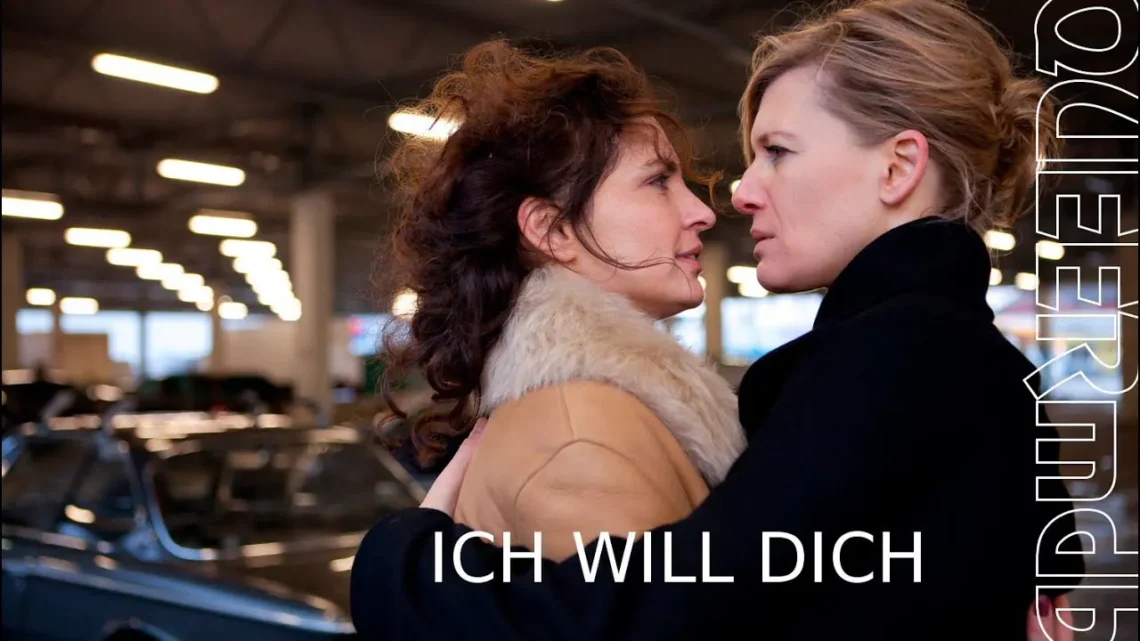
Ich will dich (2014): An Interpretation of Forbidden Desire Collapsing a Solidified Daily Life
The ramparts of tranquility we construct often collapse like sandcastles from a single gaze. This film delves relentlessly into the awe and terror a woman feels when she—having lived confined within a prison called “stability”—discovers a missing piece of herself in a stranger.
Like a sudden drop of ink onto a seemingly perfect blueprint, her life is left with a stain from which there is no return. Whether that stain becomes a scar or a new pattern for her life depends entirely on the courage to face her own desire.
🌿 Moments when this film resonates deeply
- For you, who has felt an inexplicable emptiness within the framework of a “happy middle age” as defined by others.
- For you, passing through a dawn where the “confirmation of my own existence” feels more desperate than the emotion of love.
- For you, who has locked eyes with the one person you wish to protect, even at the cost of societal collapse.
- Therefore, by the end of this piece, you must see why Marie’s choice was not “betrayal,” but “survival.”
🎞 Note before viewing
Rather than physical exposure or provocative imagery, this work focuses on the dense psychological tension and emotional fluctuations between two women. It is an in-depth psychological drama dealing with primal attraction and identity confusion rather than the moral right or wrong of the relationship.
🎬 Film Information
- Title: Ich will dich (I Want You, 2014)
- Director: Rainer Kaufmann
- Screenplay: Kathrin Richter, Ralf Hertwig
- Country: Germany Genre: Drama, Romance, Melodrama
- Runtime: 89 minutes
- Platform: Netflix (varies by country), DVD, etc.
- Cast: Ina Weisse (Marie), Erika Marozsán (Ayla), Ulrich Noethen (Bernd), Marc Hosemann (Dom)
📖 <Ich will dich> Synopsis: A strange intruder cracking the perfect blueprint [No Spoilers]
Marie, a successful architect, leads an enviable middle-class life with her husband, Bernd, and their two children. Her daily life is as precise and stable as the buildings she designs, but everything begins to tremble the moment she meets Ayla, the fiancée of her long-time friend Dom.
Ayla, possessing a free-spirited and wild charm, stimulates the inner desires Marie has suppressed her entire life, and the two fall into an irresistible attraction. Marie attempts to draw a line by denying her identity, but she finally feels alive within the secret moments she shares with Ayla.
However, the realistic barriers of Ayla’s pregnancy and marriage, along with the immense responsibility of family, thrust Marie into a violent storm. Caught between the struggle to hide the secret and the longing for the truth, Marie’s daily life gradually hurtles toward catastrophe.
🏛️ The “Other” cracking a life built like a solid structure: Marie’s isolation
Marie is an architect. She is accustomed to partitioning space and drawing guiding lines; she has confined her own life within those standardized blueprints. However, Ayla appears as an “atypical entity” that did not exist in Marie’s drawings, shaking the very foundations of the world she built.
In this film, Marie’s isolation does not stem from others, but from the prison of “perfection” she created herself. Her desire for Ayla is not a mere affair, but is interpreted as the scream and escape hatch of an ego that was suffocating under the weight of a regulated life.
💬 The language of “Want” beyond “Need”: Psychological signifiers in <Ich will dich>
The film’s title, Ich will dich (I Want You), carries an energy on an entirely different level from “I love you” or “I need you.” While “need” is a passive state of filling a deficiency, “want” is closer to an active struggle toward an object through one’s own will.
The denial repeated by Marie and Ayla—“I am not a lesbian”—paradoxically proves the magnitude of the emotion they feel. This intense attraction, which cannot be defined by existing language, only reaches its complete truth after the labels imposed by society are stripped away.
🔎 Reinterpreting the Ending: Rejoining at the airport is a choice of dignity over complacency
The scene at the end of the film, where Marie loses everything and runs to the airport to hold onto Ayla, signifies more than just a romantic reunion. The truth revealed on Christmas Eve—the most family-oriented time—completely shatters the facade of the “virtuous wife” and “successful woman” that Marie had been wearing.
Though she chose resignation over anger even when witnessing her husband’s infidelity, she finally finds her own voice when faced with the crisis of losing Ayla.
Ultimately, the point this review focuses on is not what Marie gained, but what she was willing to throw away. The embrace between the two in the final scene is not so much a completed happy ending as it is a solemn declaration heralding the start of a rough voyage. This conclusion marks the completion of an agentic destruction—tearing up the blueprints designed by society to clear a space where the soul can finally breathe.
❓ Questions regarding the ending and narrative structure of <Ich will dich>
Q. There is criticism that Marie’s actions are nothing more than irresponsible infidelity; what is your view?
From a moral perspective, Marie’s choice is clearly an irresponsible act that leaves deep scars on her family. The film, too, does not glamorize her path but observes it coldly. However, this criticism often stems from a motherhood-centered frame imposed upon women. Rather than weighing moral right and wrong, the purpose of this film is to depict the psychological earthquake that occurs when an individual deviates from a societal script. Marie’s irresponsibility is, paradoxically, an aesthetic device that proves how long she had been unfaithful to herself.
Q. Is the setting where Ayla engages with Marie on her wedding day despite being pregnant not excessive?
While it is a setting that can cause emotional discomfort, it serves as a device to show in the extreme that “social institutions (marriage)” cannot control “primal attraction (desire).” It proves that for Ayla, marriage was merely a choice for survival and responsibility, not a sanctuary for her soul. Through this, the director emphasizes the futility of formal relationships and paradoxically expresses how powerful the connection between the two truly is.
✨ <Ich will dich>, the aesthetics of truth attainable only through collapse
This film does not say that love will save us. Rather, it shows how love destroys us and how it rebuilds us upon those ruins. A stable life can be a blessing, but if one loses their essence within it, it is no different from a slow-moving death.
Marie’s journey asks us: Are you “maintaining” your life, or are you “wanting” it? Cracks in a relationship are painful, but the film eloquently and intensely speaks to the fact that light finally begins to enter through those gaps. True identity is not born from peaceful complacency, but from the painful sound of rupture as the barrier of taboo is shattered.
🕸️ When your solid daily life is shaken, what will you reach for first?
We often choose silence when we have much to lose. But if that silence is eating away at your soul, do you have the courage to risk everything to break it? I want to ask which is more desperate for you: the longing to run to the airport like Marie, or the responsibility to endure the remaining ruins.
📽 Violet Screen Recommendations: Other masterpieces dealing with female desire and relationships
- Two of Us (2019): A masterpiece about the secret love and late-life struggle of two women who have posed as neighbors for decades. While Ich will dich deals with middle-aged explosiveness, this work shows the solidity of love accumulated over time.
- The Girl and the Spider (2021): Through the process of moving and parting, this film captures the subtle tension and sense of loss between women with a sensuous mise-en-scène. The direction, which builds a narrative through space and gazes rather than dialogue, is exceptional.
To provide a more stable publishing environment, multilingual content, and better communication with our readers, we have moved our official publication to Substack.
All new film reviews and critical essays will be published on our new platform. This website will be closing down soon, so we would greatly appreciate it if you subscribed to our new space.
TODAY'S QUESTION
When did you first feel fully accepted for who you are?
Your answer isn't saved. Feel free to share it in the comments below.


You May Also Like

Room in Rome: Shedding the Veil of Deception, An Isolated Room Creates a Perfect Universe for Two Women

The Children’s Hour (1961) Review: Ruins of Isolation Left When Lies Swallow the Truth