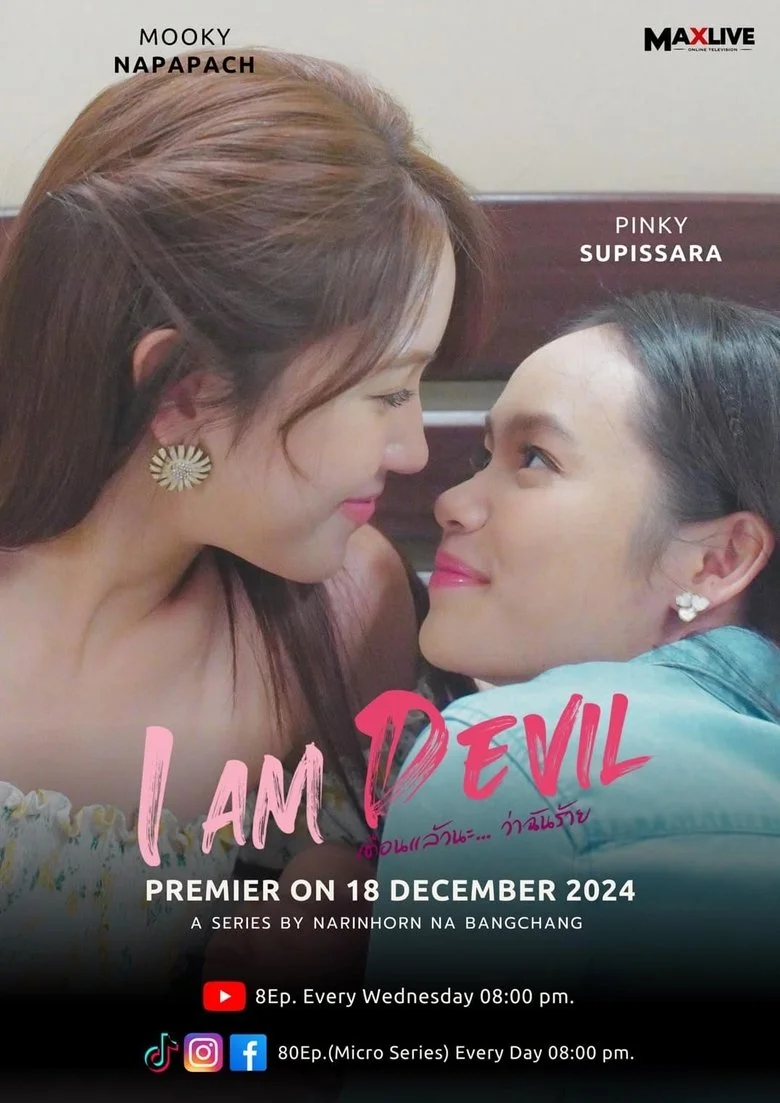
I Am Devil: A Fatal Narrative of Salvation Hidden Behind the Mask of Pain
Inside those who call themselves wicked, there usually lie fragments of a soul broken at its deepest core. When the pure emotion of love is hacked to pieces by others, the saddest defense mechanism a human can choose may be to define themselves as harsh and harmful.
A life spent erecting walls before being hurt by others, arming oneself with cold cynicism. The frame of the “wicked woman,” repeated countless times in films and dramas, is perhaps the loneliest fortress built by an acute deficiency. This work opens the door to that solid fortress, persistently chasing the gaze of two women who recognize each other’s wounds.
🌿 Moments When This Drama Deeply Permeates
- When encountering the cold gaze of someone calmly enduring inner loneliness amidst the public’s chilly scrutiny and misunderstanding
- When wishing to witness the moment a relationship that began with hostility and surveillance transforms into perfect understanding and a breathtaking stir of emotions
- When wanting to fully feel the patriarchal oppression hidden behind the glamorous high society and the sharp tension of women confronting it
Consequently, the reason to read until the end is to discover the secret and inevitable narrative of emotional salvation shared exclusively by two women, hidden behind the superficially provocative commotion of a contract marriage, and to uncover the structural value of its conclusion.
🎞 Notes Before Watching the Drama
Although this work borrows the conventional dramatic device of a fake marriage, its essence is a melodrama focused on the delicate emotional lines and high-density relationships of the characters. Rather than focusing on physical stimulation or sensational depictions, it densely captures the psychological isolation felt by the characters and the depth of emotions that gradually open toward one another.
🎬 Drama Information
- Title: I Am Devil (2024–2025) / Original Thai Title: เตือนแล้วนะ… ว่าฉันร้าย (Tuen Laew Na… Wa Chan Rai)
- Director: Thanawat Panyadee
- Screenplay: Prapas Chotianan
- Country: Thailand
- Genre: Drama, Romance, GL, Comedy-Drama
- Running Time: 2 Seasons Total
- Platform: One31, YouTube Official Channel
- Cast: Napapach Thitakawin, Subhisara Suksathan, Phurikulkrit Chonlathorn, Peeranee Kongthai
📖 I Am Devil, An Unexpected Attraction Faced by an Actress Wearing the Mask of a Villain and the Woman Surveilling Her [No Spoilers]
Mookmanee, an actress specializing in villainous roles who has ceased to believe in love due to trauma from a past lover, enters into a strategic fake marriage with Songprot to attend the deathbed of her grandmother, her only blood relative. However, Songprot’s mother, Lady Prapassorn, who resolutely opposes this marriage, infiltrates her half-sibling and graphic designer, Phrangdao, into the couple’s mansion to uncover their secrets and bring about Mookmanee’s downfall.
Phrangdao, tasked with surveilling Mookmanee and finding her weaknesses, observes the daily life of her first love, Mookmanee, from the closest proximity, despite her arrogant and cold exterior. Upon discovering the lonely and sorrowful true nature of Mookmanee, who endures all public criticism for the sake of her family contrary to her reputation, Phrangdao’s heart gradually shifts into uncontrollable empathy and a fatal stir of emotions, bringing the plot to a new turning point.
🖤 Analysis of Mookmanee and Phrangdao’s Psychological Structure in I Am Devil: A Gaze Stripping Away the Outer Shell of Misunderstanding
Within the work, the character Mookmanee confines herself to the image of the “wicked woman” consumed by the public. The Hera Club, a women-only social space she frequents, appears on the surface to be a place of free-spirited escape, but in reality, it functions closer to a psychological bomb shelter that disconnects her from external wounds.
The process of Phrangdao invading this space and Mookmanee’s private domain signifies more than mere surveillance; it represents a fracture in the defensive wall Mookmanee erected. When coldness as a defense mechanism collides with a warm gaze that sees through it, a powerful emotional tension is generated between the two, erasing the medium of Songprot entirely.
🏛 Subversion of Space and Power Structure: Secret Solidarity and Interpretation Blooming Within the Patriarchal Mansion
The mansion ruled by Lady Prapassorn is an oppressive space dominated by patriarchal values and the logic of capital. The marriage to Songprot is nothing more than a contract taking place within it, but as Phrangdao enters that space, the axis of power subtly twists. Phrangdao was dispatched as an agent to execute her mother’s commands, but upon witnessing Mookmanee’s dignity, she deviates from her mother’s power structure.
Amidst the social pressure where Nita and a reporter collude to expose Mookmanee’s past, Phrangdao’s action of standing by Mookmanee’s side can be interpreted not merely as a romantic choice, but as an autonomous political solidarity of women resisting escalating patriarchal oppression.
🔎 Reinterpretation of the Ending: Dismantling the Mask and Perfect Alignment Toward Each Other’s Worlds
The ending of this drama does not merely stop at a conventional, gratifying conclusion where the full story of the fake marriage is revealed and the antagonists are punished. By the end, Mookmanee becomes completely free from the frame of the wicked woman imposed by the public and the humiliating wounds inflicted in the past by Grace’s mother. Phrangdao also breaks free from the role of her mother’s puppet, reclaiming her artistic and autonomous life.
The scene in the final part where the two smile while looking at each other proves that they have rejected all relationship titles defined by the world and settled into each other’s worlds as the unique beings capable of healing each other’s wounds. Though they may have lost social status or reputation, they achieve human growth by acquiring the noblest dignity: absolute trust in one another. The union of Mookmanee and Phrangdao is a complete victory achieved by women who recovered their autonomy within an oppressive structure.
❓ Deep Reading of I Am Devil: Interpretations on Narrative Preferences and the Mode of Female Representation
Q1. How should we interpret the criticism that the revenge plot involving Nita and the reporter Nut in the latter half feels somewhat like a cliché conventional melodrama (sabotaging the love line)?
It is true that it follows the malicious structure of a typical melodrama. However, this critical point stems from the grammar of the “Soap Opera,” which is the genre’s inherent origin. Rather than focusing on Nita’s misdeeds themselves, the production team concentrates on the way Mookmanee is isolated once again within that crisis, and the process through which Phrangdao abandons her own safety to save her. In other words, it can be viewed as an aesthetic choice that reverses a clichéd conflict structure into a powerful catalyst to heighten the relational density between the two women.
Q2. It is questionable whether the setting where Mookmanee packages herself as a wicked woman due to past trauma aligns with an autonomous mode of female representation.
In the early parts, Mookmanee shows limitations by reacting passively to trauma and wearing a cold mask. However, as the work progresses, it is revealed that her “wickedness” is not malice intended to harm others, but a strong survival strategy refusing to succumb to absurd demands and gazes. In particular, her act of throwing off the mask through communion with Phrangdao and proudly revealing her vulnerability demonstrates the most realistic and multi-dimensional method of female representation, where imperfect women heal and grow through one another. The judgment rests entirely with the readers beyond the screen.
✨ I Am Devil, The Coldest Chronicle of Love Dismantling Every Frame in the World
The conclusion of this work does not simply signify the end of a romance; it poses a powerful question to the frame of the “beautiful and harmless victim” that modern society demands of women. It delivers a message of salvation: that even a wicked woman finger-pointed by the world can start anew if there is just one person’s gaze that recognizes the truth within her. The struggle to protect oneself amidst love, identity, and oppressive gazes is ultimately completed within a firm belief toward each other.
True salvation begins only when we reject the roles assigned by others and fully embrace each other’s most vulnerable backs.
💬 Silence and Gaze, What Kind of Mask Do You Wear in the Face of Trauma?
When deeply wounded, anyone tends to put on their own cold silence or an aggressive mask to avoid hurting anymore. It makes one ponder whether the method of distancing oneself from others by making oneself a bad person, like Mookmanee in the work, is indeed the right choice to protect oneself, or whether it is right to recklessly break through that wall and face the truth like Phrangdao. If it were you, which path would you choose between a life isolated within a lonely fortress to avoid being hurt, or a life reaching out to others even if it means being broken again?
🔮 Violet Screen Recommendations: Another World of Deficiency and Solidarity
- Play Park (2026): A drama with a warm and mature sensibility set against the backdrop of an amusement park. It begins when “Ying,” who lives fiercely as an amusement park manager and a single mother, meets “Lin,” a cold executive who newly acquires the amusement park. It received critical acclaim for its calm and profound depiction of the process by which two adult women with different wounds and backgrounds understand, comfort, and fall in love with each other.
- Be My Angel (2026): A work that brings a mysterious and lyrical sensibility to the forefront, starting with the appearance of a being like an angel or a guardian before a protagonist exhausted by the weight of reality. Within a fairy-tale-like setting, it densely portrays a narrative of salvation where the two protagonists become the one and only salvation for each other. Thanks to its warm comfort and visual beauty, it left a deep lingering impression on viewers who prefer mature and calm romance.
To provide a more stable publishing environment, multilingual content, and better communication with our readers, we have moved our official publication to Substack.
All new film reviews and critical essays will be published on our new platform. This website will be closing down soon, so we would greatly appreciate it if you subscribed to our new space.
TODAY'S QUESTION
Which ending has stayed with you the longest?
Your answer isn't saved. Feel free to share it in the comments below.


You May Also Like
Verbotene Liebe: The Aesthetics of Identity and Tragedy in the Narrative of Carla and Hanna
No abras la puerta (2014): The Fetters of Queer Relationships and the Desire for Family in a Chilean Telenovela
