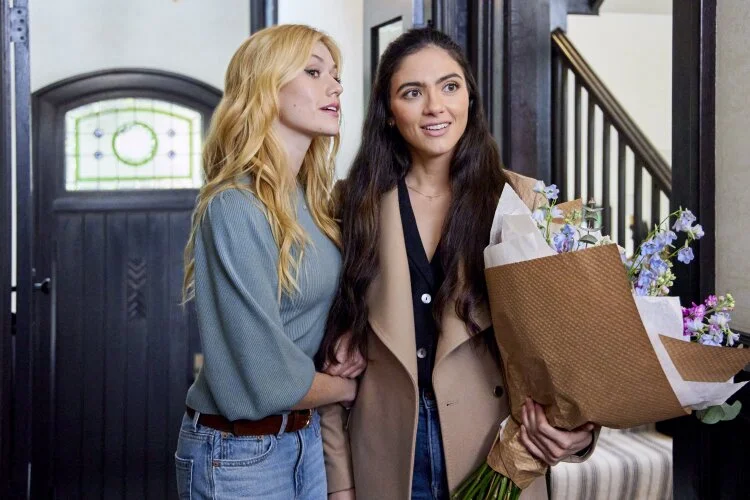
Love, Classified: How a Wounded Heart Reclassifies Love
Wounds are dulled by the presence of another, but scars fade only when one honestly confronts oneself. Set within the hallmark warmth characteristic of its channel, the protagonists’ journey toward the essence of connection poses metaphorical questions about how we accept others.
🌿 Moments When This Film Penetrates Deeply
- For those who struggle to open their hearts to others due to past trauma
- For those seeking a romance centered on harmless, emotional trust rather than sensational conflict
- For those desiring a heartwarming women-centric narrative where characters naturally permeate each other’s lives without the pain of coming out or self-denial
- For those who wish to trace a journey moving beyond analyzing the root causes of trauma toward complete reconciliation and harmony
🎞 Pre-Viewing Notes
Relying on a gentle and harmless emotional tone, this work focuses on character emotional arcs and relational recovery. It is an affective drama dealing with deep trust and natural attraction without sensational or explicit depictions.
🎬 Film Information
- Title: Love, Classified (2022)
- Director: Stacey N. Harding
- Screenplay: Lynn Sternberger
- Country: United States
- Genre: Romance, Drama
- Runtime: 84 minutes
- Platform: Hallmark Channel
- Cast: Melia Kreiling, Arielle Kebbel, Catherine Bell, Max Lloyd-Jones
📖 Love, Classified Synopsis & The Beginning of New Connections That Heal Trauma [No Spoilers]
Following her husband’s death, bestselling author Emilia abruptly abandons her family, leaving behind her two children, Taylor and Zach. Years later, Emilia returns to her hometown on the occasion of a bookstore signing and attempts to mend her bond with her children. However, Taylor, bearing the deep trauma of maternal abandonment, does not open her heart easily.
Taylor, who runs a flower shop, is persuaded by an employee to join a classic-style dating app that prioritizes conversation and shared values over photographs. There, she meets Frankie, a cardiologist. Vibrant and sincere, Frankie calmly dismantles Taylor’s defense mechanisms, bringing Taylor face-to-face with unexpected new feelings.
Meanwhile, Zach, an artist, strives to break free from the lingering lingering attachment and scars left by a past lover. The film captures the internal family conflict ignited by the mother’s sudden return, alongside the process of two siblings stepping out from the shadow of their past through new dialogue and connections.
🪴 Taylor and Frankie: Narrative Interpretation of Natural Love Attained Through Non-Definition
Within the film, the relationship between Taylor and Frankie acquires broader emotional freedom precisely by refraining from attaching explicit sexual identity labels. Taylor does not strain to define herself as a lesbian or bisexual; she simply feels comfort and attraction toward the presence of ‘Frankie’ herself.
This direction eliminates the conventional internal anguish or stigma stemming from identity exploration, allowing the viewer to focus entirely on emotional density. Fitting for her profession as a cardiologist, Frankie attentively monitors the pulse of Taylor’s closed emotions, lifting the isolation of her heart through patience rather than force.
Breaking away from stereotyped narrative frameworks, their romance demonstrates an exquisitely natural process of growth as one human being expands her heart toward another.
🩹 Remnants of Neglected Scars and Emotional Fractures in the Name of Family
Emilia’s absence filled Taylor’s entire life with the terror of instability—the fear that others could leave at any moment. Emilia’s excuse, “I couldn’t bear the grief of losing my husband,” may be an honest confession from an adult, but it fails to grant complete justification to the children left behind alone.
The film makes clear that explaining the cause of pain and the resulting suffering felt by the victim exist in separate realms. Taylor’s line, “Mom lost a husband, but we lost both parents,” strikes directly at the core of the deprivation felt by neglected children.
It suggests that subtle power dynamics and emotional debts within a family do not naturally heal simply with the passage of time; they can only be placed on the operating table through confrontation and acknowledgement.
✉️ Harmony of Classic Personal Ads and Modern Apps: The Aesthetics of Relationships Rebuilt by Conversation
The dating app, borrowing the classical newspaper format of ‘Classified Ads,’ serves as an elegant counterargument to modern dating culture dominated by external conditions and instant images. As a space where language, syntax, and mutual tastes intersect prior to visual information, it becomes an optimal safe zone where characters can lower their emotional armor.
Trust constructed through language takes root far more firmly than visual attraction. Taylor’s approach—building the relationship by sustaining dialogue slowly, much like tending to plants—restores the value of ‘approaching slowly,’ a concept lost in contemporary society.
Beyond being a mere tool for dating, this mise-en-scène device articulates the central theme: genuine communication begins when one candidly unfolds their essence through text.
🗝️ [Reinterpreting the Ending] An Ending Adopting the Dignity of Imperfection Rather than Complete Forgiveness
Emilia’s sudden health crisis and heartfelt apology open the floodgates to conflicts that had been frozen for years. Yet, the film’s ending does not insist upon complete, immaculate forgiveness toward the mother or an absolute erasure of the past. Taylor merely dulls the edge of her anger; she does not forcibly attempt an erasure of the traces of deprivation she endured.
What the protagonist Taylor gains is not the restoration of a perfect family, but self-assurance that she can form solidarity with others even while carrying her scars. What she loses is the unconditional defensiveness directed at others and the victimhood bound to the past.
The film’s ending illustrates the dignity of moving forward while embracing trauma, rather than returning to a state prior to being hurt. This conclusion stands as an achievement of emotional compromise, proving that life can continue without wiping away the marks of a wound.
The two do not come together because they are perfectly healed; rather, by accepting each other’s incomplete pieces, they ultimately fulfill a new form of family and love.
❓ Issues in Focus: Reading the Ending and Narrative Depth of Love, Classified
Q1. How should one view the criticism that the narrative justification for Emilia’s neglect and the speed of forgiveness are overly lenient?
Some viewers raise the criticism that Emilia’s act of abandoning her children is excused too easily under the guise of maternal grief. In particular, scenes where Frankie subtly encourages Taylor toward reconciliation risk appearing to treat the party’s deep trauma carelessly.
However, this needs to be understood within the harmless aesthetic context characteristic of the Hallmark Channel. The work places its full weight on the restoration of wounds rather than the explosion of conflict. Emilia’s confession is not a justification of guilt, but a process of confessing her limits as a human being; it functions as a minimal stepping stone for restarting the relationship rather than a complete pardon.
Q2. Does removing the pain of coming out and conflict as a queer narrative diminish its realism?
Criticism exists that deleting social prejudice, internalized homophobia, and extreme friction with family—elements frequently featured in queer narratives—renders the story overly utopian. A prime example is the scene where the mother, Emilia, delights simply in the fact that her daughter is dating a doctor.
Yet, this staging is a deliberate aesthetic choice. Rather than solidifying queer narratives strictly into ‘pain and struggle,’ it offers an alternative worldview showing that love can be accepted without self-denial or narrative obstacles. The absence of conflict functions not as a limitation, but as a device that forces focus onto the essence of the relationship itself.
✨ Love, Classified: Love is the Solidarity of the Wounded, Not the Perfect
Wounds inflicted within a relationship can only be filled through new forms of reflection and acceptance, not through the methods that destroyed the relationship in the first place. This film does not instruct one to unconditionally cover up an irresponsible past; it merely emphasizes the necessity of the courage to reach out to others in order to live through today.
Amid the complex fetters of love, identity, and family, what we must seek is not a faultless answer key, but the capacity to embrace one another’s imperfection. Love is not a state free of flaws, but the very act of walking at each other’s pace while carrying those flaws.
💬 Insights and Questions That Dismantle Emotional Walls
An attitude of bolting one’s heart out of fear of being hurt allows one to avoid pain, but simultaneously blocks the very channel through which new happiness might enter. Opening one’s heart despite the anxiety that an extended hand might be rejected once more is a deeply noble act of courage toward life.
When you open the door of your heart to someone, do you approach after confirming the other person’s perfection, or do you take a step forward, risking the danger while accepting your own wounds and their deficiencies as they are?
💜 Violet Screen Curation: Recommended Works Centered on Female Relationships, Trauma, and Solidarity
Recommended works offering a multi-dimensional portrayal of relationships and gentle bonds between women:
- Crush (2022): A teen romance capturing the maze-like dating and friendship of adolescents in a lighthearted, cheerful manner, portraying fresh identity exploration and emotional shifts through a bright tone.
- Am I Ok? (2022): A work dealing with subtle emotions blossoming between longtime friends and a late-blooming realization of identity, honestly depicting the boundary between quiet yet deep friendship and love.
To provide a more stable publishing environment, multilingual content, and better communication with our readers, we have moved our official publication to Substack.
All new film reviews and critical essays will be published on our new platform. This website will be closing down soon, so we would greatly appreciate it if you subscribed to our new space.
TODAY'S QUESTION
Which film feels like your 'first love' story?
Your answer isn't saved. Feel free to share it in the comments below.


You May Also Like
Funny Story: On Tragic Jokes, Fractured Relationships, and Desperate Isolation
Beanpole (Dylda, 2019): The Crimson Scars of War and the Gripping Isolation of Women