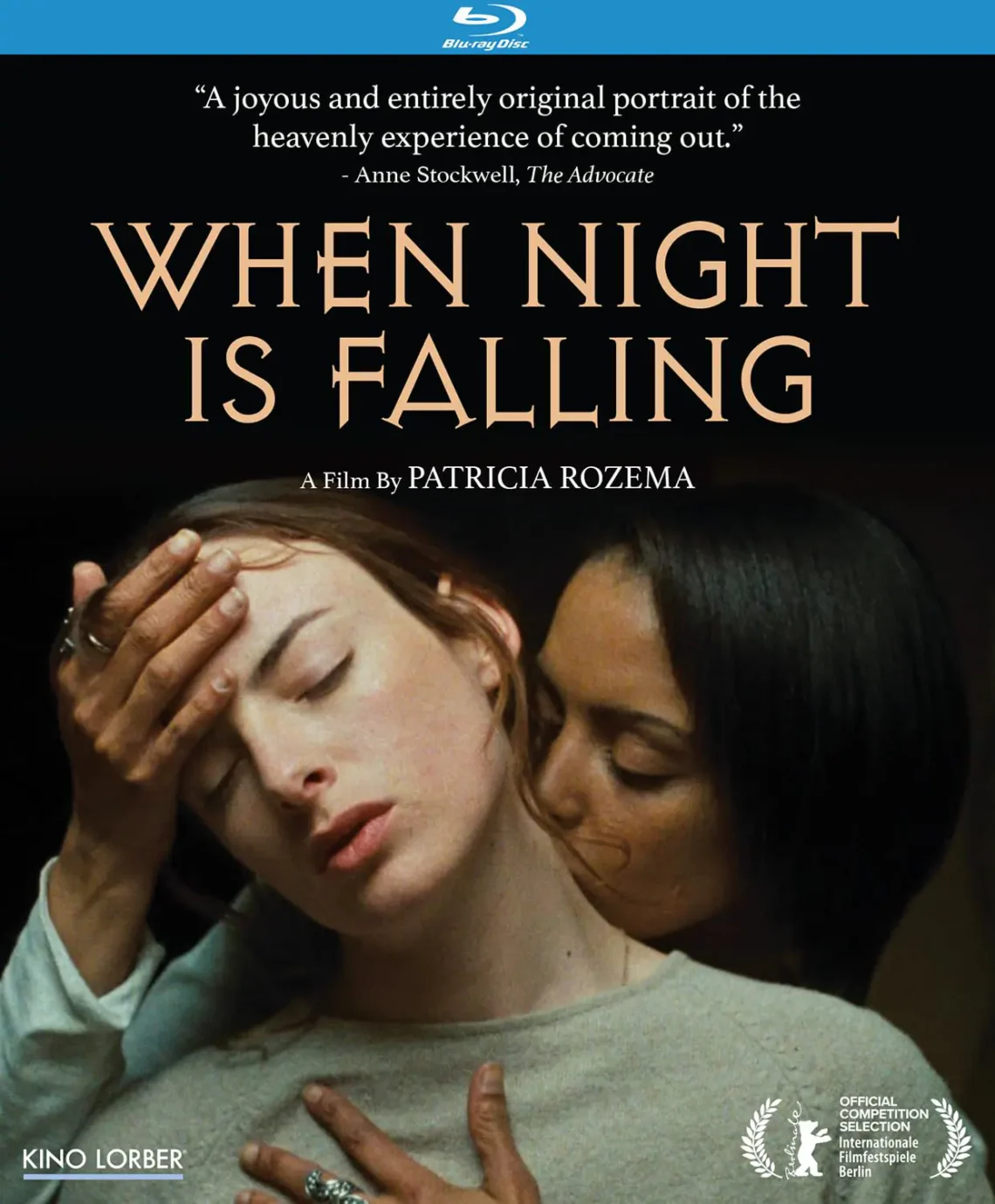
when night is falling: Gliding Freely to Break the Ice of Oppression, a Classic Reinterpretation of Female-Centric Romance
Within religious discipline and perfectly structured daily routines, we often become jailers of the prisons we build for ourselves. Behind the formidable fortress of others’ gaze and societal expectations, true desire quietly suffocates, frozen cold. The film When Night Is Falling is a story about a strange yet captivating warmth that penetrates the cracks of such a frozen life. Only when we realize that the comfort of stability was, in fact, the isolation of the soul, do we begin preparing to become the true masters of our lives.
This work does not stop at merely portraying the love between two women; it captures the sacred process of escape in which an individual rejects the inherited world to construct one of her own. The chaos and ecstasy experienced by a woman, for whom rules were everything, when she confronts instinctive freedom, intensely shake the core of all of us who live suppressing ourselves at this very moment.
🌿 Moments When This Film Penetrates Deeply
- Those who walk along the correct orbit prescribed by the world, yet face an inexplicable, cold emptiness every night.
- Those who ignore the suppressed inner voice and live wearing a perfect mask to meet the expectations of others.
- Those who wish to experience a fatal yet beautiful sense of liberation that completely upends life through an encounter with an unfamiliar presence.
The reason to read through to the end is that, beyond the mere consumption of queer romance, it testifies to a structural journey of salvation that releases our inherent desires—previously trapped in a refrigerator—into a dazzling winter forest.
🎞 Notes Before Watching
This work is an emotion- and relationship-driven film that unfolds around the visual and thematic contrast between the two extreme worlds of Christian dogma and a sensory circus. Rather than focusing on sensational or provocative depictions, it densely handles the characters’ inner anguish and the delicate emotional bond and tension between the two women, allowing for a deep immersion along the melody of emotion.
🎬 Film Information
- Title: When Night Is Falling (1995)
- Director: Patricia Rozema
- Screenplay: Patricia Rozema
- Country: Canada
- Genre: Drama, Romance, LGBTQ+
- Running Time: Approx. 90 minutes
- Platform: DVD and VOD
- Cast: Pascale Bussières, Rachael Crawford
📖 The Plot of Oppression and Liberation in When Night Is Falling and the Context of Relational Development [No Spoilers]
Camille, a professor teaching literature at a strict Christian college, lives carrying the full expectations of her academic community within a stable romantic relationship with her colleague, Martin. However, this seemingly perfect daily life encounters a deep fissure due to the sudden death of her beloved dog, Bob.
Visiting a laundromat in her grief, Camille accidentally meets Petra, a circus performer who is as free as a wild horse. Petra approaches Camille with unhesitating, honest charm, as if piercing through Camille’s repressed interior.
Trapped within a rigid world defined by religious rules and a promised future with Martin, Camille begins to experience severe internal turmoil in the face of the unknown freedom and sensory provocation proposed by Petra. Caught between the moral yardstick of the college community and the liberating flight offered by Petra, Camille’s relationships shake uncontrollably, reaching a turning point.
❄️ The Dog in the Refrigerator and the Psychological Structure of the Frozen Camille
In When Night Is Falling, Camille’s act of keeping her deceased dog in the refrigerator instead of burying it is the most critical psychological symbol running through the entire film. The refrigerator is a space that prevents decay but deprives life, translating precisely to the oppressive environment of the Christian college community surrounding Camille at the time.
While realizing she felt a deeper affection for her dog than for her relationship with Martin or her religious duties, she cannot face the reality of death and freezes it. This is a visual depiction of Camille’s internal state—suppressing her true sexual orientation and emotions, preserving herself within the category of normalcy demanded by society.
Only when Petra, acting as a hot sun, intervenes in her life does this cold, frozen state begin to melt, bringing the reality of her hidden lack entirely to the fore.
🪶 The Mise-en-Scène and Power Structure of Circus and University, Discipline and Freedom
Director Patricia Rozema sharply contrasts the two spaces—Camille’s university and Petra’s circus—clarifying the characters’ power dynamics and directorial intentions. The university visualizes discipline and religious dogma through symmetrical, static structures and cool-toned lighting, whereas the circus represents uninhibited human desire through fluid, vibrant colors and moving bodies.
Camille’s silence in response to the question about homosexuality during her chaplaincy interview illustrates the pressure of institutional power attempting to control individual identity. Conversely, the hang-gliding scene with Petra provides a physical sense of liberation that defies gravity, achieving an aesthetic subversion that makes Camille realize the futility of her existing social status and rules.
🔎 Reinterpreting the Ending — Burial in the Winter Forest and Companionship Toward a New World
The film’s ending is completed through the ritual where Camille finally buries her dog—which represented her past life—in the snow-covered forest. This is a decisive rupture, letting go of the promised stability with Martin and religious shackles, and a spiritual burial that puts to death the past self that bound her. The scene where Petra holds Camille, who has lost consciousness in the bitter cold, warming her with her own body, shows that their relationship has transcended simple romance to reach a stage of complete liberation that saves each other’s lives.
Although Camille lost the social dignity and comfort guaranteed by the Christian community, she achieved the growth and dignity of her true self, choosing and taking responsibility for her own desires. The final image of the two leaving together past the dazzling snowscape to follow the circus implies that the life awaiting them after the ending will not be a stylized settlement, but an endless journey of wandering and freedom.
The escape chosen by Camille is a grand victory of the soul, choosing an unstable festival over a comfortable grave.
💬 In-Depth FAQ on the Aesthetic Controversy and Interpretation of When Night Is Falling
Q. Doesn’t the scene where Camille hurts Petra by falsely introducing her as a “street kid” undermine the protagonist’s character arc?
Some viewers express dislike for Camille’s deceptive attitude or question the character’s morality. However, this must be interpreted as a device that realistically reproduces the terror exerted on an individual by a patriarchal, religious mainstream society. Camille momentarily feared the collapse of her safety zone and exercised the power to otherize Petra; this critical point actually becomes a powerful internal catalyst that later makes Camille realize her own cowardice and make an agentic choice to completely dismantle Martin’s world. Rather than portraying a flawless character, the work exposes the fragility of a human faltering under oppression, thereby emphasizing the value of liberation.
Q. How should we view the contemporary controversy that the Christian community is depicted in an excessively closed and negative manner?
It is true that the film depicts the religious space as rigid, which leaves room for schematic criticism from religious or conservative viewpoints. However, the director’s intention is not a blind condemnation of religion itself, but an exposure of structural violence—specifically, how a system censors and criminalizes an individual’s intimate love and identity. Given that Martin is not depicted as an evil person but merely as a faithful member of the system, it is reasonable to view this film not as an attack on a specific group, but as an aesthetic questioning of all forms of dogma that restrict human freedom, leaving the final judgment to the audience.
✨ The Timeless Implications of Identity Left by When Night Is Falling
Concluding the review of When Night Is Falling, the question we must confront is whether we, too, are currently living with something precious frozen inside our own refrigerators. Moving beyond its 1990s historical backdrop, this work sharply pierces the invisible pressure of normalcy and the confusion of identity that still operate in modern society. Camille deviating from her safe orbit to take Petra’s hand is not merely the start of a romance, but a monumental decision of self-acceptance.
True salvation does not begin with obedience to divine rules, but with the courage to validate one’s deepest desires exactly as they are.
🏹 In the Face of a Strange Proposition of Flight Shattering Your Window
We sometimes encounter inevitable provocations that completely upend our lives. When the inner signal arrives, urging you to break the comfortable shell protecting you and take flight, will you choose your existing, safe silence, or will you throw your entire body toward absolute freedom, even at the risk of falling?
🔮 Violet Screen’s Curated Selection of Female-Centric Narratives
- Breaking the Ice (2022)
- Reason for Recommendation: An independent film depicting the internal liberation of Mira, who lives suppressing herself under the heavy burden of strict family tradition and her responsibility as an ice hockey team captain, after she meets Theresa, a new player with an uninhibited and free-spirited personality.
- Summerland (2020)
- Reason for Recommendation: Set in a remote coastal village in England during World War II, this film follows Alice, a solitary writer shut off from the world and engrossed solely in research on myth and literature. When she is entrusted with Frank, a young evacuee from London, she is forced to confront the hidden history of her past relationship with Vera, the former lover who once completely upended her life.
To provide a more stable publishing environment, multilingual content, and better communication with our readers, we have moved our official publication to Substack.
All new film reviews and critical essays will be published on our new platform. This website will be closing down soon, so we would greatly appreciate it if you subscribed to our new space.
TODAY'S QUESTION
Which character has comforted you lately?
Your answer isn't saved. Feel free to share it in the comments below.


You May Also Like

Die Konkurrentin (1997): The Moment Rivalry Subverts into Affection, a Reconfiguration of Relationships

Affinity (2008) – The Interaction of Deception and Longing Within a Closed Circuit of Prison