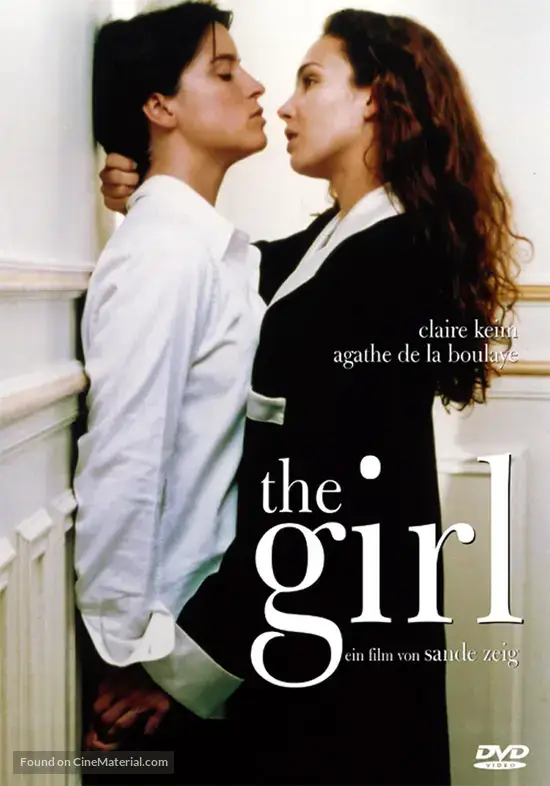
The Girl (2000): Psychological Interpretations Left by Artistic Obsession and Queer Noir
Every intense love in this world inevitably courts isolation. On the dark stage of a nightclub shielded from the gaze of others, or within the enclosed space of a private hotel room, two beings indulge in one another, attempting to construct a world entirely their own. However, when external patriarchal power and the fractures of reality penetrate those seemingly impenetrable walls, love transcends pure emotion and mutates into a struggle for survival and dignity. The Girl traces this longing for an unpossessable subject, and the destructive solidarity brought forth by that longing, through a cold yet burning noir lens.
🌿 Moments This Film Deeply Penetrates
- For those who wish to breathe in a language unique to themselves amidst social oppressions that confine the essence of existence
- For those who want to witness the precarious boundary between artistic inspiration and destructive obsession through sensory mise-en-scène
- For those who wish to break away from male-centered narratives and discover a hidden gem of classical queer cinema filled with poetic monologues and symbolism
The reason to read until the end is that beyond simple romance, this review perfectly reinterprets the textual depth of the original work by feminist theorist Monique Wittig, along with the meaning of structural liberation embedded in the conclusion.
🎞 Notes Before Viewing
This work captures the deep emotional communion and sensual attraction between women through poetic direction. While noir elements of physical violence and control flow beneath the surface, it is an aesthetic piece that unfolds around the internal conflicts and psychological tension of the characters rather than provocative depictions.
🎬 Film Information
- Title: The Girl (2000)
- Director: Sande Zeig
- Screenplay: Monique Wittig, Sande Zeig
- Original Work: Short story The Girl – Monique Wittig
- Country: France / USA
- Genre: Psychological Drama, Queer Romance, Noir
- Running Time: 84 minutes
- Platform: Mubi, Amazon Prime Video (Selected Regions)
- Cast: Claire Keim (as The Girl), Agathe De La Boulaye (as The Artist)
📖 The Girl, A Severe Attraction in Paris Brought by Art and Fascination [No Spoilers]
The ‘Artist’, an nameless painter filling her own canvases in Paris, encounters ‘The Girl’, a red-haired woman singing at a jazz club, and feels an intense inspiration at first sight. To the Artist, she is not merely an object of fascination, but an absolute salvation that will complete her artistic world.
The two are soon drawn to each other and develop into deep lovers, but behind The Girl’s life lurks the reality of an underworld entertaining wealthy men, and the violent control of ‘The Man’, a club owner who seeks to possess her completely. ‘Bu Savè’, the Artist’s long-time lover, warns of this destructive obsession of The Man and hands the Artist a handgun. Their relationship begins to spiral into an uncontrollable vortex of conflict as artistic slumps, stalking, and sudden disappearances intertwine.
🎨 Desire Confined to Canvas and the Power Structure of the Gaze
👁🗨 The Artist’s Gaze and the Fracture of the Objectified Subject
Through the Artist’s obsessive monologues and sketches, the film constantly preserves The Girl on screen. Here, the artist stands in the position of observer and creator, exhibiting a tendency to instrumentalize The Girl as a source of inspiration for her own artistic achievement.
However, The Girl refuses to remain a fixed object existing solely within the Artist’s canvas. The weight of reality and patriarchal oppression she carries constantly betray the Artist’s romantic gaze, ultimately proving the imperfection of love like a sketch that can never be completed.
⛓ The Symbolism and Control of Patriarchal Capital Named ‘The Man’
The Man is not simply a male blinded by jealousy, but a symbol of patriarchal power itself that seeks to possess and control women as capital. Monopolizing The Girl’s voice and body, he defines her relationship with the Artist as an infringement on his private property.
In this film, male violence approaches as a material threat that dominates the screen, functioning as a device that vividly demonstrates how solid and cruel the realistic walls faced by the solidarity of the two women truly are.
🔎 Reinterpretation of the Ending: The Ruin of Solidarity and Subjective Liberation Left by Gunfire
The gunfire echoing in the final scene of the film superficially appears to be a narrative of tragic ruin. The room where both The Man and The Girl lie bleeding due to the handgun handed over by the Artist starkly reveals the horrific scars left by the duel with the patriarchal system of oppression.
However, this ending must be interpreted as the manifestation of a subjective resistance chosen by The Girl to sever the chains that oppressed her, going beyond a simple tragedy left in their relationship.
Although the Artist failed to possess her entirely and lost her love, she breaks free from obsession and achieves internal growth, finally recovering her artistic self completely. The death of The Girl is a declarative end that refuses preservation by the other and destroys the patriarchal core structure by her own hand.
Instead of a happy ending where the two fully unite, the film chooses the aesthetics of a lingering resonance where each is liberated from oppression in their own way, posing a heavy question characteristic of queer noir to the audience.
💬 The Girl: Ambiguity of Narrative and Interpretation of Female Representation
Q1. What is your view on the criticism that the film treats The Girl’s reality in prostitution or her relationship with The Man with excessive ambiguity, thereby lowering the probability of the narrative?
Pointing out such narrative unkindness is entirely valid, and for audiences accustomed to conventional mainstream narrative structures, it can be an element that hinders immersion.
However, this ambiguity is an intentional aesthetic device employed by director Sande Zeig and the original author Monique Wittig.
This is because the work does not profess to be a realist film kindly explaining the characters’ backstories, but rather poetic symbolism showing a world filtered through the subjective gaze and psychological lens of the observer, the Artist.
The context was deliberately excised to visualize the existence of The Man not as a specific villain, but as a massive systemic oppression. Whether to view this as a cinematic failure or accept it as a highly literary omission ultimately depends on the aesthetic choice of the audience.
Q2. Doesn’t the way Bu Savè, the Artist’s former lover, is depicted as a saint-like figure who hands over a handgun without jealousy lack realism?
When viewed through the grammar of a typical romantic drama, Bu Savè’s bystander-like attitude and detachment feel unrealistic.
However, from a structural perspective, Bu Savè is a character who metaphorically represents the possibility of the most important alternative solidarity in this film.
Contrasting with the Artist’s immature love that seeks to monopolize and possess the other, she presents a model of a mature female relationship that maintains distance and acknowledges existence as it is.
The act of handing over the handgun is also closer to a warning to subjectively resolve the realistic threat faced by the Artist rather than simple complicity. Therefore, depending on how one interprets the instrumentality of this character, the contemporary value of the work can be read differently.
✨ The Girl: A Cruel Yet Beautiful Record of Indulgence That Tore Down a World of Oppression
Despite being a film from the early 2000s, the conclusion of The Girl touches upon the fundamental question we constantly ponder in 2026: “What is the correct gaze toward the other?” The film poetically indicts how the sublime language of love can degenerate into a power that objectifies others, and why the solidarity of women within the pimp-like system of patriarchy cannot help but be so precarious and destructive.
It does not stop at beautifully packaging the love of a minority, but stares into the discord of class and desire within it. In this respect, this work is a structural text that goes beyond mere romance.
The artistic romance of attempting to save another only repents its own arrogance after witnessing the ruin of that very other.
🕯️ When We Realize Love Cannot Be Salvation
We often fall into the illusion that we can resolve the misfortune of the person we love on their behalf. However, just as the gun handed over by the Artist ultimately returned as a tragedy, sometimes silence kept at a distance is a way to protect the dignity of the other rather than clumsy intervention.
If you were the Artist, would you hand a handgun to your precarious lover to protect herself, or would you acknowledge her reality and quietly leave her side? Please share your deep thoughts in the comments.
🍇 Another Perspective of Violet Screen: Female Narrative Curation
The Duke of Burgundy (2014)
- Reason for Recommendation: A masterpiece that portrays, through sensory mise-en-scène, how the boundaries of dominance and submission are inverted and dismantled through an intricate sadomasochistic relationship unfolding between an entomologist and her assistant. While The Girl opted for noir darkness, this work dissects the hidden power of relationships with a fluid aestheticism akin to the fluttering of a butterfly’s wings.
Erupcja (2025)
- Reason for Recommendation: A psychological drama that sharply captures the complex emotional sparks and relational fractures between two women within a sensory and experimental mise-en-scène. By intensely directing the psychological dynamics of characters precariously swaying on the boundaries of possession and freedom, attraction and lack, it re-envisions the characteristic sensual yet noir tension with a modern sensibility.
To provide a more stable publishing environment, multilingual content, and better communication with our readers, we have moved our official publication to Substack.
All new film reviews and critical essays will be published on our new platform. This website will be closing down soon, so we would greatly appreciate it if you subscribed to our new space.
TODAY'S QUESTION
When did you first feel fully accepted for who you are?
Your answer isn't saved. Feel free to share it in the comments below.


You May Also Like
Happy End?! (2014) Review: Departing an Isolated Orbit to Find Life’s Radiant Desire Beside Death

When We Met (2025) Review | A Poignant GL Interpretation Born at the Intersections of Shared Loss and Reality