Analysis of Girl Rules (2026): A Review of Women’s Intense Love Blooming Beyond Taboos
Love does not always arrive in a state of flawless perfection. Rather, it often descends with a destructive face, shattering the very defenses we meticulously erect or the past wounds from which we most desire to flee. We establish “rules” for ourselves to avoid being hurt, yet it is only at the precise moment those rules collapse that we truly confront our authentic selves.
Beneath the glamorous veneer of the fashion and advertising industries, the Thai GL drama Girl Rules captures the desire and solidarity of six flawed women through a sensory yet razor-sharp lens.
🌿 Moments When This Drama Deeply Permeates
- For those who have ever hidden behind the safe boundary of being “just friends” while pretending to be detached, unable to break free from the trauma left by a past lover.
- For those who choose to embrace the unfamiliar, burning desires surging from within, rather than the social standards and stable futures prescribed by others.
- For those who appear flawless on the outside but remain infinitely fragile within, seeking solace in someone’s firm rejection and sincere gaze.
- Why you must read to the end: Because it astutely dissects the emotional liberation and structural significance of the finale achieved when these six women shatter the taboo of “do not love her” amidst an intertwined chaos.
🎞 Note Before Watching
While this production boasts a sophisticated and sensory mise-en-scène befitting its fashion and advertising agency backdrop, the execution explicitly depicts emotional and physical attraction with considerable boldness and intensity. Rather than serving as mere provocative stimulation, these scenes function as critical narrative devices that expose the characters’ psychological voids and shifting power dynamics; thus, viewing with a strict focus on the emotional trajectory is highly recommended.
🎬 Series Information
- Title: Main Rules: Do Not Love Her (Original Title: กฎหลัก…ห้ามรักเธอ / English Title: Girl Rules) (2026)
- Director: Tichakorn Phukhaotong (Jojo)
- Screenplay: Tichakorn Phukhaotong
- Country: Thailand
- Genre: Romance, Drama, GL (Girls Love)
- Running Time: 12 Episodes (approx. 45–50 minutes per episode)
- Platform: GMMTV
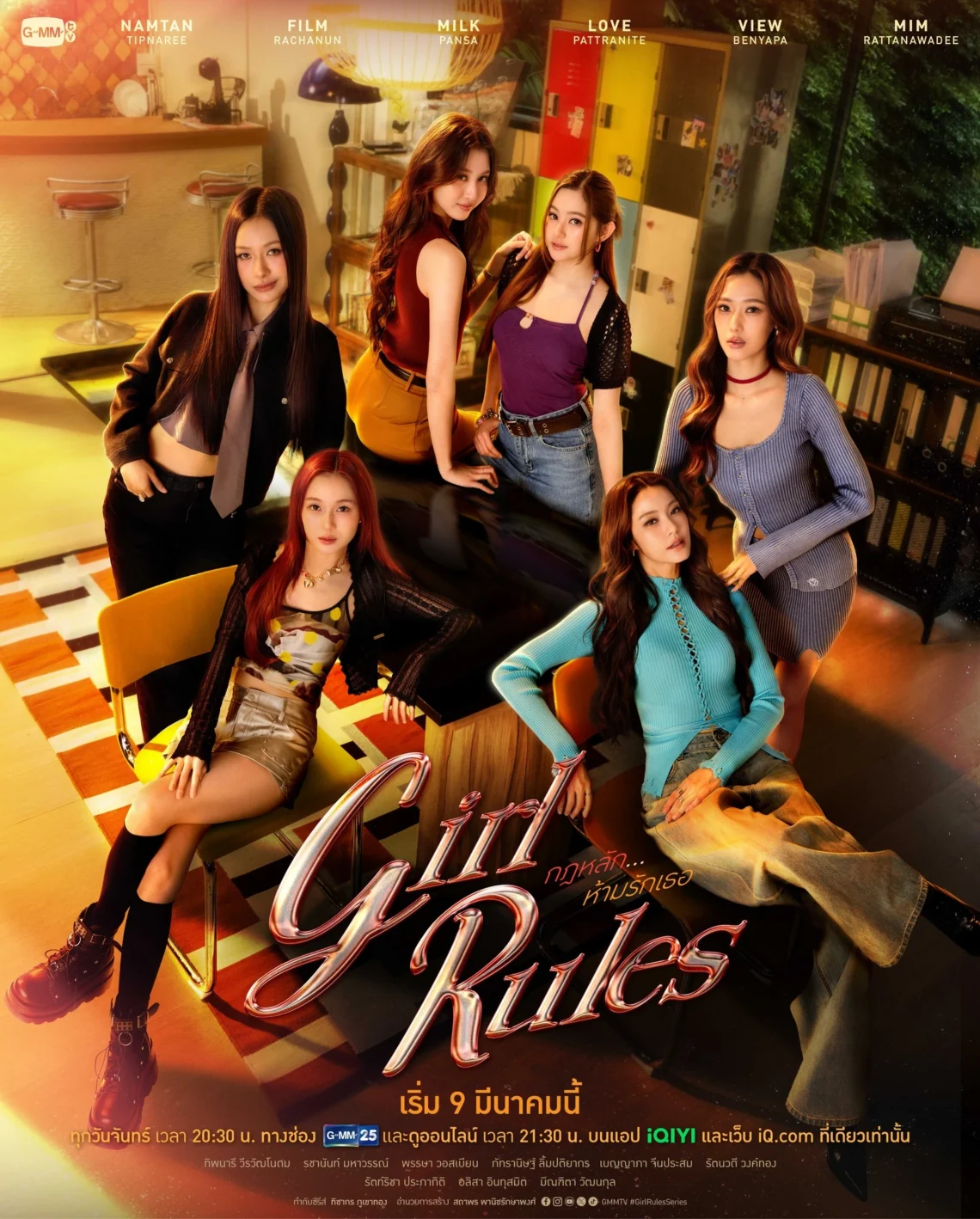
- Cast: Tipnaree Weerawatnodom (Namtan), Rachanun Mahawan (Film), Pansa Vosbein (Milk), Pattranite Limpatiyakorn (Love), Benyapa Jeenprasom (View), Rattanawadee Wongthong (Mim)
📖 Girl Rules, A Chaos of Six Intertwined Women Beyond Taboos [No Spoilers]
Into the world of Prim (Namtan), a talented director who co-founded the advertising and media agency ‘Lady Bird Production’, steps her ex-girlfriend Bambi (Film)—a project manager for a renowned fashion brand who previously abandoned her without warning. Approaching Prim under the pretext of business, Bambi delivers the cruel proposition that they remain “friends,” even as an intense vortex of physical and emotional attraction continues to swirl between them.
The situation escalates into a tense four-way dynamic with the entanglement of Gorya (Love), a freelance stylist who has harbored a secret, unrequited crush on Prim since high school, and Shasha (Milk), a top model who aggressively pursues Gorya with overt possessiveness. Meanwhile, producer Min (View), suffocating under the pressure of an impending marriage to her boyfriend, encounters Praew (Mim), a bartender and photographer at a lesbian bar, triggering her first profound existential crisis of identity and an awakening of desire. Bound together as a business team tasked with executing a single fashion campaign, the boundaries of work, friendship, and love dissolve, plunging the six women into an uncontrollable emotional maelstrom.
🔗 Exes and Chase: Deconstructing Relational Power Structures and Psychodynamics
💔 Prim & Bambi: The Contradiction of “Friends” Sharing the Same Bed
The primary axis of this narrative, the relationship between Prim and Bambi, is entirely governed by ghosts of the past—specifically, déjà vu and lingering attachment. Although Bambi maintains the justification that she left to protect her partner’s career, her departure left a deep scar of abandonment anxiety within the deserted Prim.
Following their reunion, the term “friends” proposed by Bambi operates merely as a selfish defense mechanism designed to evade vulnerability. Their contradictory behavior—acting as strict business partners by day and sharing physical warmth in intimate spaces by night—develops into a psychological psychological battle to retain emotional dominance. Tethered by the chains of lingering attachment, this relationship proves that no forward momentum is possible without fundamentally untangling the knots of the past.
🐆 Shasha & Gorya: The Collision of Push-and-Pull Within a Hard Exterior and Soft Interior
The arc between the perfectionist model Shasha and the fiercely guarded stylist Gorya takes the explicit structural form of a chase. For Gorya, who has spent years confined to the shadows of an unrequited love by looking only at Prim, Shasha’s uninhibited flirting arrives as both a threatening and seductive provocation.
The rigid wall built by Gorya begins to fracture under Shasha’s relentless persistence, yet the compelling element here is the total subversion of their power dynamic. Shasha, who conceals a profoundly fragile interior beneath a dazzling exterior, exposes her own deficiency when confronted with Gorya’s cold rejection. Through the very process of pushing Shasha away, Gorya finally realizes she can escape Prim’s shadow and claim her own autonomous desire.
🏳️🌈 Min & Praew: The Awakening of Identity Shattering Social Oppression
The narrative line between Min and Praew stands out as the most brilliant queer discourse within this series. Min is a character gradually losing her sense of self under the suffocating weight of a long-term boyfriend, familial expectations, and the oppressive mandate of “normativity” demanded by a patriarchal society.
Her encounter with Praew, a free and unapologetic lesbian, transcends simple romantic sentiment to present Min with a cataclysmic deconstruction and subsequent expansion of her worldview. Praew acts as a catalyst that destabilizes Min’s reality, forcing her to look squarely at the genuine internal desires she had suppressed for so long. Min’s trajectory of discarding her social mask to exist purely as her authentic self carries the most sublime value of independence within this chaotic network of relationships.
🔎 Reinterpretation of the Finale — The Complete Establishment of Autonomy Atop Ruined Rules
The final episode of Girl Rules refuses to artificially sew up the tangled threads of its chaotic plot. The subversion of the mandate “do not love her” ultimately yields the paradoxical interpretation that true growth becomes attainable only when one dismantles the defensive barriers constructed out of fear or external social conditioning.
In the conclusion, after enduring a complete collapse manifested through jealousy, betrayal, and exposed secrets, the six women finally relinquish the possessiveness and lingering attachments that bound them. Prim and Bambi confront their past trauma directly and choose a new paradigm of solidarity that leaves them unencumbered by ownership over one another; Min decisively casts off the shackles of oppressive normativity; and Gorya and Shasha establish an equitable dynamic rooted in the mutual recognition of their respective vulnerabilities.
What this ending leaves behind is not the hollow dissolution of relationships, but the radiant growth of individuals who have surrendered a false sense of security derived from external rules to claim their internal dignity. While their lives beyond the credits will undoubtedly remain complex and fluctuating, none of them will ever again be governed by the gaze of onlookers or the trauma of the past.
The finale of this drama is not a binding contract guaranteeing the eternity of a relationship, but an autonomous declaration of independence by women taking absolute responsibility for themselves.
💬 The Value of Female Representation in a Messy Sapphic Narrative
Q1. The relationships are highly convoluted and the emotions are quite volatile; wouldn’t this naturally polarize audiences?
Compared to traditional media paradigms where female relationships are sanitized into submissive, harmless friendships or one-dimensional, pure narratives of devotion, the “messy” trajectory of this piece will inevitably induce discomfort for certain viewers. The entanglement of jealousy, ambition, betrayal, and raw physical desire appears highly provocative on the surface.
However, this narrative holds immense critical value because it refuses to confine women to the archetypes of flawless, moral saints or helpless victims, choosing instead to fully validate them as complex entities possessing inherent human desires and selfishness. This structural complexity, which encompasses both ugliness and vulnerability, operates as an aesthetic device that accurately reflects the multi-layered psychology of real-world women.
Q2. What differentiates this production from the conventional tropes of Thai GL dramas?
While a vast majority of existing GL content remains strictly focused on school settings or idealized, pure romantic fantasies, this series distinguishes itself by intersecting professional power dynamics within the workplace with the socio-political oppressions of the real world (as seen in Min’s arc).
Rather than reducing the narrative to whether the two primary leads achieve a romantic union, the series seamlessly integrates the characters’ professional ambitions, workplace alliances, and the awakening of their sexual orientations. This represents a highly sophisticated attempt to expand queer narratives into the mainstream arena of polished ensemble office dramas.
✨ Girl Rules, Retrieving the Dignity of Existence from the Shards of Desire
Borrowing the framework of romantic love, this drama ultimately confronts contemporary society with a painful, lingering question: “Do you possess the courage to live without deceiving yourself?” Falling from the heights of a glamorous industry where they constantly performed for the external gaze, these six women paradoxically discern what is truly valuable only after hitting absolute rock bottom.
Relationships can fracture and love can mutate, but the narrative of self-discovery forged through that chaos remains indelible. At the exact locus where every rule designed to control desire collapses, authentic life finally begins.
The wandering journeys of these women who shattered the taboo of love represent the sublime process of ultimately becoming the sole legislators of their own lives.
🔮 On Unlocking the Internal Gates
We impose countless restrictions upon ourselves to avoid being wounded. We attempt to govern our hearts, whispering, “Let’s not get any deeper,” or “Maintain a proper distance.” Yet, wasn’t the exact moment that completely altered your life always the one where those very rules were utterly demolished?
What was the most courageous taboo you willingly shattered to connect fully with another human being, and what did your true face look like when the dust of that collapse finally settled? Please share your story with us in the comments below.
🍇 Violet Screen’s Curated Recommendations for Female Narratives
- 《윤희에게 (Moonlit Winter, 2019)》Reason for Recommendation: Set against the snow-covered backdrop of Otaru, this film traces the narrative of ‘Yoon-hee’, a woman who has concealed her true identity for decades under social oppression and the heavy mantle of familial responsibility.
- 《Heart Code (2026)》Reason for Recommendation: This series follows ‘Vicky’, the daughter of a powerful police official who secretly enters an elite training program to evade assassination threats, and ‘Thara’, a disciplined officer pursuing vengeance for the family she lost nineteen years ago.
To provide a more stable publishing environment, multilingual content, and better communication with our readers, we have moved our official publication to Substack.
All new film reviews and critical essays will be published on our new platform. This website will be closing down soon, so we would greatly appreciate it if you subscribed to our new space.
TODAY'S QUESTION
When did you first feel fully accepted for who you are?
Your answer isn't saved. Feel free to share it in the comments below.


You May Also Like

Marienhof 2009: Kerstin and Juliette, a Release of Desire More Intense Than Chocolate
Mine (2021): Beyond Jung Seo-hyun and Choi Su-ji’s Closed Doors, a Reinterpretation of Repressed Desire