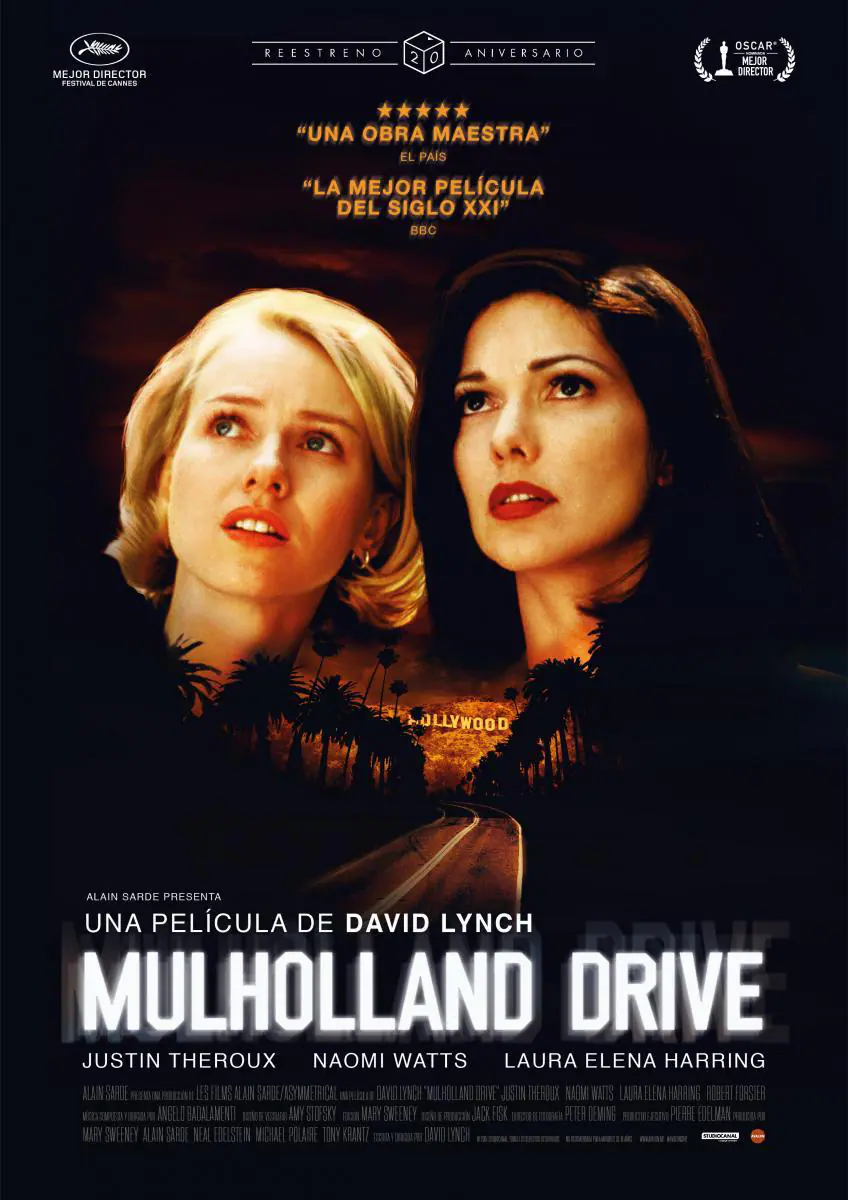
Mulholland Drive: Hollywood’s Brilliant Cruelty, the Aesthetics of Loss, and the Interpretation of Diane’s Illusion
All human beings reconstruct memory. In the face of unendurable reality and tragedy, the brain devises the most beautiful form of lie to protect itself. Director David Lynch’s Mulholland Drive is a film that takes that vast sanctuary of the unconscious as its stage.
This work is not merely an esoteric mystery thriller. It is the final scream and a poignant love song of a fractured soul, driven to deep deprivation and jealousy by an unattainable love. Within the cold interior of Hollywood hidden behind the brilliant neon signs, we witness the primal loneliness of a human being who desperately craved to be completely accepted by another.
🌿 Moments When This Film Deeply Permeates
- When one’s heart wavers under the pull of an uncontrollable fate on a road blanketed by the shroud of night
- When one feels a suffocating sense of isolation, as if left entirely alone in the world after being utterly rejected by the most beloved
- When the fear of confronting the fragments of a cold reality assails, as the sweet illusion that seemed eternal shatters
- Therefore, the reason to read to the end is to fully comprehend the aesthetics of absolute ruin hidden within the ending and the harrowing lingering imagery left by illusion, by dismantling the labyrinthine relationship between Betty and Rita.
🎞 Notes Before Viewing the Film
Rather than superficial explicitness or visual stimulation, this work is a film with exceedingly high emotional tension generated by the psychological fractures of the characters and the hallucinatory atmosphere. As the narrative centers on the deep emotional bond and poignant relationship between two female characters, it is recommended to listen closely to the eerie yet mournful sorrow flowing through the bizarre and surreal mise-en-scène.
🎬 Film Information
- Title: Mulholland Drive (2001)
- Director: David Lynch
- Screenplay: David Lynch
- Country: USA
- Genre: Mystery, Drama, Thriller, Surrealism
- Running Time: 146 minutes
- Platform: WAVVE, Watcha
- Cast: Naomi Watts, Laura Harring, Justin Theroux
📖 Mulholland Drive, a Cruel Fairy Tale of Two Women Lost on the Border Between Dream and Reality [No Spoilers]
Betty, an innocent and immensely talented aspiring actress who has just arrived from Canada dreaming of success in Hollywood, stays at her aunt’s apartment. There, Betty encounters an unexpected individual: Rita, a mysterious dark-haired woman who has hidden away after losing her memory in an enigmatic car accident.
For the sake of Rita, who cannot even remember her own name, Betty joins the journey to uncover her identity. In the process of tracing clues, the two women form a deep emotional communion and a dense sense of solidarity.
However, upon discovering a massive amount of cash inside a mysterious bag and a peculiarly shaped blue key, the atmosphere surrounding the two women begins to cool rapidly. As ominous signs hovering nearby and the enigmatic forces pressuring the film director Adam lock together like cogs, Betty and Rita perceive a massive fracture in the world they have stepped into.
🎭 The Mirror World of Betty and Rita: An Analysis of the Ideal Self Projected by Desire
The relationship between Betty and Rita that dominates the first half of the film demonstrates a perfect mutual interdependence and an ideal narrative of salvation. Betty is depicted as a flawless being possessing both talent and purity, while Rita is portrayed as a harmless, mesmerizing entity who has lost her memory and depends entirely and solely on Betty.
Examining this character structure analysis, Betty is the manifestation of the “ideal self” dreamed of by Diane, who experienced failure and despair in actual reality. Conversely, Rita is the product of a perfect fantasy, recreating Camilla—who betrayed and abandoned her—into a pure entity incapable of doing anything without her.
The mirror-like structure in which the two face each other becomes a sweet refuge that fulfills their respective deficiencies, but this ultimately amounts to nothing more than a massive defense mechanism of the unconscious designed to conceal the guilt of reality.
🕯 The Hallucination of Club Silencio: “Everything is a Recorded Illusion”
The space of “Club Silencio,” which serves as a pivotal turning point in the film, showcases the essence of the surrealist mise-en-scène inherent in this work. The master of ceremonies’ declaration that “there is no band on stage, and everything is an illusion” is a meta-structural device warning that the beautiful world of dreams built by Diane will soon collapse.
The sight of Betty and Rita shedding tears to the sorrowful song sung by Rebecca Del Rio reveals that they unconsciously intuited that their love and existence were transient, like smoke bound to disappear soon.
The bizarre staging, where the song continues to flow even after the singer collapses, exposes the limitations of the falsely woven space, guiding the audience toward the key that opens the blue box of brutal reality that Diane must confront.
🔎 Reinterpretation of the Ending — The Dissolution of Dignity Brought by Absolute Ruin
In the latter half of the film, the collapsed reality of Diane Selwyn as she awakens completely upends the points of observation. The moment the true nature of Diane—who was abandoned by the successful actress Camilla Rose and, consumed by jealousy and despair, commissioned her assassination—is revealed, the beautiful fairy tale of the first half is subverted into a horrific cruelty.
The blue key Diane receives from the hitman is the confirmation signal signifying Camilla’s death, as well as the evidence of a finality that has completely ruined her own soul.
The final moments of Diane, who chooses suicide in her bedroom to escape the spirits of the elderly couple constricting her within her hallucinations, demonstrate the absolute end met by a human being who lost love and ultimately lost even herself. Diane’s suicide is both an escape from guilt and a declarative ruin that erases her own existence from a world devoid of Camilla.
❓ Interpretation of the Narrative Structure and Ambiguity of Female Representation in Mulholland Drive
Q1. Does the “dream” narrative in the first half of the film suffer from the limitation of dismissing the relationship between women as a mere illusion?
Certain critics raise a nihilistic critique that the poignant emotional solidarity and love between Betty and Rita are ultimately nothing more than a hallucination born of Diane’s guilt. However, analyzing this structurally, it functions instead as a aesthetic device that paradoxically demonstrates what the purest form of salvation was for a woman traumatized within the harsh oppression of reality and the power dynamics of Hollywood. Rather than a simple illusion, it is valid to interpret it as a narrative that proves the magnitude of the desire for a true union that could not be achieved in reality.
Q2. What specifically do the vagrant (monster) behind Winkie’s diner and the blue box symbolize?
The bizarre vagrant behind the diner is an entity visualizing the horrific truth of the “commissioned murder” and the moral degradation residing in the deepest recesses of Diane’s unconscious. Furthermore, the blue box is a Pandora’s box that opens the door to the ugly reality that had been repressed. The structure in which the world of the dream is sucked into this box and closed can be viewed as a visual token signifying that Diane can no longer escape into illusion and must face the transgressions she committed.
✨ Mulholland Drive, a Blue Silence Blooming from the Ashes of Desire
This film fiercely demonstrates through the tragedy of the character Diane how an individual is worn down and ruined within the massive melting pot of desire that is Hollywood. The obsessive longing for love and success ultimately leads to self-destructive jealousy, and further creates a prison of illusion that confines oneself.
Through this, director David Lynch sharply questions how human identity can be distorted within relationships with others. The tragedy faced by Diane is an extreme portrait of the primal deficiency—the desire to be recognized and loved—harbored by all of us living in modern society.
Silencio. Upon the stage permeated by silence, the most brilliant lie of humankind is finally completed.
🔮 Illusion and Reality: Which is Your Choice?
When faced with unendurable pain, we often build a beautiful virtual world of our own and hide within it, just as Diane did. Between a life spent within a brilliant illusion that grants perfect happiness for that fleeting moment even if its end is ruin, and a life spent in a cold reality where one must fully bear the weight of one’s own soul despite it being miserable and agonizing—which life would you choose?
🎬 Violet Screen Curation: Another Aesthetic of Deep Relationships
- Persona (1966)Reason for Recommendation: A masterpiece by the maestro Ingmar Bergman, dealing with the psychological progression wherein the identities of two women—an actress and a nurse—become mysteriously entangled, fractured, and begin to subvert one another. It is a classic psychological thriller highly recommended for those who appreciate the psychic suspense generated when the boundaries between two female characters collapse.
- Bloomington (2010)Reason for Recommendation: A queer drama that densely depicts the sharp, delicate emotional curves and psychological conflicts between two women blooming within the power dynamics of a teacher-student relationship.
TODAY'S QUESTION
Which ending has stayed with you the longest?
Your answer isn't saved. Feel free to share it in the comments below.


You May Also Like
Blue Jean (2022) – Survival as Silence and Salvation as Solidarity: Interpreting the Intimate Fracture
Green Night, a Dark Green Liberation and Solidarity Depicted by Female Queer Noir