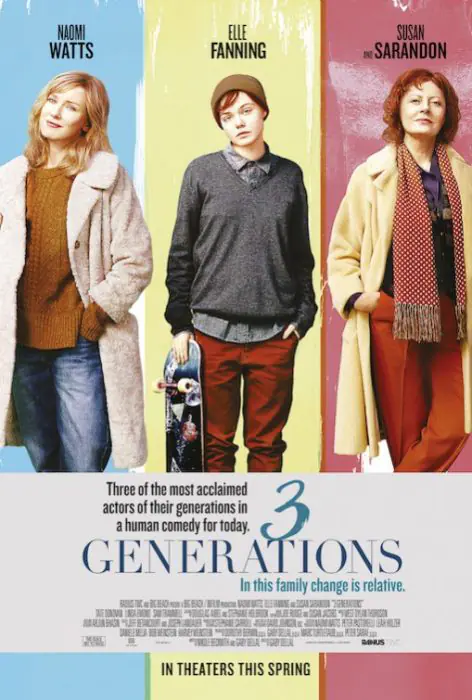
3 Generations, An In-Depth Analysis of Generational Solidarity and Identity Acceptance
Every human being lives with a fundamental sense of isolation, carrying the weight of not being fully understood by others. When that isolation stems from a discordance between one’s physical body and inner identity, loneliness transitions directly into a matter of survival.
The film 3 Generations (About Ray) is a history of three women who dismantle the walls of disconnection to hospitably embrace one another’s worlds.
🌿 Moments When This Film Deeply Permeates the Soul
- On nights when the gender framework prescribed by society feels exceptionally heavy and alienating
- When the existence of those closest to you—your family—approaches instead as a wall blocking your very essence
- When you wish to believe in the power of solidarity that fully embraces another’s pain across an immense generational divide
- For those who need the courage to step away from the gaze of others and walk forward as their authentic self
- To verify the reason why the warmth shared by these three women lingers eternally in the heart, even after the closing credits roll
🎞 Note Prior to Viewing the Film
This work meticulously captures the gender identity struggles of a teenager and the psychological conflicts of the family surrounding them. In lieu of provocative or sensationalized depictions, the narrative unfolds through a warm perspective with which all age groups can empathize, anchoring its central axis on the characters’ emotional swells and relational shifts.
🎬 Film Information
- Title: 3 Generations (About Ray, 2015)
- Director: Gaby Dellal
- Screenplay: Gaby Dellal, Nikole Beckwith
- Country: United States
- Genre: Drama, Comedy
- Running Time: 92 minutes
- Platform: Naver Series On, Wavve, Watcha
- Cast: Elle Fanning, Naomi Watts, Susan Sarandon
📖 3 Generations, A Journey to Finding One’s True Self Beyond Generational Conflict [Spoiler-Free]
Living in a New York home with his grandmother and mother, 16-year-old Ray has long felt alienated by his own body and establishes his identity as a male.
Ray finally resolves to begin hormone replacement therapy and prepare to transfer to an all-boys school, but he confronts a legal barrier: the transition process for a minor requires the written consent of his biological father. Ray’s mother, Maggie, supports her child’s decision intellectually, yet she hesitates to sign when faced with the reality of such a monumental transformation, setting out instead to locate the long-estranged biological father.
Meanwhile, the grandmother, Dolly, who has lived a progressive life as a lesbian, exhibits generational differences in perspective when confronted with Ray’s declaration of his transgender identity, leading to internal conflict.
As a buried family secret surfaces during the search for the biological father, driving Ray’s feelings of betrayal and despair to a crescendo, the three generations of women confront their respective wounds and face a major turning point.
🎨 The Three-Dimensional Structure of Generational Female Narratives Shown in 3 Generations
While this work deals with the process of Ray’s gender transition, it is essentially a film that provides an in-depth analysis of the solidarity among three generations of women and the formation of an expanded family structure.
The grandmother, Dolly, is an individual who pioneered her own identity and benefited from past LGBT rights movements, yet she offers a pragmatic compromise to her grandchild’s transgender declaration, asking, “Why can’t he just be a lesbian?” This functions as a sophisticated device that exposes the subtle trajectories and divergence in perspectives between 20th-century feminism and 21st-century queer discourse.
The mother, Maggie, oscillates violently between a maternal obligation to be the perfect supporter and a defense mechanism wishing to shield her child from social hardships. The superb merit of this film lies in its interpretation of Maggie’s hesitation not as mere obstruction, but as the universal fear and growing pains experienced by a parent confronting a child’s independence.
🔎 The Deconstruction of Secrets and the Restoration of a Matriarchal Community
Maggie’s past and the hidden family history revealed during the process of seeking the biological father’s consent inflict an immense identity crisis upon Ray. The external perception of an unstable domestic background and the lack of lineage transparency seem to jeopardize the family; however, this crisis conversely serves as the catalyst that completely erases the authority of the patriarchal male figure.
At the peak of the conflict, the men holding legal consent rights remain consistently impotent or bystanders, whereas those who confront the problem head-on and take Ray’s hand are ultimately the women remaining in the home. The film proves through its mise-en-scène and sharp dialogue that the density of time spent sharing daily life and awkwardly adjusting to one another is far more vital than the purity of biological ties.
🔎 Reinterpreting the Ending of 3 Generations, A Declaration of Dignity for Standing as an Authentic Self
In the film’s ending, having navigated all conflicts, Ray finally takes his first step into hormone therapy amidst the unreserved support of his family. This conclusion transcends a private victory of a teenager establishing his gender identity; it serves as a visual salvation demonstrating that the relationships among the three women have finally attained a ‘complete resonance.’
What Ray gains is the autonomy to govern his own body, and what he loses is the loose, hypocritical illusion of biological determinism. In this process, the mother, Maggie, grows as an individual by relinquishing a controlling maternal grip, and the grandmother, Dolly, breaks through her own dogma to learn the solidarity of a new era.
Family is not a bond of blood, but a continuous process of learning how to unconditionally welcome one another’s way of being.
Through the final moment where Ray faces the mirror as a young man, the film leaves a definitive resonance regarding how the dignity embedded within the soul, rather than mere physical alteration, ultimately redeems a human being.
💬 Limitations and Aesthetic Controversies in the Transgender Representation by a Cisgender Actor
Q1. What were the controversies surrounding Elle Fanning’s casting at the time of release, and what are the limitations of the work?
There was severe criticism from the contemporary queer cinema camp regarding the casting of Elle Fanning, a cisgender female actor, to play the role of Ray instead of an actual transgender male actor. The core of the critique was that casting lacking lived experience objectifies the transgender body merely as a ‘playable role’ to be performed.
From an editorial perspective, this criticism is entirely justified and remains a structural limitation. However, director Gaby Dellal focused heavily on depicting the vulnerability prior to physical transition and the alienation immediately preceding hormone therapy, striving aesthetically to express the character’s internal solitude. This point of divergence remains an open interpretation depending on how heavily the audience weighs the necessity of authentic representation.
Q2. Why should this film be treated as significant within reviews centered on female narratives?
3 Generations breaks away from male-centric narrative structures and intelligently utilizes a matriarchal triangular framework spanning grandmother, mother, and grandchild. While using traditional patriarchal legal order (the biological father’s consent) as the narrative engine, it offers a contemporary lesson by ensuring that the agents who resolve the crisis and autonomously reshape life are exclusively the women. Its aesthetic value is substantial in that it escapes narrative repetitiveness and embraces queer discourse within the framework of feminist solidarity.
✨ 3 Generations, A Coastline of Solidarity Reached Beyond the Waves of Identity
The ending of this film points toward a landmark direction for diversified family structures in modern society, moving beyond an individual’s personal quest for gender identity. We often attempt to possess or judge others in the name of love, but authentic love is the act of maintaining a respectful distance and offering a place by one’s side so that the other person may exist exactly as they wish to be. To modern individuals drifting amidst the confusion of relationships and identity, this film proposes a concrete manifestation of emotional solidarity deeper than blood ties. What proves my existence is not a third party’s letter of consent, but my own conviction toward my being and the validating gaze of solidarity that watches over it.
💭 Between Silence and Outcry, Where Does Your Choice Align?
We frequently conceal our most vulnerable and truthful selves from the people we love most. Between choosing silence to avoid being wounded and crying out toward the world and family to live as your authentic self, which approach was it that salvaged your life?
🔮 Queer & Female Narrative Curation Proposed by Violet Screen
- Fantasy of the Girls (2018)
- Reason for Recommendation: This film lyrically yet sharply captures the stages of admiration, jealousy, and subtle affection blooming among three girls within the space of a high school theater club. The emotional curve of adolescence experiencing identity confusion resonates closely with the wandering experienced by Ray in 3 Generations.
- The Dream Songs (2023)
- Reason for Recommendation: Set against the backdrop of a high school, this work captures the affectionate yet anxious emotional textures shared between two girls, Semi and Ha-eun, with a highly sensible visual aesthetic. The subtle sense of distance that cannot be fully articulated in words, alongside the steadfast bond supporting them, leaves a deeply poignant resonance.
To provide a more stable publishing environment, multilingual content, and better communication with our readers, we have moved our official publication to Substack.
All new film reviews and critical essays will be published on our new platform. This website will be closing down soon, so we would greatly appreciate it if you subscribed to our new space.
TODAY'S QUESTION
Which ending has stayed with you the longest?
Your answer isn't saved. Feel free to share it in the comments below.


You May Also Like
It’s in the Water (1997): A Chronicle of Liberation and the Certainty of Love Through the Era of Gay Panic

Review of Manok (Iban-ri Jang Man-ok): The Subversive Occupation of a Middle-Aged Queer Woman Breaking Isolated Boundaries