On Swift Horses (2024): An In-Depth Interpretation of Forbidden Desires and Muriel’s Gamble of Self
In the midst of an isolated life, a burning desire can sometimes become salvation rather than destruction. We all run on the orbits of others’ expectations, yet occasionally, we long to break away and set our own “stakes.”
Watching a woman confront her inner self and ultimately choose a solitary freedom within the rigid framework of the 1950s mirrors the act of facing our own hidden longings.
🌿 Moments when this film resonates deeply:
- When you wish to cast off the uniform of social roles and entrust yourself solely to your intuition.
- When a secret that cannot be told even to those closest to you becomes the sole engine of your life.
- When the fluctuations of uncertain but transparent emotions feel more urgent than a stable relationship.
Therefore, one must read through to the end to discern whether Muriel’s final gamble resulted in victory or defeat.
🎞 Note before viewing
Set against the conservative atmosphere of the 1950s, this work precisely captures the subtle psychological tension and the shifting temperatures of relationships. It is an adult narrative drama that focuses on the density of emotion and the essence of connection rather than provocative depiction.
🎬 Film Information
- Title: On Swift Horses (2024)
- Director: Daniel Minahan
- Screenplay: Bryce Kass
- Original Work: Novel of the same name by Shannon Pufahl (2019)
- Country: USA
- Genre: Drama, Romance
- Running Time: 120 minutes
- Platform: Theatrical release and major OTT services
- Cast: Daisy Edgar-Jones, Sasha Calle, Jacob Elordi, Will Poulter
📖 On Swift Horses: Gambling and Love Beyond Invisible Lines [No Spoilers]
After the Korean War, Julius, a veteran, meets his brother Lee and Lee’s fiancée, Muriel. While Lee and Muriel depart for San Diego, California, to seek a new beginning, Julius—longing for an independent life—heads to Las Vegas, causing their paths to diverge.
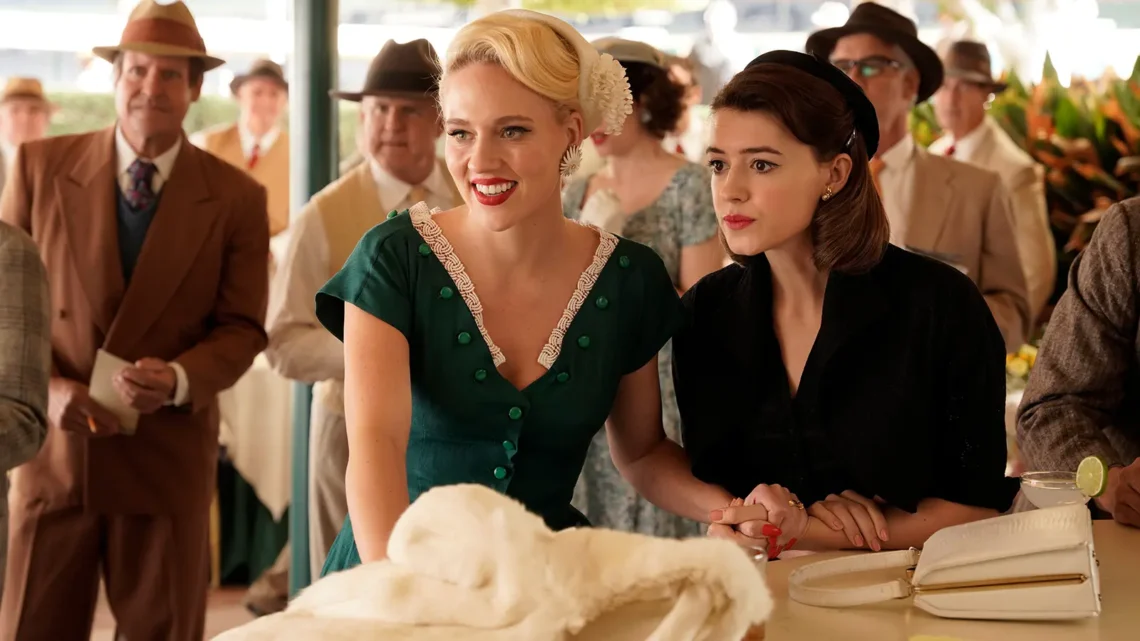
Life in San Diego appears peaceful, but Muriel increasingly feels suffocated by the stereotypical role of a 1950s devoted wife. Working as a waitress, she begins collecting hidden horse racing tips from customers’ conversations, building her own secret economic foundation through illicit gambling behind her husband’s back.
During this process, Muriel meets her neighbor, Sandra. Sandra is a character who lives with her identity proudly revealed even under the oppressive social climate, offering Muriel an emotional awakening and sense of liberation she has never experienced before. A precarious tightrope walk begins for Muriel between her comfortable life with Lee and her dangerous longing for Sandra.
🏇 The Metaphor of Horse Racing: Muriel’s Choice for Dangerous Control
For Muriel, gambling on horses is not merely a means to make money. It is an autonomous act—the only area of her life where she can produce results through her own judgment. By entering the realms of “prediction” and “betting” that were denied to women in the 1950s, she sheds the mask of “wife” imposed by the patriarchal order.
The thrill of this gamble is mirrored exactly in her relationship with Sandra. Breaking invisible rules and risking everything if caught—Muriel has essentially entered a game where she stakes not just money, but her entire life, to find her true self.
🎻 Sandra as a Mirror: The Process of Muriel’s Desire Gaining Substance
Sandra is the incarnation of freedom that Muriel admires yet fears. Seeing Sandra play Spanish music and dance confidently at the center of queer gatherings awakens the “outsider” temperament dormant within Muriel.
Their kiss transcends mere physical union; it is a ritual declaring Muriel’s total departure from the orbit of normalcy dictated by society. The afternoons spent with Sandra become an oxygen hole where Muriel can finally breathe, yet they simultaneously act as the sharpest blade threatening her hypocritical stability.
🔎 Reinterpreting the Ending — Solitary Freedom and Growth Left by the Rupture
In the film’s conclusion, Muriel leaves Lee, departing alone after leaving behind the money she earned through gambling. The catastrophe Lee faces upon witnessing their relationship paradoxically sets Muriel entirely free. While the separation from Sandra is painful, Sandra’s sharp remark—”You only wanted to invest half and keep your safety”—serves as the catalyst for Muriel to bid farewell to her cowardly past self.
Muriel returning to her mother’s old house to begin a life alone should be interpreted not as a failure of a relationship, but as the independence of the self. She has chosen a life as a singular individual responsible for her own choices, no longer just someone’s wife or someone’s lover.
Muriel’s departure is not the destruction of a relationship, but an inevitable structural collapse required to reconstruct herself as a subject.
💬 On Swift Horses: Why could their relationship not have a happy ending?
Q. Did Muriel not truly love Sandra?
From a critical perspective, one might argue Muriel consumed Sandra merely as a tool to release her own desires. However, this is closer to a survival strategy for a woman forced into a double life within the limitations of the 1950s. Muriel loved Sandra, but her world was too narrow for her to summon the social courage required to take responsibility for that love. The film adds realistic weight to the queer narrative by exposing this point rather than beautifying it.
Q. Was leaving money for Lee an act of atonement?
It is closer to the liquidation of a relationship than simple apology. By acknowledging she no longer fits into the California life Lee dreamed of and handing over her gambling winnings, she physically terminates the contractual relationship of marriage. This is interpreted as both a consideration for Lee and a final ritual for Muriel to completely liberate herself from her past role.
✨ On Swift Horses: The Solitary Dignity of One Who Broke the Shell
This film rejects the romantic illusion that love solves everything. Instead, it speaks of the solitude one faces when confronting one’s own desire, and the dignity gained when that solitude is accepted. The choice made by Muriel in the 1950s poses a heavy question to those of us in modern society who hide our true selves, trapped by the gaze of others.
True freedom is like the final card held only by those prepared to lose everything.
🐎 Questions Awaiting Your Choice
- Do we not occasionally show the cowardice of “investing only half” before the ones we love?
- Between keeping enough distance to avoid getting hurt and sincere commitment, what kind of bet are you making right now?
🎬 Violet Screen’s Recommended Curation
- Anaïs in Love (2021): The protagonist’s vibrancy in following her desires without hesitation resembles Muriel’s awakening.
- Drive-Away Dolls (2024): Moving away from the weight of period drama, this film explores women’s desires and friendships through a delightful and bold road movie format.
To provide a more stable publishing environment, multilingual content, and better communication with our readers, we have moved our official publication to Substack.
All new film reviews and critical essays will be published on our new platform. This website will be closing down soon, so we would greatly appreciate it if you subscribed to our new space.
TODAY'S QUESTION
When did you first feel fully accepted for who you are?
Your answer isn't saved. Feel free to share it in the comments below.


You May Also Like
Affinity (2008) – The Interaction of Deception and Longing Within a Closed Circuit of Prison

Whispering Corridors 4: Voice — A Chilling Sonic Tragedy Born of Lack and Possessiveness