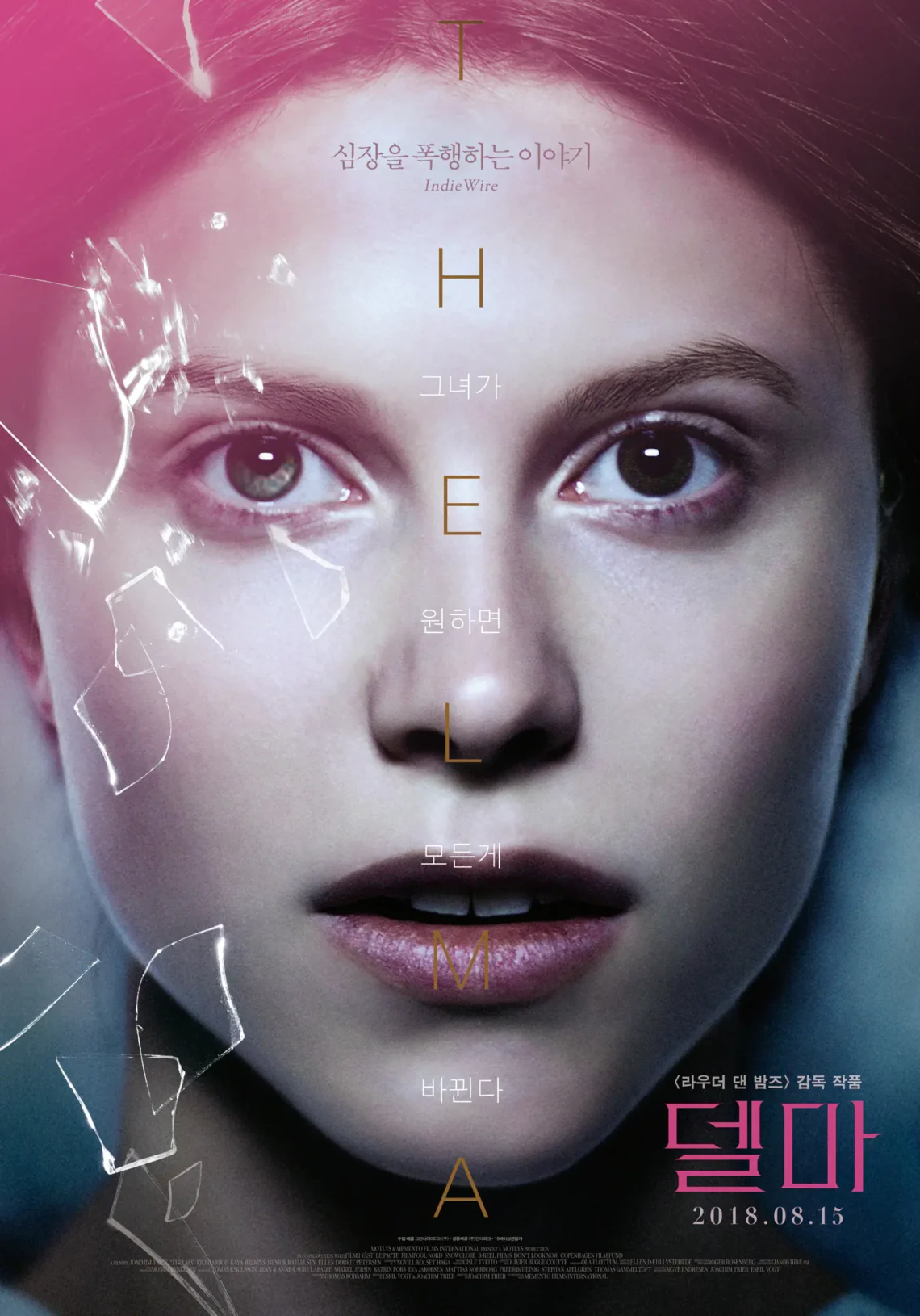
Thelma: The Eruption of Suppressed Desire and the Narrative Liberation of Surreal Awakening
The most deeply hidden human instincts can sometimes become a catastrophe, and at other times, the only means of escape. We believe we are in control of ourselves, but in reality, what we control may not be our essence, but merely the thin glass wall encasing it.
Director Joachim Trier’s Thelma is a work that depicts the moment that glass wall shatters in a manner both coldest and most fervent. This story—concerning a prison named faith, a taboo named love, and the transcendental power that breaks through them all—asks us: Is that which you so desperately desire a blessing, or a curse?
🌿 Moments Where This Film Resonates Deeply
- Those who have ever self-censored, believing that peace can only be maintained by denying their own identity.
- Those who have felt suffocated by parental overprotection that felt less like love and more like “castration.”
- Those who have experienced intense attraction toward someone manifesting as physical pain, intertwined with guilt.
The reason to read until the end is that the conclusion of this film is not a simple happy ending; it is a narrative victory showing a woman transmuting her “destructive instinct” into “creative power.”
🎞 Note Before Viewing
This work includes images that are somewhat grotesque or shocking in the process of visualizing physical seizures and supernatural phenomena. Rather than explicit sexuality, it is a psychological thriller where the taut tension between characters and suppressed homoerotic desire act as the core engines of the narrative.
🎬 Film Information
- Title: Thelma (2017)
- Director: Joachim Trier
- Screenplay: Joachim Trier, Eskil Vogt
- Country: Norway, France, Denmark, Sweden
- Genre: Mystery, Thriller, Drama, Fantasy
- Running Time: 116 minutes
- Platforms: Naver Series On, Google Play Movie
- Cast: Eili Harboe, Kaya Wilkins, Henrik Rafaelsen, Ellen Dorrit Petersen
📖 Thelma: The Process of Power Sealed in God’s Name Meeting the Key of Desire [No Spoilers]
Thelma, a university freshman raised in a strict Christian household, begins her college life in Oslo under the thorough surveillance of her parents. Amidst an unfamiliar environment and an isolated daily routine, she meets her free-spirited classmate Anja and feels a bewildering, intense attraction unlike anything she has ever felt before. However, as she suppresses her desire, defining it as sin in the name of faith, Thelma’s body begins to respond with seizures of unknown origin.
These seizures are not merely a medical condition, but a flare signaling the eruption of the supernatural power latent within her. As her longing for Anja deepens, her surroundings change unnervingly, eventually leading to events where the boundaries of reality collapse. Facing the secrets of a family that constricts her and the truths of a twisted past, Thelma stands at a dangerous crossroads between the life of a “pure daughter” defined by others and the “forbidden power” she chooses for herself.
🕊️ Suppressed Eroticism Symbolized by Seizures and the Collapse of Power Structures
The psychogenic non-epileptic seizures Thelma experiences in this film are not simply medical symptoms. They represent a violent collision between the “Superego,” constructed by patriarchal religious views and parental control, and the “Libido,” awakened through the existence of Anja. Whenever Thelma’s desire grows, the film visualizes the internal energy physically striking the external world through mise-en-scène, such as birds colliding with glass windows or flickering lights.
In particular, the father’s act of calling daily to check Thelma’s every move is surveillance disguised as protection. The father is aware of Thelma’s abilities and seeks to control them by defining them as “evil.” However, the moment Thelma begins to physically contact Anja and accept her own emotions, the walls of the order established by her father begin to crack. This is the process of a suppressed subject reclaiming her physical agency, and simultaneously, the moment when castrated desire is transmuted into power.
🐍 Flames of Guilt and the Baptism of Self: Joachim Trier’s Directorial Intent
Director Joachim Trier maps Thelma’s psychology by combining supernatural horror elements within the cold, static atmosphere characteristic of Northern Europe. The lake in the film is both Thelma’s unconscious and the place where secrets are buried. The cold water that drowned her younger brother in childhood returns to the adult Thelma, seeking to judge her.
However, the director does not leave Thelma as a victim. The “flames of hell” warned of by her father paradoxically become the tool that consumes him. This signifies that Thelma has fully internalized the fear instilled by others as her own weapon. The scene where she walks into the lake to wash herself symbolizes the birth of the self, performed by her own will rather than a forced baptism by others. Thelma now accepts the voice of desire echoing from within—rather than the voice of God—as sacred.
🔎 Reinterpreting the Ending: The Ruthless Rest Found by a Woman Who Became Creator
At a glance, the ending of Thelma may seem like a romantic conclusion where she revives Anja and returns to a normal daily life. Beneath the surface, however, lies a chilling, dominant union. Thelma has eliminated her father, healed her mother’s paralyzed legs, and called Anja back from death. This is an act of declaring that Thelma has ascended to the status of a “Creator” who reorganizes the order of the world.
The image of Thelma with Anja at the end is beautiful, but the fact that Anja is a being “summoned” by Thelma’s will suggests a relational asymmetry. Thelma is no longer a being chosen by someone else, but a wielder of power who directly creates and places the beings necessary for her world. What she has gained is her beloved partner, but what she has lost is the fragility and moral conflict felt as a human being.
By accepting her own monstrosity, Thelma has escaped the human yoke and entered the domain of a solitary god. This ending goes beyond the union of two women, offering the audience a chilling sense of liberation reached when a suppressed minority affirms their own destructiveness.
❓ In-depth FAQ on Thelma’s Ending and Narrative Structure
Q. Was Thelma killing her father self-defense, or simple murder?
From a moral perspective, it is a clear case of parricide, but within the narrative structure, it is closer to a fated usurpation. The father prepared anesthetics to kill Thelma’s selfhood, just as he had confined the grandmother in a hospital in the past. Thelma’s act is a manifestation of the survival instinct to break the chain of inherited oppression. The work portrays this not as a matter of good and evil, but as a law of nature where the positions of predator and prey are reversed.
Q. Can the relationship with Anja be considered true love?
This is the sharpest question the film poses. Thelma loves Anja, but simultaneously makes her disappear or calls her back to resolve her own anxiety. This warns of the danger that arises when love is combined with possessiveness. Critically speaking, it may be a relationship lacking Anja’s free will, but aesthetically, it is a device showing that Thelma’s interiority has perfectly conquered the external world.
✨ Thelma: Eve, Having Fled God’s Garden, Becomes the Serpent and Rebuilds Paradise
This film moves beyond the coming-of-age story of a woman experiencing identity confusion to contemplate the potential violence inherent in humans and the beauty found when that violence is liberated. Love sometimes destroys others, and salvation is built upon someone’s sacrifice. The liberation shown by Thelma is not a warm comfort, but the acquisition of power that arrives with a chilling dread. The discovery of the true self is the process of killing the God who suppressed you and becoming the only God who sustains your own world.
👁️ The Weight of Desire Hidden in Silence
Thelma filled her loss by reviving Anja, but she remains silent on whether that Anja is truly the person she loved. Do you want the person you love to move only according to your expectations, or do you want them to remain by your side with even the freedom to leave you?
🎬 Violet Screen’s Curation: Women’s Narratives Blooming in Twisted Relationships
- Holy Spider (2022): Depicts a female journalist’s struggle against religious madness and social oppression. While Thelma deals with internal oppression, this work shows the sharp solidarity of women confronting external oppression head-on.
- Bottoms (2023): A teen black comedy to lighten the heavy atmosphere of Thelma, humorously exploding suppressed energy through an all-female “fight club.”
To provide a more stable publishing environment, multilingual content, and better communication with our readers, we have moved our official publication to Substack.
All new film reviews and critical essays will be published on our new platform. This website will be closing down soon, so we would greatly appreciate it if you subscribed to our new space.
TODAY'S QUESTION
When did you first feel fully accepted for who you are?
Your answer isn't saved. Feel free to share it in the comments below.


You May Also Like

La Graine (2023) Review: Love and the Conditions of Family Beyond the Boundaries of Normativity

Kyss Mig (2011): On the Transparent Truth Encountered at the Threshold of Desire