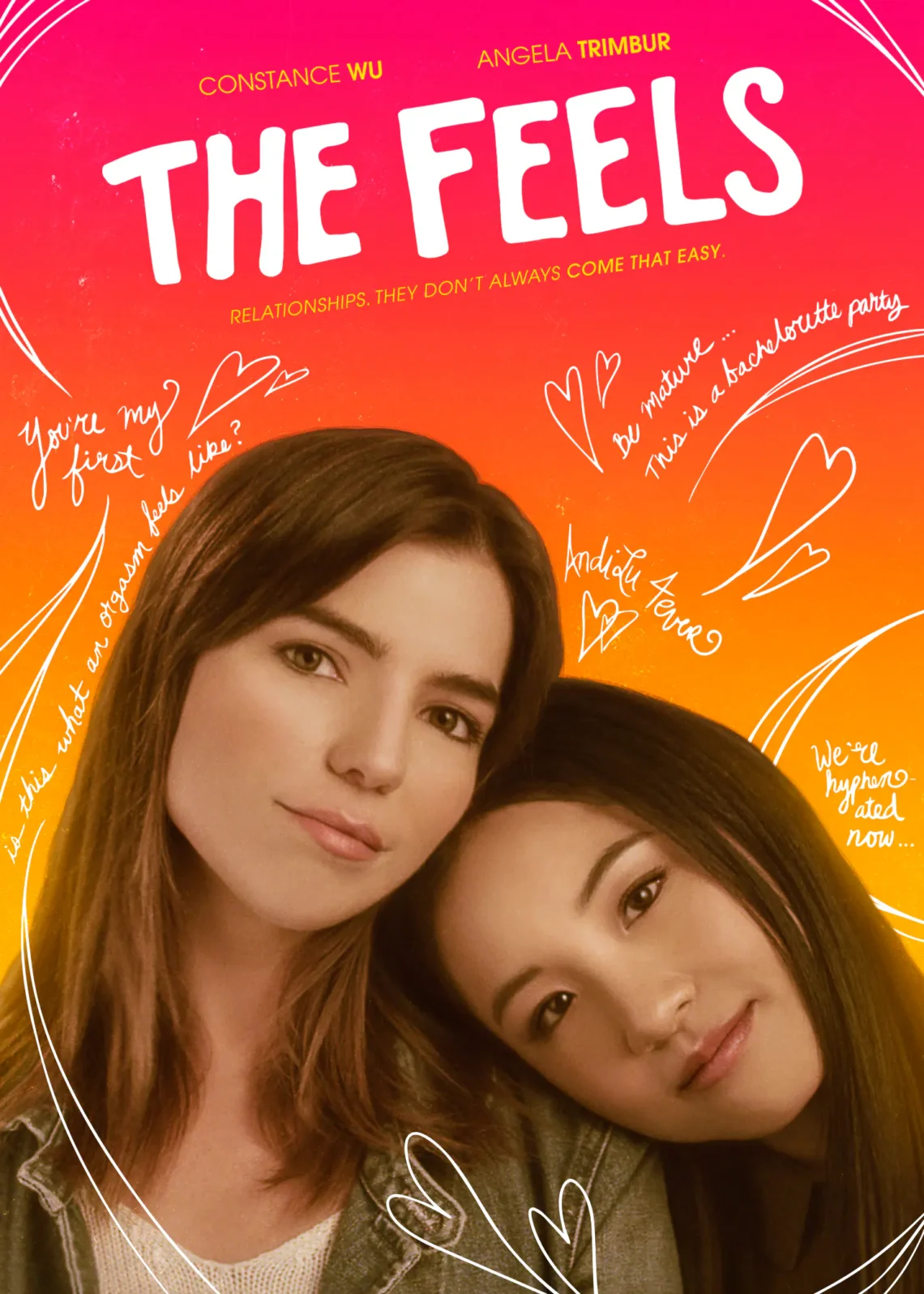
The Feels (2017): Fissures Between Ennui and Truth, the Raw Face of Obsession-Driven Relationships
Love always begins on the premise of perfect understanding, yet what we truly confront are the massive fragments of misunderstanding. The desire to possess the intimate truths of another sometimes becomes a sharp blade that shakes the very foundation of a relationship. A single confession thrown into the midst of a celebration among seven friends cruelly and humorously exposes how the things we call “faith” are built upon fragile sandcastles.
🌿 Moments Where This Film Deeply Resonates
- When a fundamental doubt—”Do I really know this person?”—suddenly rears its head within a long-term partnership or marriage.
- When you have experienced a strange sense of isolation, as if you alone are excluded, in a space that should be filled with celebration and joy.
- When you are caught in a paradoxical whirlpool of emotions where the comfort of a lie feels sweeter than the liberation of the truth.
- The reason to read until the end is that this film goes beyond a simple incident; it relentlessly tracks the chilling underside of how “physical satisfaction” and “emotional transparency” construct and collapse power structures within unions between women.
🎞 Notes Before Watching
This work explores the essence of relationships through the honest and bold conversations of adult women. While it includes uninhibited depictions of physical intimacy, these serve not as a device for provocation, but as a vital medium to reveal the psychological distance and deficiencies between characters.
🎬 Movie Information
- Title: The Feels (2017)
- Director: Jenée LaMarque
- Screenplay: Jenée LaMarque, Lauren Parks
- Country: USA
- Genre: Comedy, Drama
- Running Time: 94 minutes
- Platform: Netflix (Varies by region)
- Cast: Constance Wu, Angela Trimbur, Jenée LaMarque, Lauren Parks
📖 The Feels: A Maelstrom of Relationships Triggered by a Twisted Confession [No Spoilers]
Andi and Lu, a lesbian couple on the verge of marriage, head to a vineyard for a joint bachelorette party with their friends. At the very moment they believe they have the perfect weekend, the perfect party, and the perfect partner, a shocking confession from a drunken Lu freezes the air. She reveals that she has never once experienced an orgasm during her time with Andi and has been “faking” everything until now.
This seemingly minor bedroom secret instantly shatters Andi’s self-esteem and the trust that sustained the couple’s relationship. Taking this revelation as a turning point, the relationships of the other friends at the party also begin to pull their hidden deficiencies and conflicts to the surface, spiraling out of control. Can they move past a history built on lies to promise a truthful future?
🎭 The Asymmetry of Power Created by Unpossessed Sensation
In this film, Lu’s confession is not merely an act of venting sexual dissatisfaction. It is a record of the self-alienation one party has endured to maintain the illusion of being the “perfect partner” within the relationship. As soon as Andi loses her sense of control—the belief that she is perfectly satisfying her partner—she exhibits a rapid defense mechanism.
The intriguing point that arises here is the fact that even in relationships between women, invisible power structures exist between the “subject who provides satisfaction” and the “object who receives the benefit.” For Andi, Lu’s satisfaction was evidence of her own competence and love; the moment it is revealed as a lie, Andi’s worldview collapses. Through this, the film keenly captures how dangerous the arrogance of believing one can completely dominate or understand another truly is.
🍷 Collective Solitude Shown Through Confined Space and Ensemble Drama
The limited space of the vineyard further compresses the psychology of the characters with high density. While they outwardly cry out for solidarity and celebration, the camera does not miss the alienation and envy held by individual characters. The conflict between Andi and Lu is merely a catalyst; the friends who accompanied them also carry a lack of communication occurring within their own respective partnerships.
The director employs an improvisational acting style to capture the subtle tremors and shifting gazes hidden within the characters’ dialogue. The audience senses a chilling anxiety flowing through their convivial conversations. This prompts a reflection on how superficial our relationships with others can be in modern society, proving through mise-en-scène how easily solidarity devoid of true “empathy” can fracture.
🔎 Reinterpretation of the Ending: The Cruel Transparency Left Where Silence Was Broken
In the film’s conclusion, the two appear to make a gesture of reconciliation, but a “transparent wall” that cannot be undone has already been erected between them. By choosing to accept Lu again, Andi seems to be granting forgiveness, yet she simultaneously occupies a dominant position by holding her partner’s most vulnerable secret in her hand. Conversely, while Lu gained freedom by speaking the truth, she must live with the debt of having caused her partner an indelible sense of humiliation.
The core of this interpretation lies in the fact that life after the conclusion can never be the same as before. The union of the two now enters an extremely realistic and raw territory of “survival,” stripped of romantic fantasy. Rejecting the Western romance trope that love heals all, the film coldly points out that enduring one another while harboring wounds is the reality of a continuing relationship.
Truth does not save a relationship; it merely honestly bills us for the cost we must bear to maintain it.
❓ Questions Regarding the Ending and Narrative Structure of The Feels
Q1: What do you think about the criticism that the film missed emotional depth by obsessing too much over sexual themes?
Certainly, since this film places the subject of the “orgasm” at the forefront, it may superficially appear to be a light sex comedy. However, this setting is an essential device to explain how a woman’s physical autonomy is linked to emotional initiative within a relationship. While critics focus on the provocative nature of the subject matter, the director places greater emphasis on the structural changes—specifically, how that provocative truth destroys ordinary daily life.
Q2: Some point out that the protagonist Andi’s reaction is excessively neurotic and self-centered. Was this an intentional direction?
Yes. Andi’s hysterical reaction is a typical collapse phenomenon that appears when the identity she has painstakingly built—that of the “perfect lesbian couple”—is struck. This reflects an intention to avoid merely beautifying women’s narratives, instead revealing without filter how possessive and deficient women can also be within a relationship. The viewer feels an uncomfortable sense of identification, discovering a part of themselves in Andi.
✨ The Feels: Chilling Truth Blooming Where Fantasy Has Been Stripped Away
This work is a harrowing report on how the obsession that “because we love, we must share everything” suffocates a relationship. We constantly demand the truth from others while being unprepared to handle it. Through the rift between Andi and Lu, the film offers the paradoxical insight that what makes a relationship sustainable might not be total truth, but a silence kept at a proper distance that does not invade each other’s territory.
The completion of love begins not with knowing everything about the other, but with the respect of acknowledging that there are areas one can never truly know.
💬 What weight of truth is your relationship enduring?
Have you ever “acted” against your heart to avoid disappointing someone? Or, do you have the courage to embrace a partner’s shocking truth when faced with it? I am curious which value you would choose between the peace maintained by silence and the freedom gained through revelation.
🔮 Violet Screen Curation: The World of Complex Women’s Narratives
- Pieces of a Woman (2020): A work that relentlessly delves into a collapsing relationship after a loss and the psychology of a woman standing alone within it.
- The Watermelon Woman (1996): A must-watch film recently restored and garnering renewed attention on OTT platforms. It humorously depicts a woman’s journey to find her identity.
To provide a more stable publishing environment, multilingual content, and better communication with our readers, we have moved our official publication to Substack.
All new film reviews and critical essays will be published on our new platform. This website will be closing down soon, so we would greatly appreciate it if you subscribed to our new space.
TODAY'S QUESTION
Which character has comforted you lately?
Your answer isn't saved. Feel free to share it in the comments below.


You May Also Like

Foxfire (1996) Review: The Destructive Fascination of Female Solidarity and Queer Subtext
The Bostonians (1984) Ending: Possession vs. Liberation