Mate the Series: Reunion and Healing of Wounded Souls—In-Depth Analysis and Ending Interpretation
We all live building our own sturdy fortresses. Particularly for those carrying memories of external violence or indelible trauma, the touch of another can feel not like tender warmth, but like a threatening invasion.
Questions regarding whether salvation in the name of love is truly possible, or if it is merely a process of confirming each other’s deficiencies, have been among the longest-explored themes since humanity began crafting narratives.
The Thai GL drama Mate the Series begins its story at this very juncture. While borrowing the classic trope of a chance reunion, it fills that framework not with simple fluttery excitement, but with the desperate survival of “survivors” and the patience of the “observer” standing by their side. This work explores how relationships become tools for rebuilding an individual’s shattered world, forcing the viewer to confront their own most vulnerable parts.
🌿 Moments When This Drama Sinks Especially Deep
- For those with heart-scars so deep that physical contact with others feels like terror rather than tenderness.
- For those who wish to disbelieve the illogical word “fate,” yet find their gaze repeatedly lingering on someone.
- For those who have realized that love is not merely the sharing of joy, but the act of willingly walking into another’s hell.
- Why you should read this to the end: Because it analyzes the true meaning of being a “Mate” and how the heavy subject of PTSD is woven into the narrative beyond simple romance formulas to fill the cracks.
🎞️ Note Before Watching
This work directly deals with PTSD (Post-Traumatic Stress Disorder) resulting from sexual assault and the subsequent psychological suffering. Rather than provocative depictions, the drama focuses on the characters’ internal fears and the tension of their relationship, meticulously portraying the process of emotional solidarity and the gradual breaking down of walls rather than physical indulgence.
🎬 Series Information
- Title: Mate the Series (2024–2025)
- Director: David Bigander
- Screenplay: Mate Team (Production Team)
- Original Work: Thai novel of the same name, Mate
- Country: 🇹🇭 Thailand
- Genre: GL Romance, Human Drama
- Running Time: Approx. 45–50 minutes per episode (approx. 10 episodes total)
- Platform: WeTV (Uncut Version), Amarin TV HD Channel 34
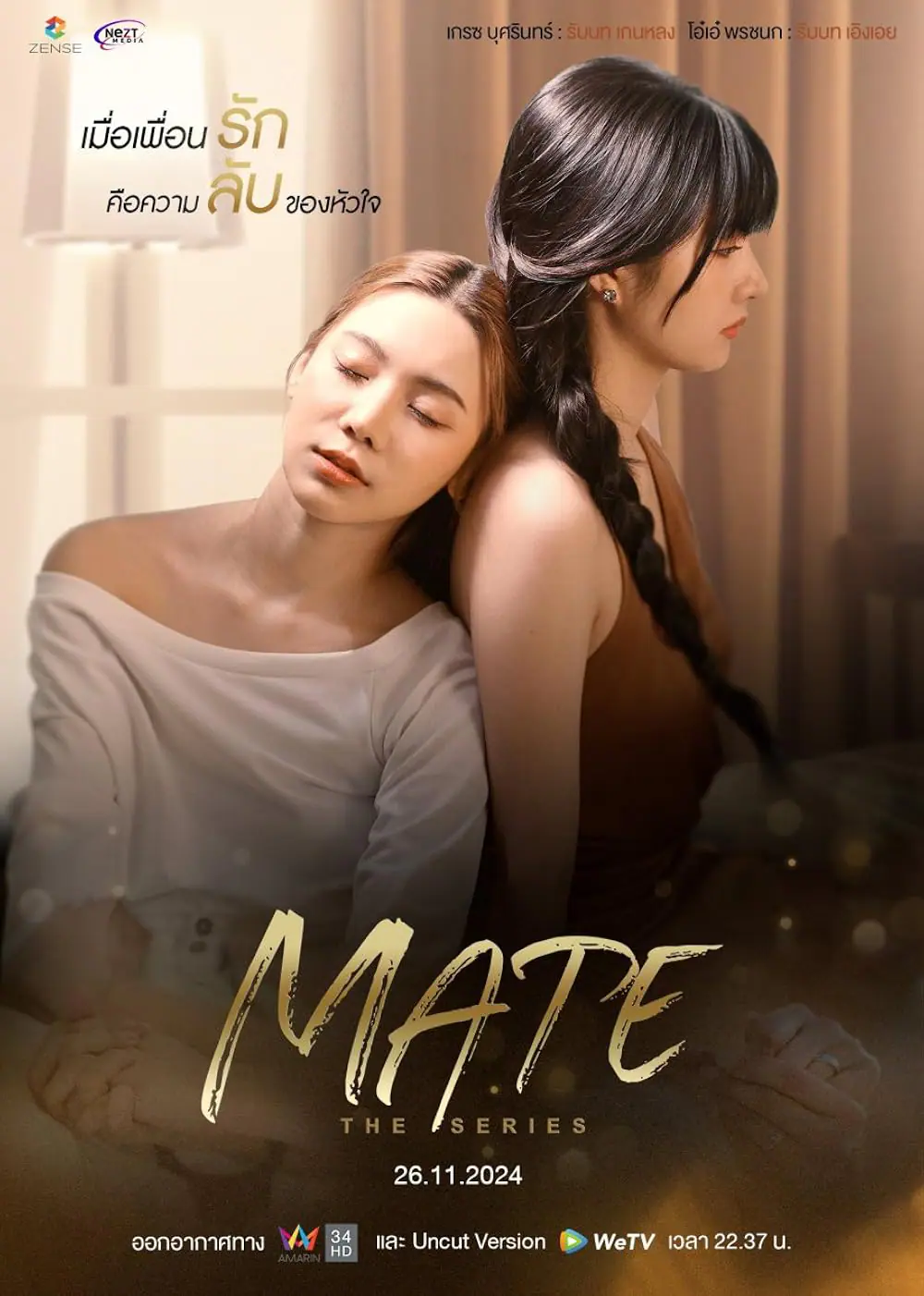
- Cast: Oaey Ponchanok Theerawan (as Aoey), Grace Budsarin Wonglilanont (as Genlong/Gen)
📖 <Mate the Series> Synopsis: Until the Chance of Reunion Becomes Inevitable Salvation [No Spoilers]
Genlong (Grace Budsarin), who possesses a perfectionist streak, falls into confusion one day when a fortune teller prophesies that her fateful partner will be a “woman.” Just as cracks begin to form in her world of common sense and logic, she reunites by chance with her precious childhood friend, Aoey (Oaey Ponchanok). However, the Aoey she meets again is a shadow of her formerly bright self, trapped in deep trauma where she recoils in shock at the slightest touch of another.
Genlong brings the displaced Aoey to her home, beginning a peculiar cohabitation. Genlong wishes to soothe Aoey’s wounds, but because she cannot hear the truth from Aoey herself, Genlong begins to investigate separately—an act that becomes a seed of conflict. Aoey harbors feelings for Genlong beyond friendship and throws out a provocative confession: “I will seduce you.” Meanwhile, Genlong wanders between the societal expectation to marry a man and her blossoming love and protective instinct for Aoey. The psychological tug-of-war between the two women as they face their scars and desires within the confined space of a cramped house gradually flows in an unexpected direction.
🕯️ <Mate the Series> In-Depth Analysis: The Aesthetics of Patience Breaking the Barriers of Trauma
The Paradoxical Relationship Structure of Physical Rejection and Psychological Proximity
The core of Mate the Series lies in the “impossibility of touch.” Aoey suffers from PTSD, which makes her extremely averse to physical contact due to past sexual assault. This creates a structure diametrically opposed to traditional romance dramas that progress relationships through physical affection.
The work obsessively captures how Genlong approaches Aoey while respecting her “personal space.” The tension arising here originates from a longing for safety rather than carnal desire. What Genlong provides Aoey is not merely lodging, but a “safe house” shielded from external threats; only within this space can Aoey finally breathe. This relational setup provides an interpretive point clearly showing that love is a realm of “waiting” rather than “possession.”
Collision Between Perfectionist Defense Mechanisms and Wounded Wildness
Genlong appears socially successful and rational, but in reality, she possesses a fragile interior shaken by the uncertainty of “fate.” Conversely, while Aoey is socially marginalized and wounded, she is far more honest and proactive regarding her emotions than Genlong.
Genlong’s defense mechanism of drawing a line—”I love you, but only as a friend”—actually stems from the fear she feels because she is already in love. In contrast, Aoey’s declaration, “I will seduce you,” represents a transparent desire. Their relationship offers deep immersion to viewers as the power structure never solidifies, with the roles of caregiver and recipient constantly inverting.
Mise-en-scène and Space: Contrasting Direction of Closed Rooms and Open Hearts
Genlong’s house in the drama is an important device reflecting the characters’ psychological states. The dissonance created as Aoey’s instability infiltrates Genlong’s clean, organized space unfolds in a visually interesting way. The director adjusts the emotional density by how the physical distance between the two characters is placed within the camera frame.
Specifically, the use of mirrors or windows to observe one another effectively conveys the psychology of characters trying to accept painful truths indirectly when they are too agonizing to face head-on. This work demonstrates the classic virtue where silent gazes convey more than provocative dialogue, securing a differentiated depth in the Thai GL review market.
🔎 Reinterpretation of the Ending: The Completion of Eternal Solidarity Declared by “Mate”
The ending of Mate the Series holds value beyond the mere fact that two women became a couple. The process of Aoey breaking out of the prison of trauma that she had confined herself in—despite numerous obstacles and misunderstandings—to stand fully beside Genlong signifies the “completion of healing.”
The lingering resonance of this work’s ending lies not in a smooth life ahead of them, but in the fact that they have earned the right to hurt together, even if the scars remain. Genlong volunteered to be Aoey’s healer, but ultimately achieves growth by breaking and expanding her own rigid worldview through Aoey’s love. What the protagonists have gained is not a sweet label called “love,” but an existential determination to willingly share and shoulder each other’s pain.
Love is not an eraser that wipes away wounds, but a warm coat draped over scars.
This sentence pierces the essence of the relationship this drama aims for. Their lives after the finale will still have to battle societal prejudice and personal anxieties, but they are no longer alone. This drama concludes by declaring that the naming of a “Mate” is the act of handing over the key to one’s darkest room to another.
❓ <Mate the Series> The Boundary Between Controversy and Aesthetics
Q1. Are the themes of trauma and sexual assault consumed excessively as tools for romance?
Some viewers may criticize that Aoey’s pain was used as a setting to heighten romantic tension with Genlong. However, the work never rushes Aoey’s recovery. By giving significant weight to the process where Genlong refuses to forcibly “correct” Aoey’s rejection and instead steps back to wait until she opens her heart, the drama proves that “human respect” must precede any romantic device. This is read as a cautious approach by the production team that transcends mere instrumentalization.
Q2. Genlong’s character sometimes feels excessively indecisive; is this a narrative limitation?
Genlong’s hesitation is less a personality flaw and more a realistic portrayal of the process where her rational system of life, built over a lifetime, collapses before the unexpected variable of “love for a woman.” Had Genlong accepted Aoey’s feelings easily from the start, the context regarding identity struggles and societal pressure would have been weakened. Her immaturity is better interpreted as the essential labor pains of finding one’s true self.
✨ <Mate the Series> The Single Question Love Rising Above Wounds Asks Us
This work ultimately asks us: Are you ready to fully understand someone else’s hell? Love is not a flashy firework, but a patience akin to cupping a small, dying candle in your palms against the wind and rain. Mate the Series redefines the nobility of relationships through the journey of two women who cross the turbulent waves of trauma and identity to reach a sanctuary in each other.
True solidarity is not about fixing another’s wounds, but about silently guarding one’s place beside them during the time it takes for those wounds to close.
💬 Are you ready to let someone into your room?
Sometimes, letting someone see your weakness requires more courage than loving someone. Do you need the courage to reveal your wounds like Aoey, or the patience to fully wait for another’s wounds to heal like Genlong?
🕵️ Violet Screen Curation: Other Gazes into the Depths of Relationships
- 23.5 (2024): The work that signaled the mainstream entry of the Thai GL genre. If Mate is a somewhat heavy psychological drama, this piece is a fresh school romance that deftly weaves identity concerns into a lighthearted tone, perfect for a change of pace.
- Blank The Series (2024): Deals with age gaps, social class, and repressed desire. Like Mate, it features a superb narrative of breaking “taboos”—though of a different form than Aoey’s psychological barriers—and is highlighted by the performances of a highly talented cast.
To provide a more stable publishing environment, multilingual content, and better communication with our readers, we have moved our official publication to Substack.
All new film reviews and critical essays will be published on our new platform. This website will be closing down soon, so we would greatly appreciate it if you subscribed to our new space.
TODAY'S QUESTION
What genre or mood do you always reach for when you're alone?
Your answer isn't saved. Feel free to share it in the comments below.


You May Also Like

Black Mirror: Hotel Reverie Analysis – Desperate Desires Born of Virtual Isolation

Vigil Ending Explained and Plot Summary: A Solidarity of Love and Trauma Awakened by Deep-Sea Isolation