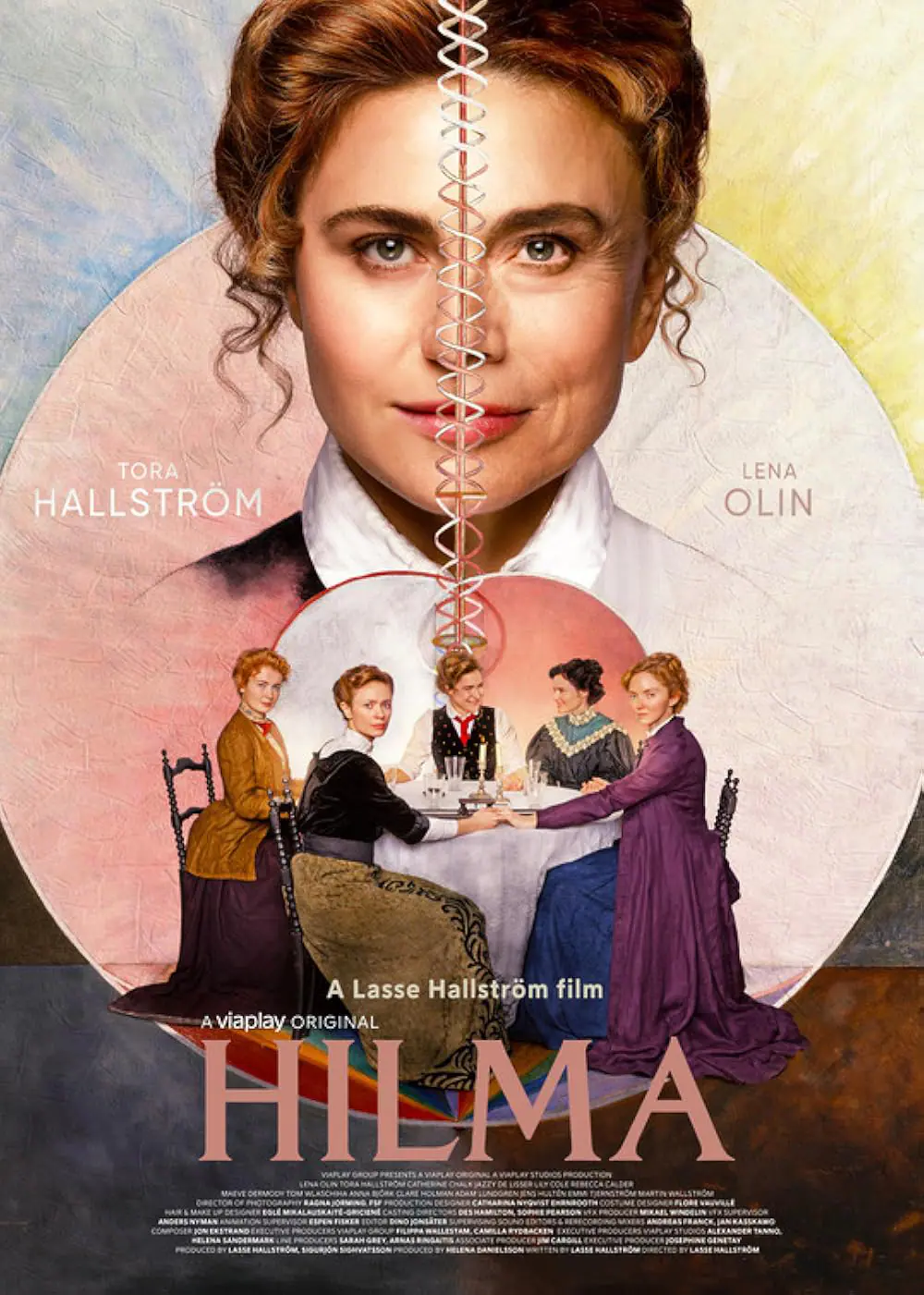
Hilma (2022) Movie Review: Abstract Pioneer Hilma af Klint, an Isolated Soul’s Immortal Desire Carved onto Canvas
The world often forgets how to welcome a genius who arrives too early. In an era of arrogant materialism—where we believe only in what we can see—the life of a woman who sought to record the truths beyond the visible was inevitably destined to meet with isolation.
The film Hilma is a record of the artistic struggle endured by Swedish painter Hilma af Klint, and simultaneously, a chronicle of the intense solidarity among the women who sustained her soul. This work goes beyond a mere chronological listing of an artist’s life; it illuminates a grand attempt to visualize humanity’s fundamental questions: “Where do we come from, and where are we going?”
🌿 Moments where this film resonates deeply:
- When you are carrying on a lonely struggle because your values do not align with the world’s standards.
- When you wish to confirm the spiritual tremors and cosmic order—which language cannot possibly explain—through art.
- When you want to witness how the intellectual union and emotional fluctuations of women become the engine for great creation.
Ultimately, the reason to watch until the end is to understand the value of the uncompromising dignity contained within Hilma’s decision to seal her works for 20 years after her death.
🎞 Note before viewing
This work is a drama that focuses on the psychological gravity and spiritual communion between characters rather than the depiction of physical relationships. Love and jealousy between women, alongside artistic camaraderie, form the core of the narrative, with the cinematography itself unfolding as fluidly as an abstract painting.
🎬 Movie Information
- Title: Hilma (2022)
- Director: Lasse Hallström
- Screenplay: Lasse Hallström
- Country: Sweden, United Kingdom
- Genre: Drama, Biography
- Running Time: 119 minutes
- Platform: Viaplay (selected regions), check local platforms for availability
- Cast: Tora Hallström (Young Hilma), Lena Olin (Old Hilma), Catherine Chalk (Anna Cassel), Jazzy De Lisser (Thomasine Anderson)
📖 Hilma: The Solitary Journey of a Female Artist Who Transcribed the Order of the Unseen World onto Canvas [No Spoilers]
The film begins in 1944, with an elderly Hilma looking out of a bus window, reflecting on her past. After witnessing the death of her sister Hermina as a child, Hilma develops an intense curiosity about the world beyond death. Upon entering the Royal Academy of Fine Arts, she faces discrimination within the male-dominated, conservative art world, yet forms “The Five”—a spiritual group of four other like-minded women.
Through séances and meditation, they attempt to communicate with “High Spirits.” Under their spiritual direction, Hilma begins to paint massive abstract works that diverge completely from the representational art of the time. Amidst a passionate relationship with her wealthy patron and lover, Anna Cassel, and new emotional waves with a nurse named Thomasine, Hilma completes works destined for her own “Temple.”
However, when even Rudolf Steiner—revered as the intellectual giant of the age—dismisses her art, Hilma makes the momentous decision to choose the future over a present that will never understand her.
🎨 In-depth Interpretation of Hilma’s Pursuit of Spiritual Science and Artistic Union
👁🗨 The self as a ‘Spiritual Scientist’ visualizing the unseen world
Hilma af Klint did not define herself simply as an artist. She was closer to a scientist exploring the world of the soul. In the film, her act of painting spirals and geometric shapes onto massive canvases is portrayed not just as an expression of personal inspiration, but as a sacred act of recording the blueprints of the universe.
While male painters of the time were contemplating abstraction by deforming the shapes of visible objects, Hilma brought forth an order from a dimension that did not exist in the physical realm. This suggests that the sexist environment she endured actually liberated her from existing grammars. When the art establishment forced her to enter through the side door, she instead flung open a cosmic door entirely outside the establishment.
🌓 Anna Cassel and Thomasine: Precarious emotional curves between possession and freedom
The relationship with Anna Cassel is both the material foundation supporting Hilma’s artistic world and the epicenter of her most intense emotions. Anna believed in and sponsored Hilma’s talent, yet felt alienated whenever Hilma submerged herself into her private spiritual world. Specifically, the appearance of Thomasine, a nurse, deepens the rift between the two.
Anna’s jealousy stems from more than just romantic sentiment; it arises from the fear that the artist she wished to possess is finding new inspiration through the care of another. The conflicts unfolding in the isolated space of Villa Furuheim demonstrate how intellectual and fierce relationships between women can be. While Hilma is grateful for Anna’s devotion, she struggles to maintain her artistic independence, wary of her soul becoming subordinate to another’s wealth or emotions.
🔎 Reinterpretation of the Ending — ‘The Vision of the Temple’ completed across time and space
The film’s ending juxtaposes Hilma’s lonely death in 1944 with the magnificent 2019 exhibition at the Guggenheim Museum in New York. This is not a simple tale of posthumous success. The “Spiral Temple” Hilma craved so much during her lifetime was not a physical building, but was ultimately completed through the sensory transference felt by future audiences as they walk among her works.
Her testamentary command to hide her work for 20 years was not an act of revenge against her era, but a benevolent patience, waiting until human consciousness matured enough to understand her language. Hilma lost the recognition of her contemporaries but gained artistic eternity. Hilma’s silence was not a surrender to the world, but a strategic suspension to leap across time and protect her truth.
❓ Inquiries surrounding Hilma’s art and relationships
Q1. What structural wounds did Rudolf Steiner’s harsh criticism leave on Hilma?
Steiner’s dismissal of Hilma’s work as merely “intellectual” is based on historical fact. The film uses this scene to structurally demonstrate how easily male intellectuals of the time judged women’s spiritual experiences. While this criticism plunged Hilma into deep frustration, it paradoxically served as a catalyst for her to solidify her secret worldview without being swayed by external evaluations.
Q2. What is your view on the criticism that the conflict with Anna Cassel was melodramatically excessive?
Some viewers point out that the jealousy and emotional battles between the two overshadow Hilma’s artistic achievements. However, this can be interpreted as the director’s intention not to package a female artist’s life solely through the lens of one-dimensional genius. By showing that great art also blooms atop mundane emotions and economic foundations, the film succeeds in restoring Hilma as a human being of flesh and blood, rather than a mystical medium.
✨ Hilma: A spiral of comfort reaching us across 100 years
The film Hilma is a majestic record showing the distance a woman had to keep from the world to protect her identity and genius. Hilma af Klint’s life was an endless struggle between love and jealousy, art and science, and the visible and the invisible. Her story poses a question that remains valid for us today: “How long can you wait for your truth?”
Art does not begin with the reproduction of the visible, but with the courage to finally make the invisible seen.
🌀 A Spiral Conversation: Where does your truth lead?
Is there a “secret temple” of your own that you wish to maintain until the end, even if you are not understood by others?
Sometimes, the denial of those closest to us becomes the soil for growth. Will you stay by the side of a loved one who does not believe in you, or will you wait for a future public that will believe in your truth, even if it means solitude?
📽️ Violet Screen Curation: Other perspectives recording women
- Ammonite (2020): Set in 19th-century England, this film depicts the static attraction and artistic solidarity between Mary Anning—who lived an isolated life collecting fossils on the fringes of society—and another woman.
- Benedetta (2021): Set against the backdrop of a 17th-century convent, this work deals with the relationships between women where mystical spiritual experiences and the desire for power intertwine.
To provide a more stable publishing environment, multilingual content, and better communication with our readers, we have moved our official publication to Substack.
All new film reviews and critical essays will be published on our new platform. This website will be closing down soon, so we would greatly appreciate it if you subscribed to our new space.
TODAY'S QUESTION
Which couple, on screen or in real life, are you rooting for right now?
Your answer isn't saved. Feel free to share it in the comments below.


You May Also Like

About Cherry: Records of Fluid Identity and Imperfect Female Solidarity

Affinity (2008) – The Interaction of Deception and Longing Within a Closed Circuit of Prison