Drive-Away Dolls Analysis: An Eruption of Transgressive Desire Subverting Queer Road Movie Conventions
While many films delve into the inner worlds of isolated individuals, few shatter that isolation using “impulse” as an engine. In a life suffocating under the gaze of others, what we truly crave may not be orderly consolation, but a liberated desire—one we are willing to achieve even if it turns everything into a mess. At this juncture, Ethan Coen strips away solemnity to depict the journey of two women in the most audacious and uproarious manner.
🌿 Moments When This Film Resonates Deeply
- For those worn down by the dryness of daily life, having forgotten even what they truly want.
- Cinephiles who enjoy unpredictable “B-movie sensibilities” that deviate from conventional narrative structures.
- Audiences longing for a provocative female narrative that awakens the suppressed self.
The reason to read until the end is to gain insight into the correlation between the “deconstruction of power” and “subjective pleasure” hidden behind a simple criminal caper.
🎞 Note Before Viewing
Please note that this work is a high-intensity black comedy featuring frequent depictions of body parts and sexual iconography. It is a work focused on the relational dynamics between characters and the satire of power rather than mere sensational provocation.
🎬 Film Information
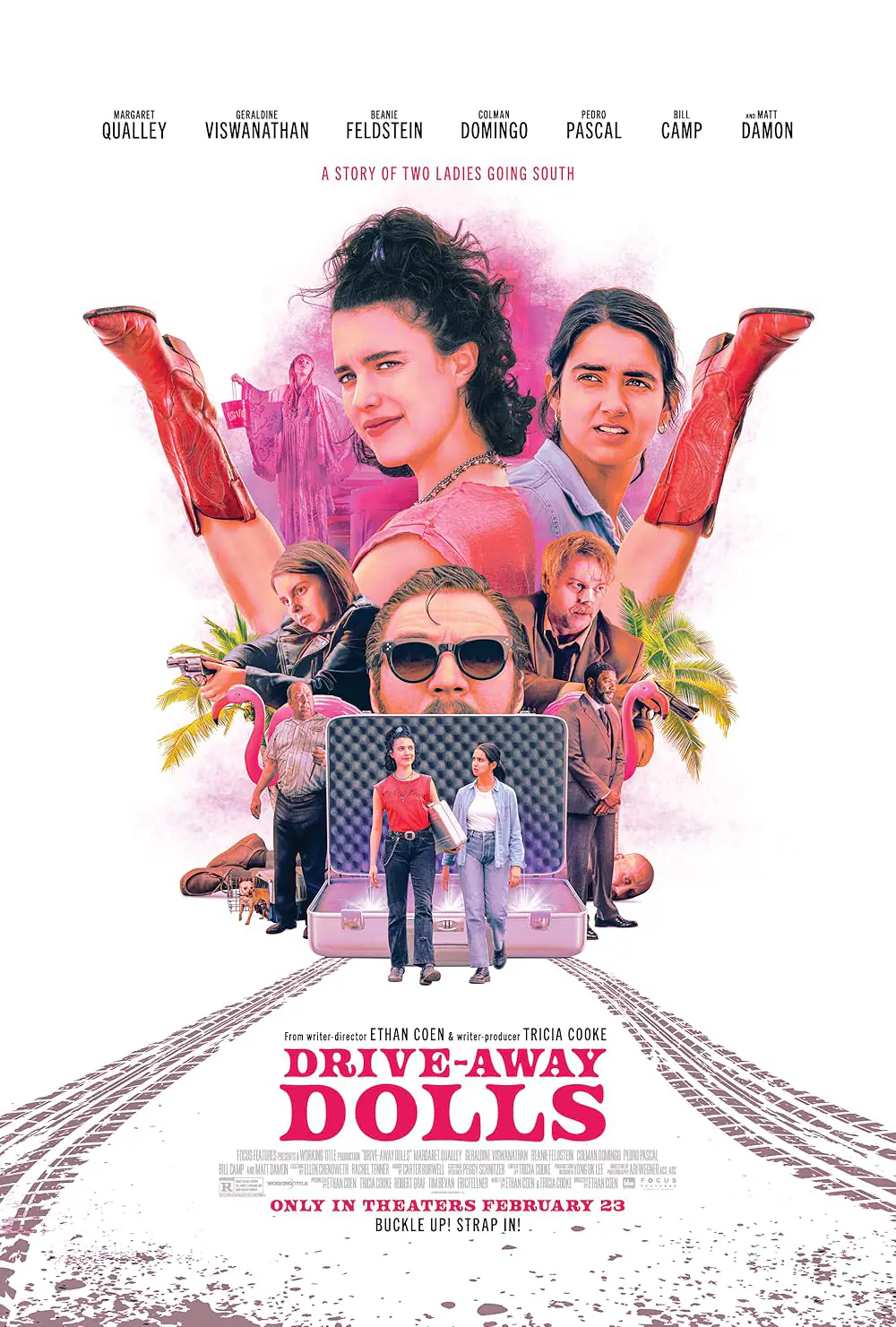
- Title: Drive-Away Dolls (2024)
- Director: Ethan Coen
- Screenplay: Ethan Coen, Tricia Cooke
- Country: USA
- Genre: Comedy, Crime, Road Movie
- Running Time: 84 minutes
- Platform: VOD, Peacock (International)
- Cast: Margaret Qualley, Geraldine Viswanathan, Beanie Feldstein, Matt Damon
📖 Drive-Away Dolls: A Breakout Sprint Triggered by a Twisted Delivery Mishap [No Spoilers]
In 1999 Philadelphia, Jamie, a free spirit, finds herself kicked out of her home due to recurring infidelity issues. Left with nowhere to go, she unceremoniously joins her polar opposite—the introverted Marian—on a trip to Florida. To save on costs, the two utilize a “drive-away” service to deliver a stranger’s vehicle to its destination.
However, due to a staff error, they are handed a vehicle containing a mysterious suitcase intended for a criminal organization, transforming their peaceful trip into a pursuit. Unaware of the shocking contents hidden in the trunk, Jamie constantly proposes escapades and parties, while Marian buries herself in books, attempting to defend against those impulses. As the bumbling syndicate members tail them and the two women’s discordant rhythms overlap, the incident begins to spiral toward unexpected political conspiracies and personal awakenings.
🎡 Interpreting the Relationship Forged by Jamie and Marian’s Asymmetrical Desires
The core of this film lies in how the extreme personality contrast of the two protagonists explodes complementarily through the road movie format. If Jamie symbolizes uncontrollable energy radiating outward, Marian represents the repressed self trapped within social norms and internal censorship.
Ethan Coen frames their journey not as a simple escape, but as an expansion of Marian’s internal territory. Jamie’s recklessness serves as the catalyst that demolishes Marian’s rigid walls, and the commotion arising from this process provides an opportunity for the pair to mock the world’s order (the male-centric criminal underworld and political power). The solidarity they display by the conclusion completes a unique aesthetic, in that it is not based on moral righteousness, but on the union of imperfect beings affirming each other’s deficiencies as they are.
🏺 The ‘Dildo’ in the Trunk: The Ridiculous Collapse of Masculine Power
The “severed head” and the “collection of phallic plaster casts” serving as the film’s MacGuffins are tools that bluntly satirize the authority and illusions of a male-dominated society. These items, containing the secrets of influential politician Gary Channel, demonstrate how power players who project dignity in the public sphere are mired in bizarre and vulnerable desires in the private realm.
The criminal organization’s pursuit is an attempt to restore the collapsed order of authority by recovering the suitcase. However, Jamie and Marian do not fear this “dangerous bag”; instead, they appropriate it as a tool for their own profit and pleasure. This is an arrangement that flips the convention of films treating women as victims or auxiliary figures in crime. Particularly in the ending, the $1 million and the plaster casts they acquire are converted into capital for building their new lives by appropriating male power.
🔎 Reinterpreting the Ending — A Record of Subversive Victory Mocking Conventionality
The setting of the two women heading toward Massachusetts, where same-sex marriage is legal, in the final scene is a political declaration that goes beyond a simple happy ending. The plaster casts they keep no longer function as someone’s weakness, but as trophies earned while mocking patriarchal authority. The politician’s career, collapsed before Sukie’s gun, signals the end of an old era, while the two women’s sprint announces the beginning of a new one.
What they have achieved is not social recognition, but the establishment of agency—taking responsibility for their own desires. Jamie realizes the importance of relationships, opening the possibility of settling down, while Marian breaks through her repression to face her own pleasure. The film’s conclusion is a perfect narrative hijacking by a marginalized group that has sublimated social taboos into play.
❓ In-depth FAQ Regarding the Interpretation and Reception of Drive-Away Dolls
Q1. Are there limitations to this being Ethan Coen’s solo directorial effort without his brother?
Because the tone is exceedingly light and leans heavily into B-movie sensibilities, reactions may be polarized for audiences expecting the weighty black comedy typical of the Coen Brothers. However, this is an intentional “kitschiness” and should be interpreted as Ethan Coen’s independent grammar, focusing on imagery and rhythm rather than deep philosophy. From a critical perspective, some point out that the narrative is fragmentary, but this is a result of maximizing the randomness inherent to the road movie genre.
Q2. Were the sexual depictions in the film absolutely necessary?
Some viewers may feel uncomfortable with the excessive sexual codes. However, in this film, “sexuality” is not a mere stimulant but a core mechanism for deconstructing power. It is an aesthetic device that exposes how sandcastle-like the authority of politicians is by manifesting their hidden shames as sexual symbols. I encourage readers to view this not as obscenity, but as a poignant satire of hypocrisy.
✨ Drive-Away Dolls: The Path That Opens When Undefined Desires Race Ahead
This film shows how those who have deviated from the orbit of “normalcy” defined by the world draw their own maps. The attitude of the two women, who dismiss even crime and conspiracy as a cheerful ruckus, paradoxically shows how ridiculous the many social pressures constricting us actually are. The process of a journey that began with a fracture in a relationship ending in complete self-affirmation whispers to us to grab the steering wheel of life ourselves.
Freedom is finally completed when one deviates from the given path to make their own noise.
🎡 Audacious Imagination Awakening a Stagnant Life
What are you hiding in the trunk of “the gaze of others”? Do you have the courage to open that bag and brandish it toward the world?
📽 Violet Screen Curation: Other Narratives of Liberation
- Duck Butter (2018): Depicts an experimental relationship between two women who spend 24 hours together trying to share every emotion. While not a road movie, it intensely shows the essence of relationships and the clash of egos.
- Bottoms (2023): A teen comedy centered on high schoolers who start a “fight club” to gain the attention of the girls they have crushes on. A work that unpacks queer narratives with delightful and audacious humor.
To provide a more stable publishing environment, multilingual content, and better communication with our readers, we have moved our official publication to Substack.
All new film reviews and critical essays will be published on our new platform. This website will be closing down soon, so we would greatly appreciate it if you subscribed to our new space.
TODAY'S QUESTION
Which character has comforted you lately?
Your answer isn't saved. Feel free to share it in the comments below.


You May Also Like

Carmilla (2019): A Gothic Reading of Forbidden Desire and Female Narrative

It’s in the Water (1997): A Chronicle of Liberation and the Certainty of Love Through the Era of Gay Panic