The Favourite: An Interpretation of the Triangular Structure of Isolation and Desire Eroding Beneath the Facade of Power
When love becomes a secondary instrument of power, the relationship inevitably sinks toward tragedy. We long to possess another entirely, yet at the apex of that possession, we are met only with the reflection of our own wretched deficiency in the mirror.
The film The Favourite (2018) utilizes the cloistered stage of the 18th-century British Royal Court to chillingly unearth the fundamental solitude of being through the jagged fragments of emotion exchanged between three women.
🌿 Moments When This Film Permeates Deeply
- When the instinct for self-preservation precedes the heart’s desire to love another.
- For those souls who have ever operated a cold calculator hidden behind a veil of kindness.
- When you wish to focus on the fragile human tremors of those enduring the weight of a crown rather than its brilliance.
- If you seek to witness a human alienation that remains valid in modern power structures beyond a simple period drama.
- By the end of this piece, you will understand the structural necessity of why such a desperate struggle ultimately concludes in futility.
🎞 Note Before Viewing
This work portrays psychological pressure and sexual tension between characters metaphorically and, at times, boldly. It should be noted that the film’s strength lies in the emotional provocation of its twisted relationships rather than mere physical explicitness.
🎬 Film Information
- Title: The Favourite (2018)
- Director: Yorgos Lanthimos
- Screenplay: Deborah Davis, Tony McNamara
- Country: UK, Ireland, USA
- Genre: Drama, Period Piece, Black Comedy
- Runtime: 119 minutes
- Platform: Disney+, Google TV
- Cast: Olivia Colman, Rachel Weisz, Emma Stone
📖 The Favourite Plot: A Battle for the Queen’s Heart Between a Fallen Noble and a Powerful Duchess [No Spoilers]
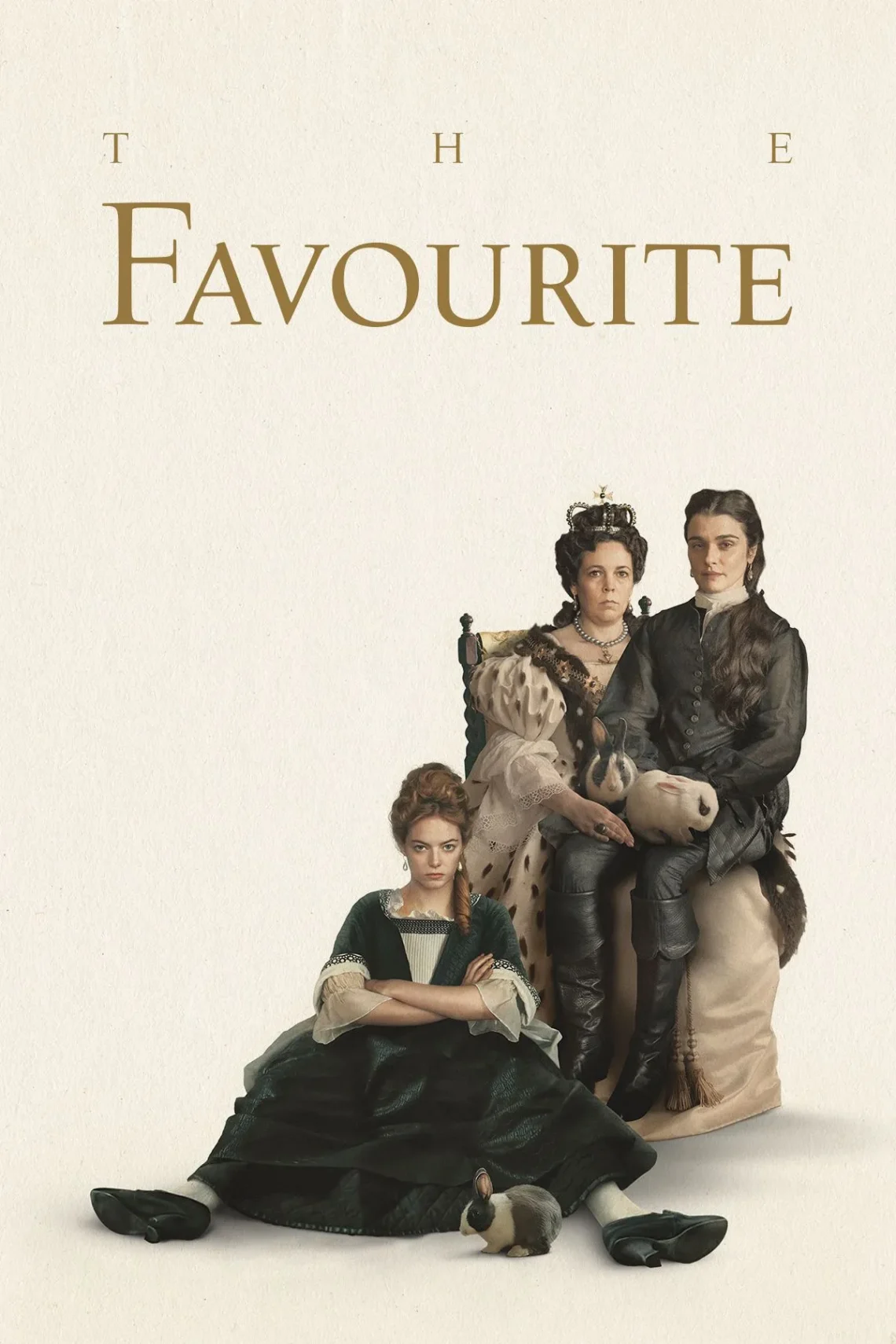
Early 18th century, Britain is in the midst of war with France. Queen Anne (Olivia Colman), who appears to hold absolute power but is in reality sickly and neurotic, is flanked by her longtime friend, lover, and political partner, Sarah Jennings (Rachel Weisz). Sarah rules as a formidable power, managing state affairs in place of the Queen’s frailty.
One day, Abigail Hill (Emma Stone), a maid from a fallen noble family, comes to her distant relative Sarah to beg for employment. Starting as a lowly scullery maid but harboring an intense desire for social mobility, Abigail begins to gain trust by treating the Queen’s ailing legs.
As Sarah’s blunt, direct counsel and Abigail’s sweet, calculated comfort clash, the equilibrium of the once-placid court begins to collapse. Abigail’s meticulous strategy to penetrate the center of power and Sarah’s sharp vigilance to stop her eventually hurtle toward an irreversible catastrophe centered on the choice of a single woman: the Queen.
🏰 Twisted Spaces and the Queen’s Isolated Psychology Projected Through Fisheye Lenses
Director Yorgos Lanthimos utilizes wide-angle and fisheye lenses to the extreme, depicting the vastness of the palace as a distorted prison. The opulent hallways and high ceilings overwhelm the characters, and within them, the relationships of the three women are dissected as if they were organisms under a microscope.
For Queen Anne, the 17 rabbits are not merely proxies for her deceased children. They are a concrete symbol of her deficiency, the scream of a human being rotting at the pinnacle of power without ever being fully understood. Sarah attempts to make the Queen stronger by confronting this wound directly, while Abigail pretends to lick the wound, using it as her own sanctuary.
The core of this film lies not in who holds power, but in what is being sacrificed to maintain it. While the power structure between the three figures shifts constantly, they all ultimately instrumentalize one another, driving themselves into a state of emotional vacuum.
🦢 Interpretation of <The Favourite>: The Deception of Abigail’s Rise and the Scars Left by Sarah’s Sincerity
Abigail’s arrival creates a ‘crack of sweet falsehood’ in the ‘world of cold truth’ that Sarah had established. Because Sarah loves the Queen, she does not hesitate to use sharp words; conversely, Abigail chooses only the words the Queen wishes to hear in order to protect herself.
The treatment of the gaze is particularly interesting here. Sarah stares directly at the Queen, rebuking her weakness, while Abigail prostrates herself at the Queen’s feet, fueling her ambition from a lowly position looking upward. Sarah worries for the country and Abigail worries for her survival, but for the lonely Queen, a tender touch in the moment was more desperate than the fate of the nation.
Ultimately, the moment Sarah is exiled from the court, the film demonstrates a subversion of values beyond simple victory or defeat. Truth is shunned for being abrasive, while deception is chosen for its softness. However, the price of that choice is severe. The Queen breaks the only mirror that truly cared for her, and in return, she is forever exalted but chooses to become an alienated god.
🔎 Reinterpreting the Ending — An Eternal Cycle Without Winners or Losers, Crushed Beneath Rabbit Feet
The final scene of the film declares a chilling end to the relationships through overlapping afterimages. Abigail finally ousts Sarah and takes her place by the Queen’s side, but the reality she faces is merely the grueling labor of a maid rubbing legs and the cold dominion of the Queen.
The rabbit she steps on is no longer an object of affection, but a projection of her own status—something that can be crushed at any moment under the Queen’s whim. The direction, where the faces of the Queen, Abigail, and the phantom rabbits overlap, signifies the total annihilation reached by this triangle.
By leaving the palace, Sarah finally becomes free from the shackles of power, whereas Abigail, by entering the palace, has locked herself in a massive prison. The moment one believes they have triumphed, a miserable submission begins; this is the final punishment Queen Anne bestows upon Abigail.
Unity achieved at the height of power is completed by degrading one another into functional slaves rather than whole human beings.
🧐 Questions on the Ending of <The Favourite> and New Horizons in Female Narratives
Q1. The male characters seem excessively caricatured or instrumental. Is this a limitation of the work?
Considering the history of period dramas where women were consumed as ornaments for male desire, the intent of this work is clear. Depicting even the men with political decision-making power as beings swayed by the Queen’s slightest mood is an intentional subversive aesthetic. This should be read not as the castration of masculinity, but as a device showing how infantile and ridiculous the nature of power itself can be.
Q2. What are your thoughts on the criticism that Abigail’s end is ambiguous and doesn’t depict clear poetic justice?
This film does not aim for moral instruction. By showing that the opulent bedroom Abigail enjoys is actually a space where she must clean the Queen’s waste, the author poses a more cruel question to the audience: “Did that position you craved truly save you?” More terrifying than a clear punishment is the eternal futility that follows achievement.
✨ The Fundamental Human Sorrow Hidden Behind the Mask of Power in <The Favourite>
This work relentlessly exposes the raw face of humanity hidden behind ornate dresses and wigs. It chillingly proves how wretched and simultaneously piteous a human being can become when the desire to be loved clashes with the compulsion to survive.
Even in modern society, we often diminish ourselves to serve our own ‘Queens’ or to become someone’s ‘Favourite.’ However, the film warns through Queen Anne’s heavy gaze that what we find at that place we reached by trampling others is, in the end, only another form of isolation.
True power does not lie in possessing someone, but in maintaining the dignity of not being possessed.
👁️ Your Gaze Hidden in Silence
In your relationships with others, are you closer to the honest but blunt ‘Sarah,’ or the tender but calculating ‘Abigail’? In moments where survival takes precedence over love, I wish to ask: what is the weight of the self-esteem you are willing to throw away?
💜 Violet Screen Curation
- Servant (2019–2023) / Apple TV+
- Deals with the strange tension between a woman suffering from the pain of loss and a mysterious nanny who enters her home. Recommended if you enjoy the claustrophobic atmosphere and psychological pressure of The Favourite.
- Happening (L’Evenement, 2021) / Film
- Captures the desperate choice of a woman struggling for her future in 1960s France through a documentary-style lens. The narrative of maintaining agency despite temporal limitations leaves a powerful resonance.
To provide a more stable publishing environment, multilingual content, and better communication with our readers, we have moved our official publication to Substack.
All new film reviews and critical essays will be published on our new platform. This website will be closing down soon, so we would greatly appreciate it if you subscribed to our new space.
TODAY'S QUESTION
When did you first feel fully accepted for who you are?
Your answer isn't saved. Feel free to share it in the comments below.


You May Also Like

When Time Got Louder: Choosing Yourself Between Love and Care

Unpregnant: A 900-Mile Road Trip Proving the Dignity of Choice and the Reconstruction of Friendship