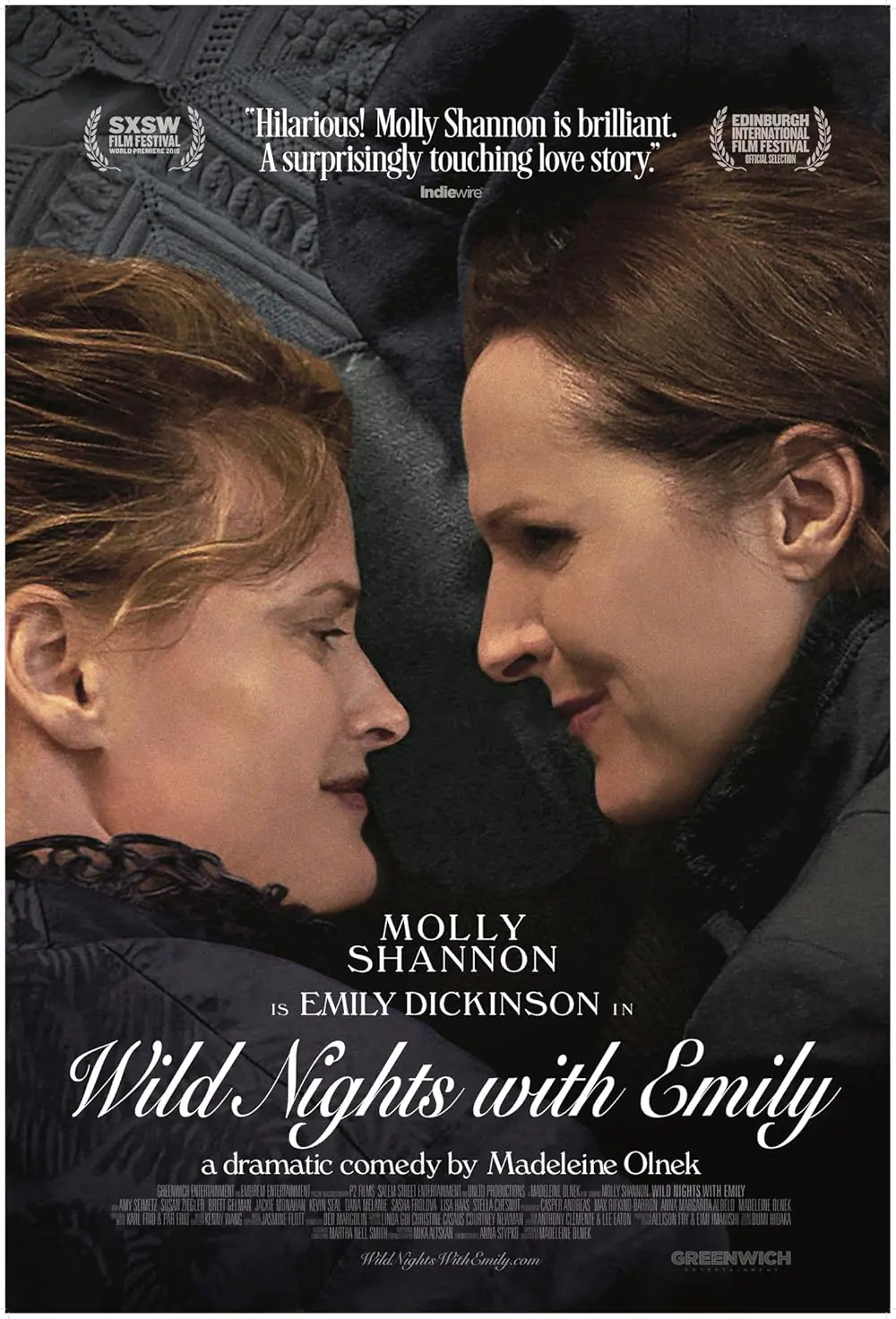
Wild Nights with Emily: A Delightful Provocation Restoring the Desires of an Erased Genius
Sometimes, we prefer to believe in convenient myths rather than the truth—much like the image of Emily Dickinson as the “recluse,” clad in white, writing poetry in solitary confinement from the world.
However, the story changes entirely if what burned within that quiet room was not mere loneliness, but a fervent desire for someone and a sharp satire directed at society. This film shatters the portrait of the fossilized Great Figure, restoring the vibrant life and love of a woman hidden among the shards.
🌿 Moments When This Film Deeply Resonates
- For those who have experienced having their truth edited while trapped within the framework of “normalcy” defined by the world.
- For those who have passed through a time when they had to encapsulate a desperate heart for someone under the dry, clinical term “friendship.”
- For those who persistently search for the voices of women that the grand text of history has attempted to erase.
- The reason you must read this to the end is to witness the thrilling subversion of how the narrative of the “tragic genius” we thought we knew is reborn as a narrative of “fervent lovers.”
🎞 Note Before Viewing
While this work deals with the life of Emily Dickinson, it rejects the solemnity of the traditional biopic. Rather than explicit sexual depiction, it focuses on the emotional density and the communion through correspondence between two women, portraying the structural limitations faced by female artists of the time in a manner that is both humorous and poignantly painful.
🎬 Film Information
- Title: Wild Nights with Emily (2018)
- Director: Madeleine Olnek
- Screenplay: Madeleine Olnek
- Country: USA
- Genre: Comedy, Drama, Romance
- Running Time: 84 minutes
- Platform: Naver Series On, Apple TV, etc.
- Cast: Molly Shannon, Susan Ziegler, Amy Seimetz
📖 Wild Nights with Emily Plot: A Secret Solidarity Blooming from Erased Letters [No Spoilers]
The film begins by directly contradicting the stereotype of the “recluse poet” Emily Dickinson that we commonly know. Emily and Susan, who have shared a deep bond since childhood, share feelings that go beyond mere friendship.
However, as Susan marries Emily’s brother Austin and moves in next door, their relationship transforms into a peculiar form of intimate secrecy—as neighbors and family. Emily spends her nights writing her burning longing for Susan into poetry, while Susan remains by her side as her most brilliant critic and sole confidant.
The work interweaves Emily’s struggles to bring her poetry to the world against the walls of a patriarchal publishing industry with the prelude to the historical distortion that occurs after her death. In particular, the subtle power dynamic with Mabel Loomis Todd—who edited Emily’s poems after her passing and sought to erase Susan’s existence—serves as the axis for the film’s central tension.
🖋️ The Reality of a Fervent Female Narrative Hidden Behind the Mask of Reclusion
The genre of comedy employed by this film serves as a tool for social subversion beyond simple laughter. The traditional gaze that dismissed Emily Dickinson as a “social misfit” is exposed as the incompetence of a male-centered society unable to handle her genius.
The Emily in this film is by no means frail. She is portrayed as a proactive figure struggling to protect her artistic identity, expressing fury when her poems are edited down to the very words and punctuation marks.
Specifically, the relationship with Susan is the most essential psychological driver of this film. Their kisses, embraces, and letters prove that Emily’s poetry did not stem from abstract imagination, but from concrete physical experience and love.
📜 Interpretation of Historical Distortion Created by Textual Variation and Power
Director Madeleine Olnek demonstrates how history is edited through the character of Mabel Loomis Todd. While Mabel is credited with introducing Emily’s poetry to the world, she was simultaneously a censor who erased Susan’s name and obscured the recipients of the poems.
By inserting scenes of Mabel’s lectures, the film sharply points out how artificial the image of the “mysterious virgin poet” she propagated to the public truly was. This is not merely a story of the past, but a brilliant example of how women’s achievements and relationships can be instrumentalized and distorted for the purposes of others. The isolation Emily experienced was less a voluntary choice and more a final stronghold to protect her own truth.
🔎 Reinterpreting the Ending — The Victory of Love Remaining as Ineradicable Sentences
The film’s conclusion illuminates the countless bundles of poems left in Emily’s room after her death. The process of Susan’s name being scraped away with a knife and covered with ink by Mabel is presented with visual cruelty.
Yet, the film does not dwell solely on that tragedy. Instead, it focuses on the sentences that ultimately survived among those damaged papers, and the true image of Emily fossilized in Susan’s memory.
The lingering resonance of the ending is a declaration of complete union; though their relationship was temporarily obscured by history, the purity of that emotion was never destroyed. What Emily gained was not posthumous fame, but the fervent love she lived. What she lost was only a reputation tailored to the eyes of others.
The void of love erased by history is destined to be refilled by the most truthful sentences.
❓ Regarding the Ending and Narrative Ambiguity of Wild Nights with Emily
Q. What are your thoughts on the criticism that the film is excessively comedic, making Emily Dickinson’s suffering appear light?
It may certainly be jarring for audiences expecting the weight of a traditional biopic. However, these comedic devices are an effective tool to highlight the absurdity of the world surrounding Emily. Responding with “laughter” to a world that seeks to preserve her only as a “sad woman” is the most powerful form of resistance and an aesthetic choice that grants her human vitality.
Q. Is the relationship with Susan an interpretation based on historical fact?
Recent academic research and infrared scanning technology have revealed that the majority of the recipients erased from Emily’s letters were indeed “Susan.” The film was produced based on this modern reinterpretation. The work does not fill historical gaps with mere imagination; rather, it chooses the process of reassembling the fragments of truth that were intentionally hidden.
✨ Wild Nights with Emily: For All the “Emilys” Beside Us
Though this film deals with a 19th-century poet, its gaze is directed precisely at us in 2026. The women of the past who had to hide their identities to survive are connected to the women of today who still struggle to find their voices, linked through the mirror that is Emily.
The film eloquently and delightfully speaks to how relationships and love can be butchered by power, yet how persistent the life force of truth remains. Beyond simply viewing a poet’s life story, it has the power to make us reflect on whether there are parts of our own lives being “edited” by others.
True art is not born in an isolated room, but from the sparks of emotion that fly when colliding with others.
💬 Silence within Relationships: What is Your Choice?
Some choose the silence of disconnecting from the world to protect their love, while others break that silence to cry out to the world. Emily performed both simultaneously through the medium of poetry.
If your precious relationship were denied by the world, would you leave behind secret records like Emily, or would you become a silent witness staying by their side like Susan?
📽️ Violet Screen Recommendation: Finding Female Narratives of a Different Grain
- Love Lies Bleeding (2024)
- Reason for Recommendation: If Wild Nights with Emily dealt with fervent desire within a static space, this work is a female narrative of destructive energy that brings the body and desire to the forefront. The direction, which pushes the madness and liberation of a relationship to the extreme, is impressive.
- Bottoms (2023)
- Reason for Recommendation: A teen comedy that completely breaks away from heavy traditional clichés while dealing with relationships between women. Highly recommended for those who wish to enjoy the subversive comedic code found in Wild Nights… with a modern sensibility.
To provide a more stable publishing environment, multilingual content, and better communication with our readers, we have moved our official publication to Substack.
All new film reviews and critical essays will be published on our new platform. This website will be closing down soon, so we would greatly appreciate it if you subscribed to our new space.
TODAY'S QUESTION
Is there a hidden gem you always recommend to friends?
Your answer isn't saved. Feel free to share it in the comments below.


You May Also Like
Blue Is the Warmest Color Review: An Interpretation of Radiant First Love, Desire, and Class-Based Isolation
Despite the Falling Snow: The Aesthetics of Female Narrative and Ending Interpretation Melting the Cold Winter of the Cold War