Portrait of a Lady on Fire: A Gaze Preserved in Flames, a Chronicle of the Eternal Specular
We believe we “see” others, but in reality, we often merely collect fragments of what we wish to see. Truly encountering the abyss of the other can sometimes accompany the terror of one’s own world collapsing.
On an isolated beach in 18th-century France, the gaze of two women transcends mere romantic sentiment to become a noble struggle that validates each other’s existence. The flames that ignite within Portrait of a Lady on Fire do not burn to vanish; they blaze to become an eternal fossil in the name of memory.
[Work Information]
| Category | Details |
| Title | Portrait of a Lady on Fire (Portrait de la jeune fille en feu) |
| Director | Céline Sciamma |
| Lead Cast | Noémie Merlant / Marianne Adèle Haenel / Héloïse |
| Year/Country | 2019 / 🇫🇷 France |
The Psychology of the Canvas Where Subject and Object Dissolve 🎨
The opening of the film strictly follows the grammar of “observation.” Marianne, a painter, surreptitiously steals glances at the face of Héloïse, who refuses a strategic marriage, and records her features in fragmented details.
During this phase, the interpretation of Portrait of a Lady on Fire borrows from the conventions of the “Male Gaze”—an attempt to possess the subject—but this is subverted the moment Héloïse rebukes Marianne‘s work, stating, “There is no life in the ‘me’ you have seen.”
💭 When Héloïse, once the object of observation, decides to pose of her own volition, the power dynamics between the two dissolve, and an equitable “gazing” begins. The realization that while the painter looks at the model, the model is also looking at the painter, becomes an intimate conduit that permeates their very souls.
A Temporary Utopia on an Island of Women, Erasing Class and Sharing Survival 🕯️
The manor, vacated by the Countess mother, becomes a vacuum where the rules of patriarchy are temporarily suspended. Here, Marianne, Héloïse, and the maid Sophie (Luàna Bajrami) dismantle the walls of social class and sit side-by-side to share a meal.
Their solidarity becomes even more robust in the face of the painful survival issue that is Sophie‘s abortion. The act of not averting their eyes from suffering, but gazing upon it together and recording that moment again through painting, symbolizes the only weapon 18th-century women possessed: the “record of memory.”
✨ The Héloïse relationship orientation stems from a will to deeply intervene in each other’s lives and act as witnesses, reaching far beyond simple affection. By affirming each other’s existence on this isolated island, they finally breathe as human beings rather than social subjects.
Orpheus’s Backward Glance: An Immortal Love Perfected by Choosing Loss 📖
the conversation among the three women regarding the myth of Orpheus serves as the most elegant foreshadowing throughout the Portrait of a Lady on Fire ending. Héloïse conjectures that Orpheus did not turn back by mistake, but rather that Eurydice may have requested him to “turn around.”
This is a sovereign decision to choose the “completion of memory” over the possession of love, given that their parting is already predestined. The moment Héloïse, clad in a white dress, calls out “Turn around (Retourne-toi)” to the departing Marianne, they sublimate loss into artistic eternity rather than sorrow.
🎻 In the concert hall where Vivaldi’s The Four Seasons resonates, the tears of Héloïse, who surrenders herself to the fury of the music as Marianne watches from afar, prove that this love remains in the present tense—much like the trace of Marianne etched on page 28 of Héloïse‘s book.
💌 When the Sovereignty of the Gaze Abides with Us
Through this film, Director Céline Sciamma declares that “love is an exchange of equal gazes.” Even in modern society, women’s relationships are often defined as someone’s wife, daughter, or rival; however, this work demonstrates the power of “pure gazing,” stripped of all such modifiers.
💭 The process of a being who once refused, saying “Do not look at me (Ne me regardez pas),” coming to say “Look at me (Regardez-moi),” mirrors the existential struggle of all women seeking sovereignty within an oppressed life.
We still live on, each harboring our own “Page 28.” The memory of being fully understood by someone, and the courage to stand alone based on that memory, is perhaps the warmest consolation this film offers to its 2040 female audience.
♾️
Was the final tear shed by Héloïse one of regret, or was it a surging sense of life? If there is a moment of an “unforgettable gaze” remaining in your heart, please share it in the comments.


You May Also Like
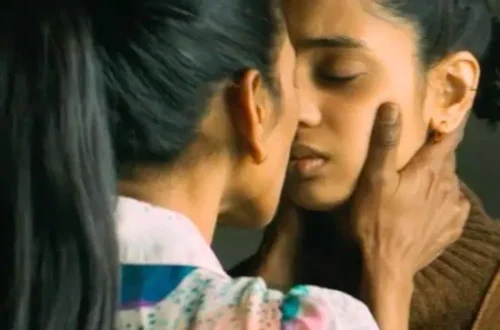
The Shameless: Solidarity Blooming in a Wasteland of Loss—A Harsh yet Radiant Record of Survival

Jennifer’s Body: Between Indulgence and Destruction, a Brutal Chronicle of Unpossessable Souls
