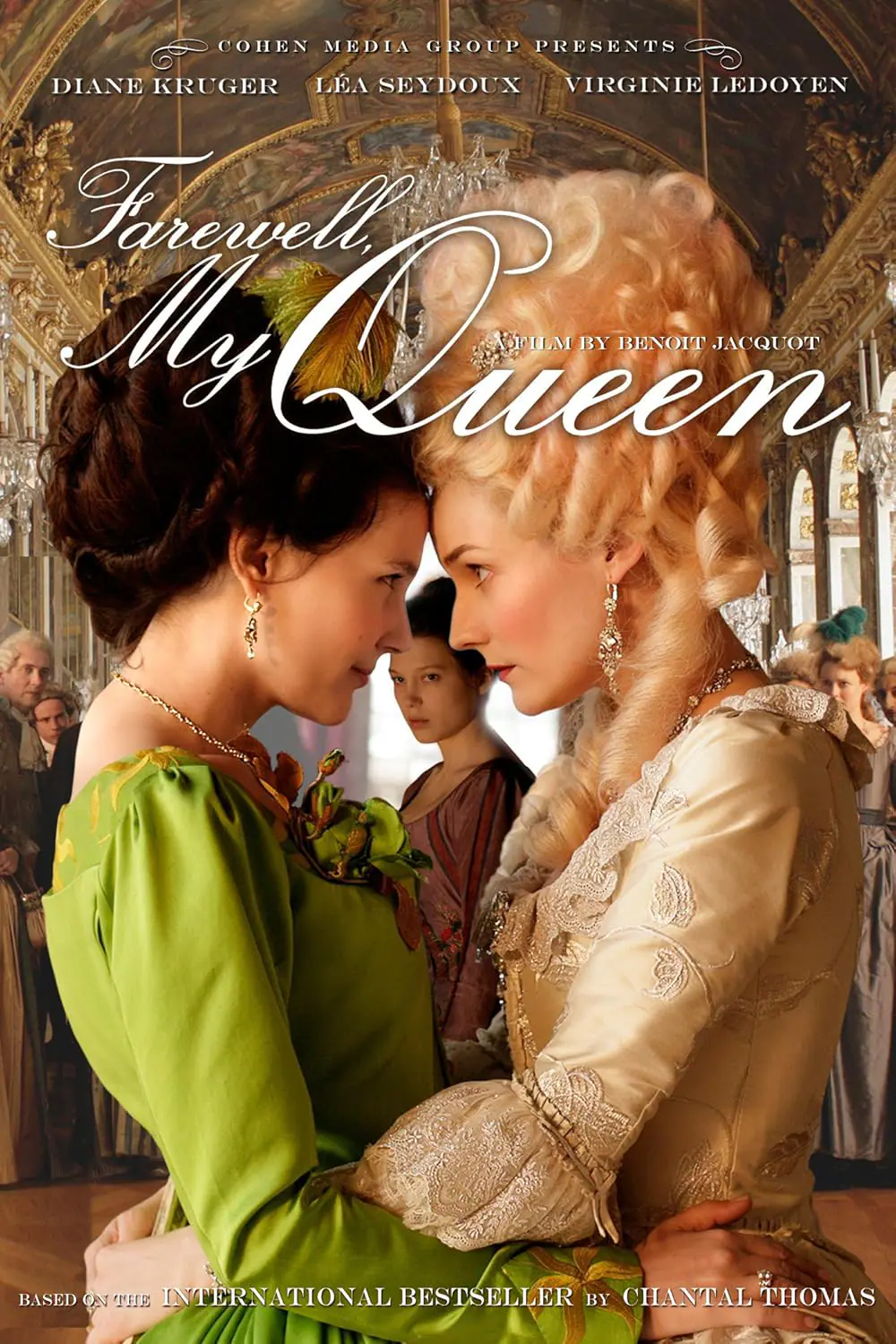
[Farewell, My Queen] A Narrative of Twisted Affection Refracted Through the Cold Prism of Class
The silence just before a storm breaks is not peace, but rather an instinctive dread foretelling imminent ruin. 💭 In July 1789, as Versailles—the most opulent prison in human history—began to crumble, a peculiar tension flowed through its halls, one left unrecorded by history.
We often remember revolutions as massive political tides, but for some, it was a profoundly private tragedy—one that required erasing one’s own existence while yearning for the gaze of a single person. 💔 Farewell, My Queen relentlessly traces this chronicle of twisted attachment through the eyes of a servant.
[Farewell, My Queen] Production Information
| Item | Details |
| Title | Les Adieux à la Reine (Farewell, My Queen) |
| Director | Benoît Jacquot |
| Cast | Léa Seydoux (Sidonie Laborde) / Diane Kruger (Marie Antoinette) / Virginie Ledoyen (Gabrielle de Polastron) |
| Year/Country | 2012 / 🇫🇷 France |
🕯️ Imbalanced Longing Born in a Secret Library: The Erased Self of Sidonie Laborde
Beyond the gilded exterior of Versailles, living in servant quarters permeating with the scent of mold, Marie Antoinette was the only religion and light for Sidonie Laborde. ✨ Her duty was to read to the Queen, but what she truly read was not the text, but the fragile inner world of Marie Antoinette.
The core of any [Farewell, My Queen interpretation] begins with the realization that this relationship could never be horizontal. The emotions held by Sidonie Laborde wore the cloak of loyalty, but in reality, they were closer to a desperate desire to transcend the walls of class. To the Queen, however, the servant was merely a consumable object, no different from a well-thumbed book.
The tragic nature of the [Sidonie Laborde relationship] lies in her willingness to endure even physical pain for the Queen. The Queen’s capricious command forbidding her from scratching a localized itch from a mosquito bite was but a minor precursor to the grueling sacrifice that lay ahead.
🏛️ Marie Antoinette’s Fixation on an Unattainable Lover and the Instrumentalization of Power
Conversely, Marie Antoinette’s gaze is fixed entirely upon Gabrielle de Polastron (Duchess of Polignac). To the Queen, Polignac was the only fantasy she wished to cling to amidst a collapsing dynasty, and toward this end, she lavishly pours out both her authority and her servant’s devotion.
The most cruel point in the progression toward the [Marie Antoinette ending] is the fact that the Queen precisely exploits Sidonie‘s affection. The Queen’s plan—to save the woman she loves by utilizing the gaze of the one who loves her—starkly reveals how class weaponizes and exploits love.
Marie Antoinette commands Sidonie to dress in Polignac‘s clothes and act as a decoy on a path toward potential death. This request, beginning with the words “If you love me… (Si vous m’aimez…),” was not a plea for sublime sacrifice, but the most elegant yet violent way for a person in power to violate the soul of the powerless.
✨ Truth Trapped Inside a Fake Gown: The Struggle of Solitude and Existence Faced by Modern Women
Ultimately, Sidonie leaves Versailles wearing the ornate dress of Polignac, the very woman she so envied. 🎭 As her reflection in the mirror takes the shape of another rather than herself, she experiences an intersection of ecstasy and despair. It was simultaneously the only opportunity to finally be held by the Queen and a death sentence declaring she could never again live as herself.
In the [Farewell, My Queen ending], as she disappears into the darkness aboard a carriage, Sidonie’s expression remains ambiguous. She drifts between the relief of having protected the Queen and the solitude of having her own existence completely erased. This pierces through the existential anguish of women today who live by mistaking the desires of others for their own within relationships.
The film explores how the “women in the shadows,” overlooked by history, were sacrificed under the grand narrative of power, and how the relationships that budded between women in that process can be as precarious as they are mesmerizing. ⭐ Her final confession, “I have forgotten who I am,” symbolizes the ruin of the self brought about by blind devotion to another.
🌹 Violet Screen’s Curation: Narratives of Twisted Attachment and Class
If you wish to further dwell on the lingering resonance of Sidonie’s dry yet burning gaze, I recommend the following works:
- The Handmaiden (2016): A masterpiece depicting the subversive solidarity and liberation of two women blossoming amidst class layers and deception.
- Portrait of a Lady on Fire (2019): The artistic love of two women rendered eternal through ‘looking’ and ‘remembering’ within the constraints of status and era.
Have you ever experienced erasing your true self for someone else? Or how do you define the sacrifices made in the name of love within an asymmetry of power? Please share your deep insights in the comments.


You May Also Like

Jennifer’s Body: Between Indulgence and Destruction, a Brutal Chronicle of Unpossessable Souls

[Zomer] A Season Passing Through the Fever of Identity: The Temperature of Brilliant Solitude and Solidarity
