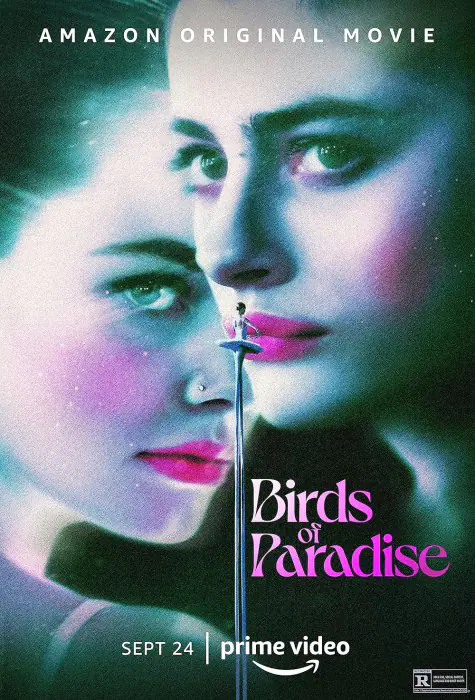
[Birds of Paradise] A Falling Ascent: The Grotesque and Beautiful Indulgence Blooming in the Cracks
We often confirm our own form only through the mirror of another’s gaze. Particularly in the insular world of ballet, which demands extreme perfection, the existence of ‘self’ is like a cruel mirage that can only be proven by trampling over others to rise.
Birds of Paradise (2021) is the story of two girls who find each other within that mirage. On a stage where solitude and ambition intertwine, what they share is not mere friendship or competition, but a destructive solidarity perfected by consuming each other’s souls.
🩰 [Birds of Paradise] Work Overview and Standard Information
| Category | Detailed Information |
| Title | Birds of Paradise (2021) |
| Director | Sarah Adina Smith |
| Cast | Diana Silvers (Kate Sanders) / Kristine Frøseth (Marine Elise Durand) |
| Year/Country | 2021 / 🇺🇸 USA |
💎 [Birds of Paradise Interpretation] Two Souls Trapped in a Mirror: The Psychological Transference of Kate and Marine
The clash between Kate Sanders and Marine Elise Durand over a single contract with the Paris Opera Ballet is also a collision of class and deprivation. Kate, an outsider with a poisonous talent despite her poverty, invades the world of Marine, who possesses upper-class elegance but is eroded by a sense of loss.
💭 While they sharpen their edges toward one another, they discover the ‘missing piece’ they long for in each other’s eyes. Kate lusts after Marine‘s artistic liberation, while Marine admires Kate’s desperate obsession with survival, and they begin to exchange their very selves.
The relational orientation between Kate and Marine transcends a simple rivalry. The act of etching indelible marks onto each other’s skin is a manifestation of a primal desire to incorporate the competitor as part of oneself—an attempt to bind the only person who understands them amidst a lonely struggle for existence.
🕯️ [Birds of Paradise Ending] The Aesthetics of Destructive Freedom: Abandoning Perfect Technique
The film reaches its zenith at the moment Marine Elise Durand rejects the prescribed choreography on stage to perform a forbidden dance. To escape the vast prison of social expectation and maternal pressure, she chooses to ‘fall,’ thereby completing a paradoxical ‘ascent.’
💔 The ending of Birds of Paradise betrays the grammar of sports films that distinguish between winners and losers. Marine does not concede victory to Kate; rather, she walks into her own abyss where the very value of ‘victory’ becomes meaningless. This serves as a sharp critique of the obsession with achievement faced by modern women.
In the final moment, when Kate Sanders stands alone under the spotlight, her eyes reflect a visceral sense of loss for the vanished Marine rather than the euphoria of a winner. The one wearing a hollow crown and the one who attained freedom through self-destruction—their diverging paths vividly illustrate the ambiguous boundaries of their relationship.
🏹 Narrative Achievement and Modern Implications: The Existential Struggle of Women in an Isolated Competitive Society
Through her mise-en-scène, director Sarah Adina Smith relentlessly delves into the physical pain and mental devastation hidden behind the ballet company’s splendor. The two women in Birds of Paradise are tamed to destroy each other within a system where patriarchal authority and artistic purism converge.
✨ Yet, the film focuses on the emotional density between women that strangely blooms even within that process of destruction. By subverting the criteria of ‘success’ defined by the world and communicating in a language only they can understand, their figures ask what ‘true self-verification’—which we have lost in the infinite competition of modern society—really is.
To the women of today who believe that social achievement is the completion of the self, this film asks: Is the flight you dream of achieved by clipping another’s wings, or is it the liberation found by fully facing your own darkness?
💬 Violet’s Insight: What does your ‘Bird of Paradise’ look like?
Have you ever experienced a moment where your closest rival became your deepest confidant? Please share your thoughts in the comments about that ambiguous tension—much like Kate and Marine—where you pushed each other to the brink of ruin yet ultimately saved one another.
Curated Narrative Works for Women
- Black Swan (Darren Aronofsky): The extreme aesthetics of madness and ego-fragmentation in the pursuit of perfection.
- The Neon Demon (Nicolas Winding Refn): Predatory desire for beauty and the brutal solidarity between women.


You May Also Like

The Deep Sky: The Abyss of Female Relationships Forged by the Collapse of Intellectual Consensus and Sensory Isolation

The Shameless: Solidarity Blooming in a Wasteland of Loss—A Harsh yet Radiant Record of Survival
