40 Love: The Courage to Cross the Line, the Aesthetics of Affect Blooming on the Court
Throughout our lives, we encounter countless ‘lines.’ These are invisible barriers—the distance between oneself and others, the rules dictated by society, and the limitations we set for ourselves. The moment isolated egos discover one another often begins with an unexpected collision.
For lonely modern women, love may be more than just sharing emotions; it is perhaps a courageous struggle to deviate from one’s own orbit and be pulled into another’s gravitational field. Today, I wish to delve into a sensory narrative that captures that sweet yet dizzying moment of departure.
[40 Love] Production Information
| Category | Details |
| Title | 40 Love (Cornetto Cupidity Love Stories) |
| Director | Lloyd Lee Choi |
| Cast | Phoebe Neidhardt (as Debbie) / Fernanda Romero (as Maria) |
| Year/Country | 2014 / 🇬🇧 United Kingdom |
🎾 [40 Love Interpretation] A Romantic Collapse of Forbidden Lines Orchestrated by the Arbiter of Boundaries
On the tennis court, Debbie is a ‘line judge’ responsible for determining whether a ball has landed in or out. Her life consists of clear rules and static observation. In contrast, Maria is a star player who moves dynamically across the court to seize victory.
The core of the 40 Love interpretation lies in how this physical distance translates into a psychological class disparity. The gap between the anonymous Debbie, who upholds the rules, and the radiant Maria, who shines within them, collapses through the playful intervention of Cupid (a stray tennis ball).
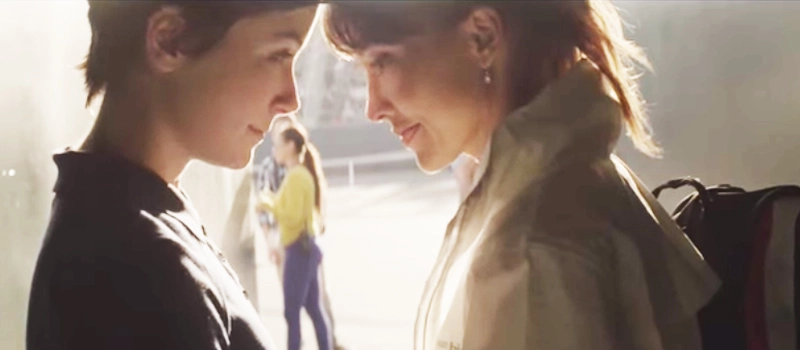
💭 As the adage goes, “All great love begins with an accidental collision that destroys order.” The moment Debbie is struck by the ball, the silence that suppressed her is shattered, and a narrative where they finally meet each other’s gaze begins to operate.
🍦 [Debbie’s Relational Orientation] When the Loneliness of Ordinariness Embraces the Glamorous Solitude of a Star
Debbie, portrayed by Phoebe Neidhardt, is a character who hides deep insight behind her shyness. As she watches Maria on the court, she does not merely admire her; she reads the solitude hidden beneath the pressure of victory.
Fernanda Romero, in the role of Maria, delicately expresses the exhaustion concealed behind a glamorous exterior. Their relationship evolves beyond the ‘star and fan’ dynamic into a mirror image where they recognize each other’s deficiencies. Ultimately, the orientation of Debbie’s relationship is not toward the other’s brilliance, but toward the internal human vulnerability beneath it.
✨ Their communion is sufficiently intimate without the need for grand narrative devices. The mundane yet sensory act of sharing a bite of ice cream replaces the ‘ambiguous tension’ between the two women with a deeply private and close solidarity.
🏆 [40 Love Ending] How to Remain a Victor of Love, Not a Loser of Zero (Love)
In the tennis score ’40-Love,’ the term ‘Love’—meaning zero points—is paradoxically the most beautiful metaphor in this film. While it may be an index of defeat in a match, in the narrative of a relationship, it symbolizes a total immersion toward only one person.
The 40 Love ending cheerfully depicts the moment when all conditions—fame, talent, and social status—surrender to the pure emotion of ‘love.’ Instead of a victory trophy, Maria takes Debbie’s hand and walks out toward real life beyond the court.
⭐ “Fame, fortune, talent and beauty surrender to love.”
This famous line is the most intuitive declaration of the ‘right to be happy’ that queer narratives needed to claim in 2014. Instead of social prejudice or a tragic conclusion, the happy ending—melting away like sweet ice cream—delivers a positive energy regarding the possibilities of love to modern women.
🎬 Criticism & Modern Implications: A Message of Solidarity Delivered by a 9-Minute Aesthetic
Director Lloyd Lee Choi has portrayed the relationship between women as an exquisitely elegant and universal romance, even within the constraints of branded content. This is an achievement that proves queer narratives are no longer the ‘pain of a special few,’ but a ‘journey of fluttering hearts’ that anyone can empathize with.
To women living in modern society, this work asks: Are you ready to cross the ‘safety line’ you have drawn between yourself and others? Loneliness is sometimes fragile enough to be broken by a single accidental ball thrown by another, and what fills that crack is ultimately the warm gaze that affirms each other’s existence.
Do you, dear readers, remember a moment of ‘fateful accident’ where you crossed a mental line with someone? Or was there someone you wanted to reach even if it meant breaking the rules? Please share your precious experiences and interpretations in the comments.
✨ Violet Screen’s Curation: Further Readings on Women’s Narratives
- Portrait of a Lady on Fire: A narrative of women as artistic companions, where love dwells wherever the gaze lands.
- Carol: A sophisticated classic romance that races toward the other through social taboos.

