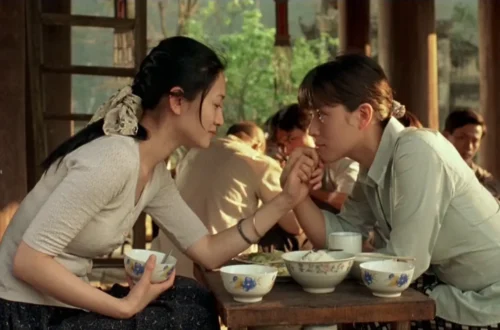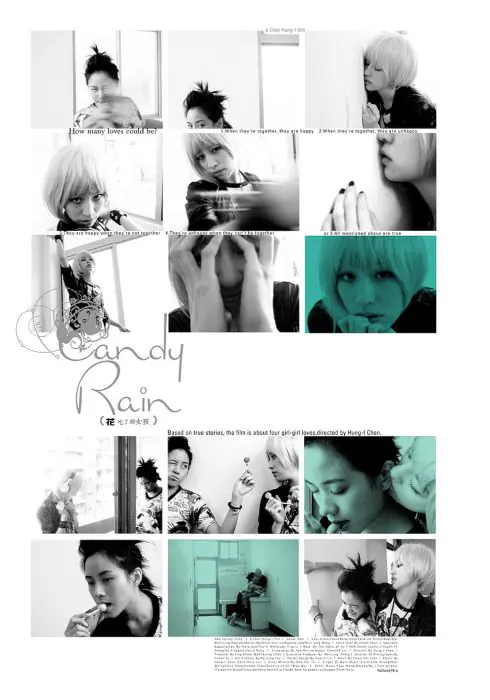
Candy Rain (2008) Film Review & Interpretation: A Solidarity of Four Colors Born of Isolation and Longing
Love tempts us with the sweetness of candy, yet at times, the sticky obsession hidden behind that sweetness swallows us whole. Even as we yearn to connect with another, we live facing the fear of isolation—the dread that our very essence might blur within that relationship.
Through four “flavors” of love hidden in the humid air of Taipei, the film Candy Rain tenaciously traces the shape of the ‘true self’ that women attempt to find by indulging in and repelling one another.
🌿 Moments When This Film Sinks Deep
- When you feel the desperate contradiction of loving someone while being unable to let go of their hand due to the gaze of the world.
- The moment you realize that in a toxic power dynamic where you lose yourself, parting is the only salvation.
- When a promise made to a first love, unforgotten through the passage of time, shatters against the wall of reality.
- When you wish to visually witness the process of a destructive passion, in the name of love, consuming you.
- This is why you must read this piece to the end. The conclusion of this film is not a simple breakup; it declares a new liberation for female narratives.
🎞️ Note Before Viewing
This work sensually depicts intimate relationships and emotional fluctuations between women. While some episodes portray emotional pressure or physical conflict, these function as aesthetic devices to reveal the characters’ deficiencies and desires.
🎬 Movie Information
- Title: Candy Rain (花吃了那女孩, 2008)
- Director: Chen Hung-i
- Screenplay: Lin Yan-ru, et al.
- Country: Taiwan
- Genre: Romance, Omnibus, GL
- Running Time: 106 minutes
- Platform: GagaOOLala, DVD
- Cast: Belle Hsin (as Jessie), Yang-kun Chen (as Pon), Waa Wei (as Lin), Sandrine Pinna (as U), Kao Yi-ling (as Summer), Niki Wu (as Spancer), Karena Ka-Yan Lam (as Ricky)
📖 Candy Rain Synopsis: Four Pieces of Love Trapped in Taipei’s Rainfall [No Spoilers]
Set against the backdrop of Taipei, the film is structured as an omnibus featuring four couples, each embodying a different “flavor” of love.
🏝️ Story 1. If the Southland Freezes (Jessie & Pon)
- Theme: 『 Love That is Happy Only When Together (Happy Together) 』
- Relationship: A sanctuary for two vs. The gaze of the outside world
🌐 Story 2. City of Invisible Aggression (U & Lin)
- Theme: 『 A Relationship Happier When Apart (Happy Because We Are Not Together) 』
- Relationship: The Perfectionist vs. The Free-spirited Dominator
🕊️ Story 3. Dreaming Opposite Dreams (Spancer & Summer)
- Theme: 『 Unhappy Love Because We Cannot Be Together (Unhappy Because We Are Apart) 』
- Relationship: Social Conventions vs. An Unforgotten Promise
🔥 Story 4. As If a Flower Ate That Girl (Ricky & …)
- Theme: 『 Love That is Not Happy Even When Together (Or the Chaos of Love Itself) 』
- Relationship: Chaos, Jealousy, and the Loss of Self
The four episodes begin as sweet as candy, but ultimately force a confrontation with the essential solitude of love.
🍬 Psychographic Interpretation of Isolated Women in Candy Rain Through Pop-Art Mise-en-scène
Director Chen Hung-i, drawing on his background in music videos, visualizes the characters’ isolated interiors by overlaying Taipei’s aged spaces with primary pastel tones. Specifically, the cramped room where Jessie and Pon stay in the first episode is read as a womb-like space protected from the prejudices of the outside world, yet simultaneously a closed-off location where the social self is castrated.
The intersection of anxiety and relief they feel is maximized through the color contrast of props filling the screen. As the love deepens, the space becomes more ornate; however, the emotional emptiness of the characters deepens in inverse proportion to those brilliant hues. This direction exquisitely reflects the psychological paradox where individual independence is threatened as the density of a relationship increases.
Ultimately, the director uses mise-en-scène to create a gap between ‘seeing’ and ‘feeling,’ inviting the audience to partake in the emotional thirst felt by the characters beyond the screen. This directorial technique goes beyond a simple romance film, providing humanistic insight into how female desire is projected onto physical space.
🎞️ Taipei’s Rain and Candy: The Expiration Date of Relationships Suggested by Candy Rain’s Conclusion
The title Candy Rain symbolizes the temporary sweetness of love and the damp melancholy that follows. In particular, the third episode featuring Spancer and Summer starkly illustrates how the social norm of marriage mangles individual, sincere emotions. Despite a promise made ten years ago being kept, the reality of a child and a husband standing between them acts as a social sentence announcing that the relationship’s expiration date has passed.
The core of the interpretation here is that their unhappiness stems from structural pressure rather than individual choice. The film thoroughly shatters the romantic fantasy that love will solve everything. Instead, it compels the audience to stare at the ruins of loss left in love’s wake, posing questions about the sustainability of relationships.
The conclusion drawn as the four stories intersect is clear: love is not an eternal sanctuary, but an organic process that constantly changes, decays, and is reborn. The film insists that the pain arising during this process is not a side effect of love, but a part of love itself.
🔎 Reinterpreting the Ending — Staying Myself Without Being Eaten by the Flower of Love
In the final episode, Ricky’s obsession and destructive dating history most directly embody the meaning of the original title, ‘The Flower Ate That Girl’ (花吃了那女孩). Ricky indulges in numerous relationships but finds rest nowhere; ultimately, her very existence is swallowed by the massive flower that is love. This ending serves as an extreme depiction of the tragedy resulting from the loss of subjectivity within a relationship.
However, Ricky’s chaotic final appearance is read not as mere ruin, but as the dignified struggle of one who has revealed their desires without reservation. Even knowing she will be hurt, she continues to throw herself at others, proving her own vitality through that very pain. What the protagonists gain is not a stable love, but a harrowing self-awareness of who they truly are.
The women after the finale will likely love others in a different way than before. The “solitary freedom” gained by giving up on the attempt to achieve total union with another—that is the final point of growth reached by Candy Rain.
The attempt to achieve union with the ‘other’ in love inevitably entails a fracture: the dissolution of the ego.
💬 FAQ Regarding Candy Rain’s Ending and Narrative Structure
Q1. How should we interpret the violence and obsession shown by Ricky in the fourth episode?
Many viewers may feel a sense of repulsion toward Ricky’s destructive way of relating. This can be interpreted as a subversive critique of the existing gaze that excessively idealizes or romanticizes love between women. The director does not hide that women’s love also encompasses the dark side of human nature: possessiveness, jealousy, and physical conflict. This portrayal is an aesthetic attempt to represent female characters not as one-dimensional victims or pure-hearted protagonists, but as multifaceted subjects of desire.
Q2. What are your thoughts on the criticism that the omnibus format hinders immersion?
The fact that each episode is short and disconnected can be a limitation for readers who value narrative continuity. However, this is an intentional structure designed to reveal facets of love one by one, like ‘opening a bag of candy.’ Rather than a grand narrative running through the whole, it is a method of shaping the abstract concept of ‘love’ by gathering momentary emotional fragments. Since the intent is emotional transference rather than narrative completeness, the audience needs to individually savor the lingering resonance left by each piece.
✨ Candy Rain, A Memoir Written by Isolated Souls Indulging in One Another
The film Candy Rain represents the sensual peak of 2000s Taiwanese queer cinema. The question it poses to us today is clear: Do we want to be saved through love, or do we want to discover ourselves through love? Through a precarious tightrope walk between relationship and identity, the film proves that love is by no means just a sweet candy.
Ultimately, this work is a record of a beautiful tragedy created by the fundamental human desire to connect with others. The isolation and ecstasy we experience when we love someone are all essential pieces that complete the being that is ‘I.’
Love is not a victory in possessing another, but the courage to face one’s own depths through the mirror of another.
🌸 How to Confirm the Heart Pooled in Silence
At the moment you feel closest to someone else, are you seeing that person’s soul, or are you seeing the illusion you have projected?
Are you the type to erase yourself for the sake of love, or the type to push love away to protect yourself?
📽️ Violet Screen Curation: Other Variations of Female Narratives
- The Summer (그 여름, 2023)
- Reason for Recommendation: Delicately portrays the subtle distance and affection felt by two women, who were once each other’s entire world, as they reunite as adults through watercolor-like animation. It is a work concerning the cruelty of time, sharing a similar tone with the third episode of Candy Rain.
- Green Night (녹야, 2023)
- Reason for Recommendation: Follows the precarious solidarity of two women racing through the unfamiliar night of Seoul to escape an oppressive reality. Through sensual mise-en-scène and tense pacing, it intensely expresses the desire for liberation.
To provide a more stable publishing environment, multilingual content, and better communication with our readers, we have moved our official publication to Substack.
All new film reviews and critical essays will be published on our new platform. This website will be closing down soon, so we would greatly appreciate it if you subscribed to our new space.
TODAY'S QUESTION
What's the most memorable new release you watched this year?
Your answer isn't saved. Feel free to share it in the comments below.


You May Also Like

4 First Dates: The Illusion of Perfection and the Aesthetics of Proximity Questioned by Modern Queer Romantic Comedy
Girls in Uniform: Forbidden Love Piercing Through Oppression and the Hidden Truth of Female Narrative