Homeward Bound: An Intimate Wave of Middle-Aged Women Drawn from a House of Silence
At some point in our lives, we often become strangers even to those most familiar to us. Especially within the rigid fence of “family,” emotions that remain unspoken and curl inward settle as heavy sediment in our respective abysses.
The film Homeward Bound (비밀일 수밖에) does not stir up that sediment; instead, it follows its texture with a precise gaze. The process of two women, encountered within an isolated space, staring at their own shadows through each other’s existence is profoundly lonely, and thus, paradoxically radiant.
📋 Essential Data
| Category | Details |
| Title | Homeward Bound (비밀일 수밖에) |
| Director | Kim Dae-hwan |
| Cast | Jang Young-nam (as Jeong-ha), Ok Ja-yeon (as Ji-seon) |
| Year / Country | 2025 / South Korea |
🗝️ Psychological Narrative of ‘Space’ Visualizing Interior Suppression and Liberation: Jeong-ha’s Exile or Sanctuary
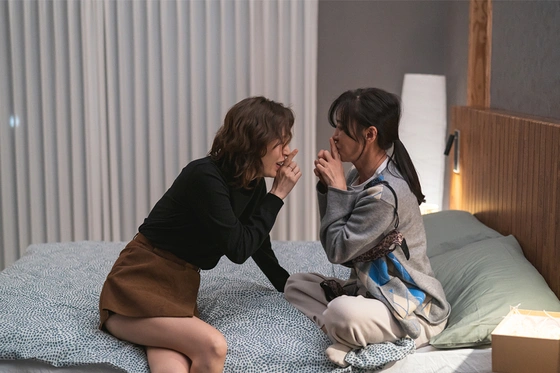
The first clue to a Homeward Bound interpretation lies in the duality of the space occupied by the protagonist, Jeong-ha (Jang Young-nam). Bound by her social status as a high school teacher in the small city of Chuncheon, her home is both an exile that isolates her from the external gaze and a sanctuary where she can conspire with Ji-seon (Ok Ja-yeon), her only refuge.
The static camerawork capturing every corner of the house reveals the layers of patience Jeong-ha has endured for a long time, while simultaneously serving as a device to amplify the tension with the uninvited future in-laws. 💭 Her hands, striving to maintain perfect order, actually resemble an internal defense mechanism on the verge of collapse.
In particular, when even her private bedroom is invaded ahead of her son’s wedding, Jeong-ha‘s psychological seclusion reaches its peak. 🏚️ The faint presence of Ji-seon, who wanders like a guest despite it being her own home, visually demonstrates how space encroaches upon and represents a character’s identity.
⏳ Psychological Tension Woven from Class and Ambivalent Emotions: The Conflicting Devotion of Jeong-ha and Ji-seon
The Jeong-ha and Ji-seon relationship and orientation is far too complex and heavy to be defined by the simple word “romance.” Between Ji-seon, who stands by as a devoted witness, and Jeong-ha, who cannot cross the boundary, trapped in her persona as a teacher and her responsibility as a “provider,” there exists a profoundly sorrowful emotional chasm.
Ji-seon, relatively free from social pressure, wishes to give Jeong-ha unconditional love, but Jeong-ha seals their relationship under the label of “cohabitation with a close friend” in the face of the norm of her son’s happiness. 💔 The psychological tension arising at this point vividly reveals the weight of the existential struggle middle-aged queer women must endure in Korean society.
At the moment they discover a part of themselves in the other’s wounds, their sharp boundaries transform into a strange sense of homogeneity. ✨ The silence of Ji-seon, who swallows her pain every time Jeong-ha denies herself, paradoxically becomes a sorrowful engine that forges the relational density between the two even more firmly.
🖼️ Metaphorical Meaning Captured by Mise-en-scène in Gaze, Touch, and Silence, and the Symbolic Integration of the Homeward Bound Ending
The lingering resonance of the Homeward Bound ending is completed when the metaphorical mise-en-scène built up throughout the film converges at a single point. The director formalizes the existential agony of women through the contrast of light and shadow, and the visual dichotomy of closed doors and open windows.
⭐ “A secret is not something that is kept; it is something left behind because it cannot find a subject to be uttered to.”
This sentence permeates the entire work, throwing a powerful social message to modern women. For Jeong-ha, a professional woman struggling in solitude within patriarchal power structures and social roles, the act of hiding her illness and identity is a desperate choice for survival.
Ultimately, the film chooses a lukewarm warmth—acknowledging each other’s vulnerability and accepting that imperfection—rather than the catharsis of a cool, clear exposure of all secrets. 🌟 This closure resembles our actual lives, offering even deeper consolation.
🖋️ Criticism and Modern Implications: What Makes Our Lives a ‘Secret’?
Homeward Bound (비밀일 수밖에) is a masterpiece that calmly portrays the solitude and solidarity of women hidden behind the normative festival of marriage. The portrait of Jeong-ha, who had to erase her true self due to her honor as a professional and the weight of being called a “mother,” symbolizes the gap between social demands and the self faced by women in their 20s to 40s.
The film suggests that a true family is not a relationship without secrets, but one that silently bears the weight of the other’s secret together.
👉 Reader Question: Between the secret Jeong-ha tried to protect and the silence Ji-seon had to endure, which one moved your heart more? Or, if you have your own story that “can only be a secret,” even from your family, please share it in the comments.
🎬 Violet Screen’s Curated Recommendations
If you wish to feel a similar temperature and the intimate psychological depiction of women more deeply, I recommend these works:
- [Moonlit Winter (윤희에게)]: A masterpiece dealing with a past first love encountered in snowy Otaru and the self-affirmation of a middle-aged woman.
- [Jeong-sun (정순)]: A powerful portrait of a middle-aged woman protecting her dignity amidst the tragedy of digital sex crimes.


You May Also Like

[Along Came Wanda] Solidarity Blooming from the Ruins of Loss, a Existential Leap for Middle-Aged Women

[Zomer] A Season Passing Through the Fever of Identity: The Temperature of Brilliant Solitude and Solidarity