Irma Vep: An Existential Mirror of Women Encountered Within a Labyrinth of Duplicated Ghosts
We sometimes find ourselves trapped in a prison of images projected by others. Especially when the subject is an actor standing before a camera, the essence of “self” is bound to get lost, gradually being encroached upon by the ghost of a role.
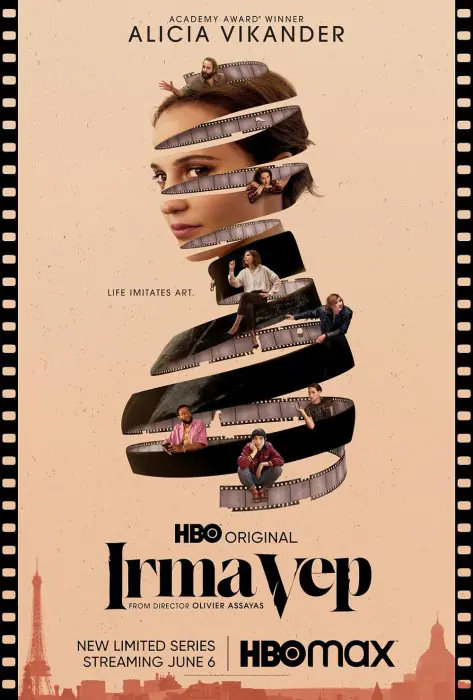
The HBO series Irma Vep, directed by Olivier Assayas, remakes the 1996 film of the same name. Borrowing the form of meta-fiction where art and commerce, past and present are intertwined, it intellectually dissects the process of modern women’s solitude and identity fusion.
📋 Essential Data
| Category | Details |
| Title | Irma Vep |
| Director | Olivier Assayas |
| Cast | Alicia Vikander (as Mira Harberg), Adria Arjona (as Laurie), Jeanne Balibar (as Zoé) |
| Year / Country | 2022 / USA, France |
🗝️ Psychological Narrative of ‘Space’ Visualizing the Interior: Mira Harberg’s Paris Hotel Room and the Sanctuary of the Velvet Suit
The first layer of an Irma Vep interpretation lies in the duality of the space occupied by the protagonist Mira Harberg (Alicia Vikander). For her, having arrived in Paris leaving Hollywood stardom behind, the hotel room is a place of exile isolating her from external gazes, while simultaneously serving as a private chamber where the role and the self collide.
When Mira Harberg runs across the rooftops at night wearing the black velvet suit of ‘Irma Vep,’ the space transcends physical limits and shifts into a site of supernatural liberation. 💭 The hallucinations, such as passing through walls, visualize her desire to escape the social oppression she feels, providing spatial proof of the existential anxiety inherent in the acting profession.
The massive set of the filming location is a prison where order and chaos coexist for Mira Harberg, and within it, she constantly struggles with her own duplicated image. 🖼️ The invasion of space soon leads to the invasion of identity; the suit she wears becomes both a protective shield and the skin of a ghost that swallows her whole.
⏳ Psychological Tension Woven from Class and Ambivalent Emotions: Mira’s Desire Wandering Between Laurie and Zoé
The Mira Harberg and Laurie relationship and orientation are permeated with the remnants of the past and an addictive love-hate dynamic. Laurie (Adria Arjona), a former assistant and lover, projects her own identity onto Mira‘s success, emotionally craving and destroying each other within a power imbalance.
Conversely, Zoé (Jeanne Balibar), an agency employee, represents a new possibility providing Mira with mutual respect and intellectual stability. 💔 While Laurie ties Mira to past traumas and self-destructive patterns, Zoé performs the role of an anchor pulling her back to the real world.
✨ The psychological tension Mira Harberg feels between the two women is not merely a whim of romantic feelings, but a struggle to settle her past and move toward a mature self. The emotional distance and density between them are elegantly portrayed through the subtle air flowing amidst fleeting glances and silence, rather than through clarity in dialogue.
🖼️ Metaphorical Meaning Captured by Mise-en-scène and the Symbolic Integration of the Irma Vep Ending 📽️
The Irma Vep ending paints a portrait of a woman left within a labyrinth of images, where the real self and the ghost of the role have either completely merged or remain eternally inseparable. Through a mise-en-scène where mirrors and monitors multiply infinitely, the director gives shape to the solitude of women living in an era of ‘duplication without an original.’
⭐ “Cinema is a dance of ghosts, and we lose ourselves by playing those ghosts.”
The ghosts of the 1915 original and the 1996 film, which permeate the work as a whole, are the artistic debts the current Mira Harberg must bear and the will to survive she must inherit. 🌊 Whether she chooses to shed the velvet suit at the last moment or remain within it forever, it serves as a powerful metaphor for how modern women must handle the “skin” of social roles.
Ultimately, instead of providing a clear resolution to the chaos of all relationships, the series offers deep comfort by acknowledging the ‘weight of secrets’ each person carries and choosing a lukewarm warmth that accepts that imperfection.
🖋️ Criticism and Modern Implications: What Makes Our Lives ‘Ghosts’?
Irma Vep (2022) asks how artistic cinematic quality can survive in the era of streaming content, while simultaneously delivering a heavy message to women experiencing a gap between fame and self.
An actor’s fate—where one can only shine by erasing their true self—aligns with the portrait of modern women who must constantly edit themselves to meet social demands. This series tells us that the journey to find the true self is, in the end, about learning to affirm one’s current self between the specter of the past (Laurie) and the phantom of the future (Zoé).
👉 Reader Question: Which do you empathize with more: the ‘fear of being encroached upon by a role’ or the ‘liberation found through it’ that Mira Harberg experienced? Or, if you have ever felt like a ghost yourself because of a social mask, please share your story in the comments.
🎬 Violet Screen’s Curated Recommendations
If you wish to delve deeper into similar atmospheres and intimate psychological depictions between women, I recommend these works:
- [Clouds of Sils Maria]: Another masterpiece by Assayas dealing with the taut tension between an actress and her manager and the flow of time.
- [Personal Shopper]: A mystery drama containing the solitary journey of a woman facing loss while communicating with an invisible presence.


You May Also Like
Supergirl (2015–2021): The Gravity of Solidarity Orbiting the Planet of Self
My Safe Zone: Devotion Mending the Fissures of Loss, A Perfect Fortress Built by Two Women